
Nkechi Njaka
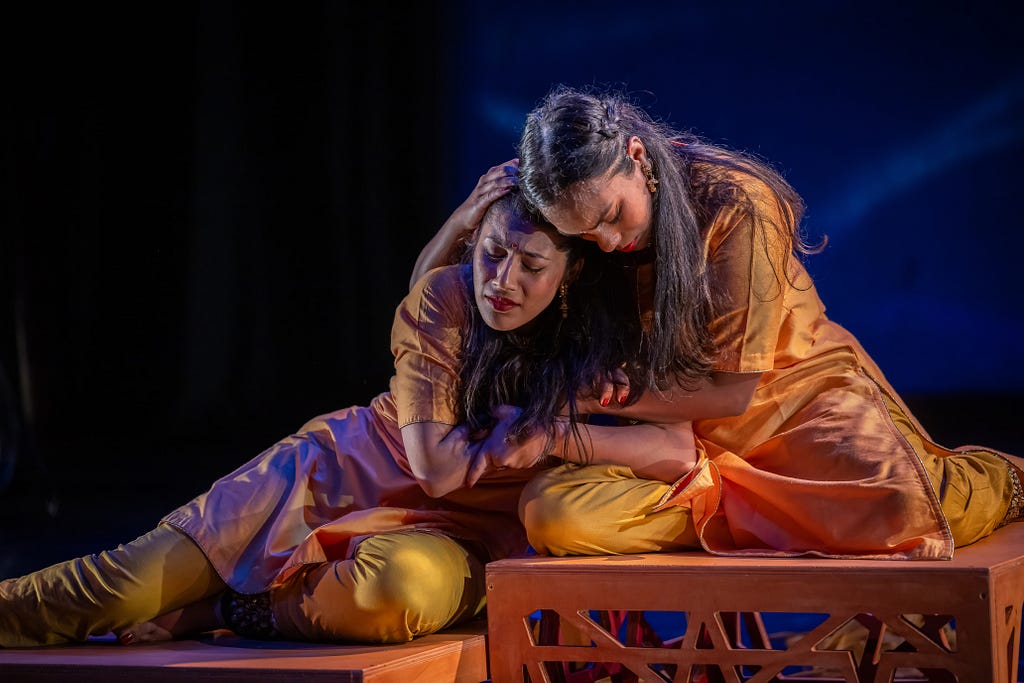
The Veil of Janki Bai, a new Kathak dance-drama and multimedia performance by the Chitresh Das Dance Institute, transformed the ODC Theater stage into somewhat of a theatrical shrine — in the best way possible. Co-Artistic Directors Charlotte Moraga (Choreographer) and Alka Raghuram (Dramaturg and Multimedia Artist) created a work that honors both the spirit and struggle of Janki Bai through classical Kathak, live music and stunning visuals. Who is Janki Bai? A question present in the theater that was answered throughout this powerful performance. This work bows deeply to Janki Bai (1880–1934), a luminary whose art and survival illuminate the complex intersections of beauty, pain, and power.

Known as one of the first female Hindustani classical musicians to be recorded on the gramophone, her voice secured placement into the earliest archives of modern Indian music. But behind her haunting melodies exists a fearless commanding presence and someone who survived violence and misogyny. She gave herself the artist name “Chappan Churi,” which translates to “the one with fifty-six gashes.” And she always performed veiled, hiding the fifty-six scars on her face, which were marks of a violence meant to silence.
Instead, her voice became immortal. This performance featured dancers Vanita Mundhra, Ishani Basak, Srija Bhattacharya, and Ishq Pradhan, with live music by vocalist Saneyee Purandare Bhattacharjee, Sudhakar Vaidyanathan on tabla, Rohan Misra on sarangi, and Narendra Joshi on harmonium. The music was crucial to the experience, with Moraga expressing during the artist talk-back that without this music, there is no dance; the two exist as one.
Reverence emanated from the performers into the audience. The musicians, introduced by name and their relationship to the Janki Bai and to one another, were seated on their own stage rather than hidden in an orchestra pit. Together they were unified, a tight knit community in witness rather than accompaniment. Beside them, multimedia projections rippled across the front of the theater space. The animated illustrations, archival imagery, and fragments of newspaper text revealed both the inner landscape of Janki Bai’s psyche and the public gaze that attempted to define her. The filmic narration wove her story with mythic references, recalling Sita “the perfect woman,” asking whether obedience and purity are still metrics of worth.
The musicians, dance and projected media accomplished more than resurrecting Janki Bai’s biography. The Veil of Janki Bai invited inquiry, asking the timeless questions: Who gets forgiven and who carries the blame? What does it mean for a woman to create art from her pain? What parts of someone’s story must be veiled, and what parts must be revealed?
The history of Janki Bai is a moving testament of the word formidable, and it delicately framed each of the performance sections. The show began with the incredible youth dancers who varied in age but were matched in skill and focus. Kathak’s lineage of intergenerational intent was a reoccurring theme — that dance is not just meant to be danced but taught and passed along. This theme of legacy continued to be a through-line.

A striking moment unfolded in a solo where Vanita Mundhra faced a mirror, confronting both her reflection and the shadow she cast. Behind the scrim, another dancer appeared only as a silhouette, suggesting a divided self, an inner witness and an outward performer. The effect was haunting — two women dancing as one, separated by the thin veil of perception and expressions of identity misunderstood.
“My songs echoed in the palace,” a voice intoned during the penultimate section, “and my heart burned to force an artist to hide behind a veil. The king was mesmerized and offered me gold. He said he was transported — and my gashes became flowers. My pain turned to power.”
The performance reminded audiences that to “tell a story” in Kathak is not simply to entertain but to embody its truth. Raghuram’s multimedia design reflected this beautifully by allowing film, sound, and movement to merge into a unified expression.
Sharing this story is important. And Kathak literally translates to telling a story. Through the classical Indian dance traditions’s rhythmic footwork and expressive storytelling, Janki Bai’s life asks us to reflect on a reality that is still incredibly present today. Globally, about one in three women, an estimated 736 million, have experienced physical and/or sexual violence in their lifetime. Worldwide, nearly half of all women have faced psychological aggression by an intimate partner, and one in four have endured severe physical abuse. The Veil of Janki Bai situates these staggering realities within a lineage of creative resistance, reminding us that art can be both pain and poetry.
In a world where women’s voices are still constrained by outdated perceptions of virtue and power, Janki Bai’s legacy calls us to listen differently and to hear the divine feminine as a sound that refuses erasure. As the final notes of sarangi faded and the dancers radiated her essence, what remained in the theater was reverence and profound recognition.
How beautiful to hold that even when scarred, the voice of a powerful woman will carry the sound of survival, transforming pain into beauty creating these timeless songs. The Veil of Janki Bai felt like a poetic device for the agency of women in art, for the right to be seen, and for the stories that still ache to be told.
Nkechi Deanna Njaka (she/her) is a practice-based creative researcher, choreography artist, public speaker and culture writer whose work explores the intersection of embodied presence, somatic research, well-being, science, art, and social practice. She is the founder of The Compass, NDN lifestyle studio, and co-founder of the sleep app DreamWell, emphasizing mindfulness and creativity as essential for individual and global well-being.
“The Veil of Janki Bai” Reflects On Voice, Violence And The Divine Feminine was originally published in ODC.dance.stories on Medium, where people are continuing the conversation by highlighting and responding to this story.