
Garth Grimball
Alice’s Adventures in Wonderland must be one of the most referenced novels in the English-language canon. From direct adaptations to allusions in blockbusters like The Matrix, Lewis Carroll’s narrative birthed an endless capacity for artists to interpret his singular characters and worlds built on chess and playing cards.
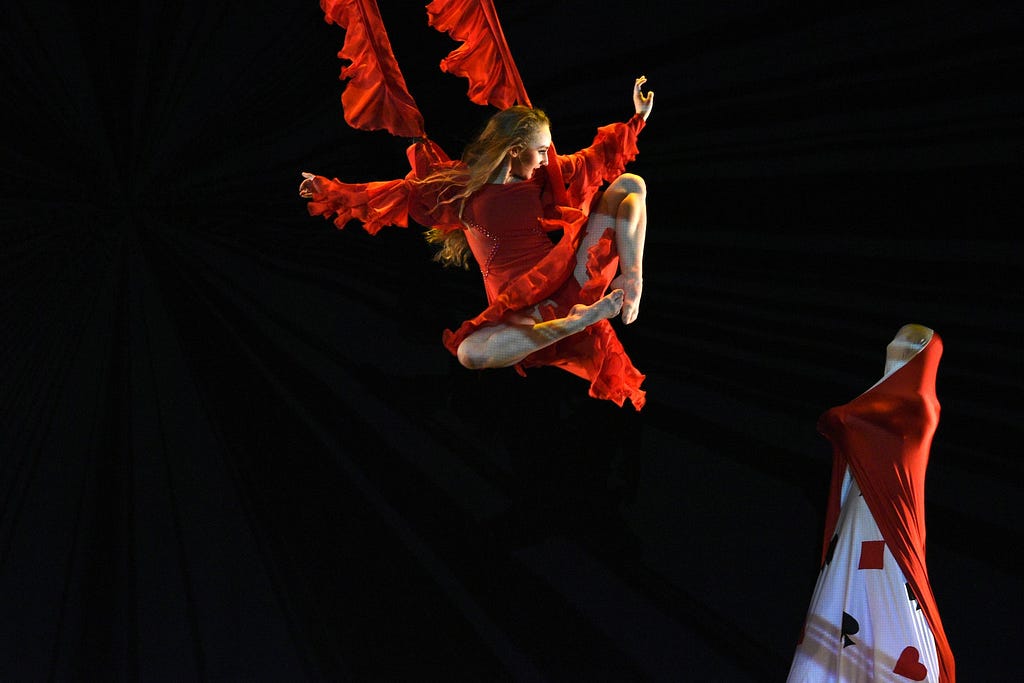
MOMIX performed their Alice on November 29–30 at Zellerbach Hall. Act one sees a projection of Carroll on the curtain before opening onto a “floating” Alice character. Under the brightening lights the stage magic was revealed to be a ladder rigged to the sky grid with Alice seated at one end and another dancer dressed as Carroll standing at the other counterbalancing the weight of the ladder. A lovely duet followed that realized MOMIX’s company identity as dancer-illusionists. The two dancers never touched, but their evolving states of balance provoked a relationship of sincere trust in isolation.
The scene ended in a blackout. Light up sneakers raced across the stage. Since Carroll’s text is ubiquitous, no other details were needed to know the rabbit was late for an important date. It was clever and efficient. Once Alice is officially in Wonderland, it was clear that Alice is not concerned with plot. The show is like an extended act two of The Nutcracker divertissements. Characters are each given one scene, and often without Alice present, so that the raison d’etre came not from how MOMIX would render the narrative arc of the story, but how do they interpret the now iconic characters. Because each scene was so discrete, the performance in full sometimes felt like checking boxes rather than following Alice down the rabbit hole. But the repetitive rhythm was relieved when the stagecraft and choreography were equally inventive.
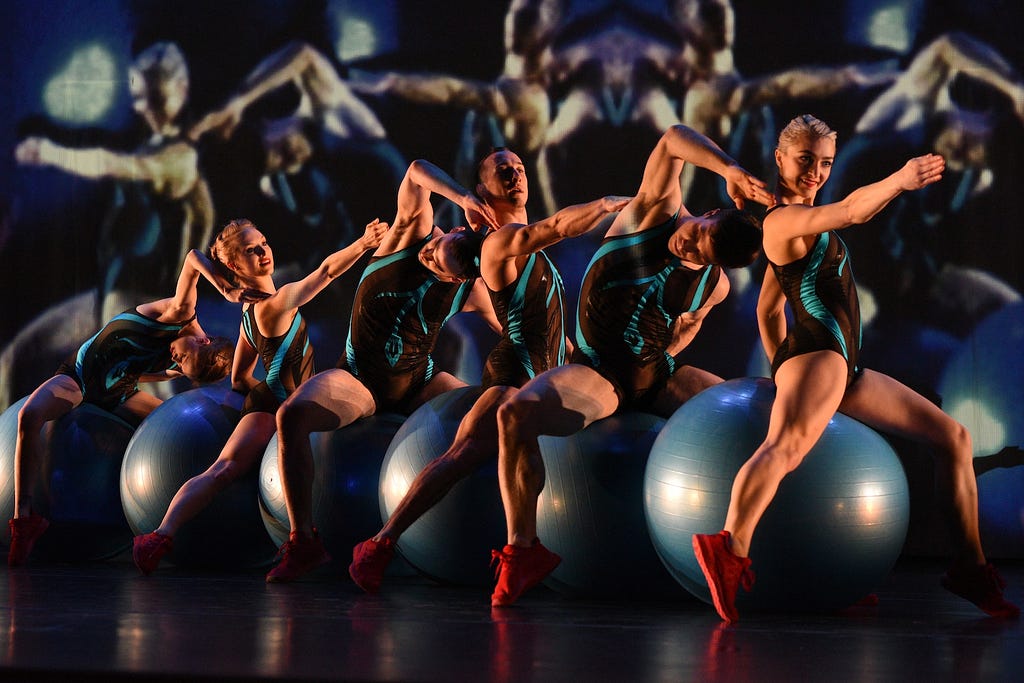
If MOMIX doesn’t have a brand deal with an exercise ball maker, they should. I first saw the company in a 2007 performance of Lunar Sea which featured the prop. In Alice the balls are used to great effect as the Caterpillar. The dancers bounced, rolled, tossed and stacked all over the stage. Inverted projections made their motions feel infinite.
The Cheshire Cat gets only a brief moment as a projection, but The Tweedles and a scene of rabbits brought the real sinister and disconcerting energy to the production. Dressed in only nude shorts or tops with head pieces, the choreography in both scenes was heavy on body rolls.

The four Tweedles wore giant cut out photos of baby faces. The combination of adult svelte bodies with baby faces was effectively disarming. But in all of these scenes there was no Alice, there was no cipher for the audience, so we were left to make of the characters what we wanted (which is interesting), but there was no tension between the outsider-protagonist and the Wonderlanders, so there was no dramatic effect to emphasize the heightened reality of Wonderland.
Act one ended with “Cracked Mirrors.” The scene was mesmerizing. The company’s four male dancers manipulate large reflective panels. The four female dancers are all costumed as Alice and run behind and through the panels, disappearing and multiplying. Once the Alices exit, the men lifted the panels in front of themselves, with their backs to the audience, and ran back and forth. It looked like there was another dimension through the mirror where doppelgangers were running to meet them.

Act two was inspired by Alice Through The Looking-Glass. Human forms gave way to abstracted costumes in which the dancers punctuated fabric with accompanying projections. Some of the scenes overstayed their welcome. “Into the Woods” was an acrobatic quartet that at one point had the two men lip-synching to the music — why? “Bed of Roses” was wonderfully simple in its conceit: two Alices danced between three big paper flowers that floated about them from rods held behind the curtain. But the choreographic ideas end before the scene does.
Alice does justice to Carroll’s inventiveness, but without an Alice to follow, Wonderland felt less wonderful.
Garth Grimball is a dance writer and artist based in Oakland, CA. He is a contributor to SF Examiner and Dance Media. He is the editor of ODC Dance Stories.
MOMIX’s “Alice” Is All Action And No Plot was originally published in ODC.dance.stories on Medium, where people are continuing the conversation by highlighting and responding to this story.