
Garth Grimball
I can’t remember the last time I left a performance so curious of the whys that informed each decision, but so unbothered by the uncertainty because the decisions were so clearly wrought, as Baye & Asa’s HotHouse. And it was my second time seeing it. HotHouse premiered at Pioneer Works in Brooklyn in January 2023, and was presented by ODC Theater last weekend, March 14–16. While the touring version demanded set alterations that kept the audience in a proscenium relationship rather than in the round, and the music was recorded not live, the dancing by Amadi ‘Baye’ Washington and Sam ‘Asa’ Pratt was as intense and carnivorous as its first performance two years ago.
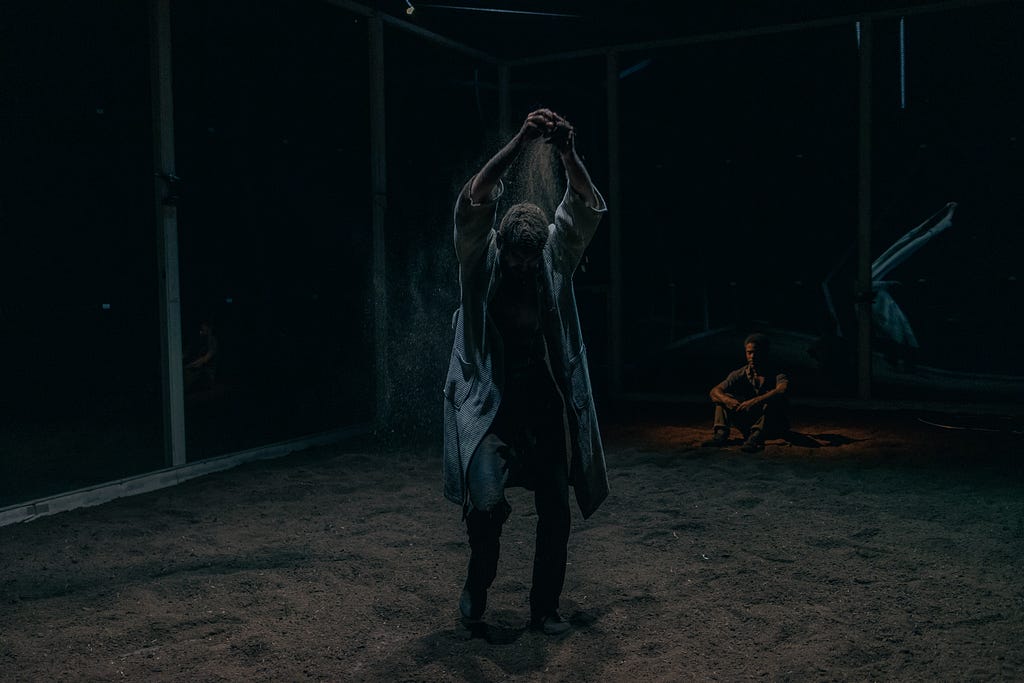
The ODC Theater walls were veiled in plastic sheets. At eye-height various hooks held clothing and props around the perimeter. Sparse and clinical, the theater felt like a quarantine cell except for the pile of soil upstage center. Two lighted rectangles delineated the floor separating and containing the duo. The movement vocabulary and performance intensity is set from the jump. Julian Pratt and Harlan Steed’s heavy metal score blared at a volume that necessitated pre-show handouts of ear plugs. Baye and Asa stalked back and forth in their corners, falling in and out of unison they threw themselves into turns, down to the floor, into chugs, slices and pivots. When they did step beyond their spotlights the only change was proximity, the momentum raced along when they lifted and tossed one another. The duo danced like two power tools rending into space.
Moments of softness and subtlety stilled — one would hold the other like a pieta (more on that later), a hug from behind like a request for protection — before the roar of fury or desperation impelled them to their peak velocity again.

Asa changed into grey sweats. Baye changed into a different pair of dark separates. The quality of the movement didn’t markedly change but the relationship shifted. What was perhaps a shared drive splintered. The lights jumped off and on allowing enough visibility to create the sense of a montage. Each dancer took turns moving in or through tableau while smoke emanated from their hands or backs or chests. Asa collapsed on the mound of soil and started chugging from a bottle. He ran at Baye who pushed him away at each attempt. Back on the mound Asa spat red liquid, like blood, onto the plastic veil. After several bouts Baye pulled out a hose and sprayed Asa into submission.
The final quarter of HotHouse takes a very distinct turn into a content territory much more specific than what preceded it. Subtext becomes text. Allusions bow to identification. HotHouse is a pandemic-specific dance, it was born out of isolation and concerns an isolation born from disease, politics and the urgent lack of a shared societal urgency. Where do people turn when they fall into systemic fault lines?
Jesus Christ. Post-baptismal hose down, Asa donned a robe and a crown of thorns. He slowly, searchingly made his way down stage as Baye watched, still. Lyrics joined the music for the first time: a male voice singing his preference for a Christian life. Asa posed looking out into the audience. Baye left the stage, exited the plastic cell, refuting that salvation could come from a savior, or an individual with a savior complex.
Garth Grimball is a dance writer and artist based in Oakland, CA. He is a contributor to SF Examiner and Dance Media. He is the editor of ODC’s Dance Stories.
It’s Hard To Leave “HotHouse” was originally published in ODC.dance.stories on Medium, where people are continuing the conversation by highlighting and responding to this story.