
Garth Grimball
Before Yaa Samar! Dance Theatre began their performance of Gathering inside of Zellerbach Playhouse, there were two expository acts, one written and one performed.
The performance exposition began when a zaghrata filled the lobby. The ululation from members of the cast focused the audience on Nadim Bahsoun who informed us that we were gathered for a Palestinian wedding and the bride and groom were almost ready. Bahsoun was Khalil, best friend of the bride Israa (Samaa Wakim) who was marrying Ali (Mehdi Dahkan). Khalil and friends shared anecdotes from previous Palestinian weddings in their lives as they served tea and moved briskly throughout the lobby engaging people with compliments (“I love your dress!), questions (“Has anyone been to a Palestinian wedding?), and instructions (there was a participatory element to Gathering, and interested parties should remove their shoes before stepping onto the stage).
Program books always provide some context, but the Gathering program articulated specific themes and choices and why artistic director Samar Haddad King directed these elements into the show. Program sections included: On Palestinian Culture; On the Symbol of Oranges; On the Symbol of the Ostrich; On the Current Political Context. For many other performances this could come off as overly didactic, but, in my humble opinion, narratives about Palestine are rarely authored or controlled by Palestinians, so this exposition felt like necessary table setting and direction: these elements are not to be misinterpreted.
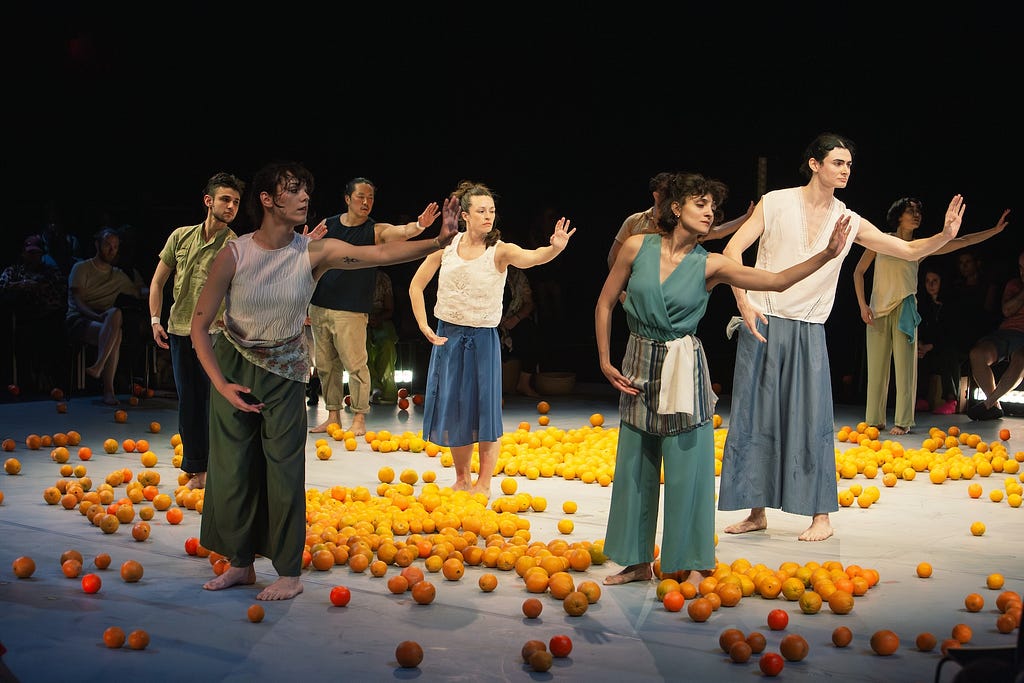
The Playhouse had a pile of oranges center stage. The cast of fourteen busied themselves chatting and taking in the space as if to make sure it was wedding ready. Israa asked, “Can you fix the light?” And her words were projected on screens above the audience in the round. A ladder was carried in, and since it was not an A-frame, it required many hands to stabilize it so that a dancer could climb up. This action was a motif throughout Gathering: collective work to fix a problem or uplift an individual.
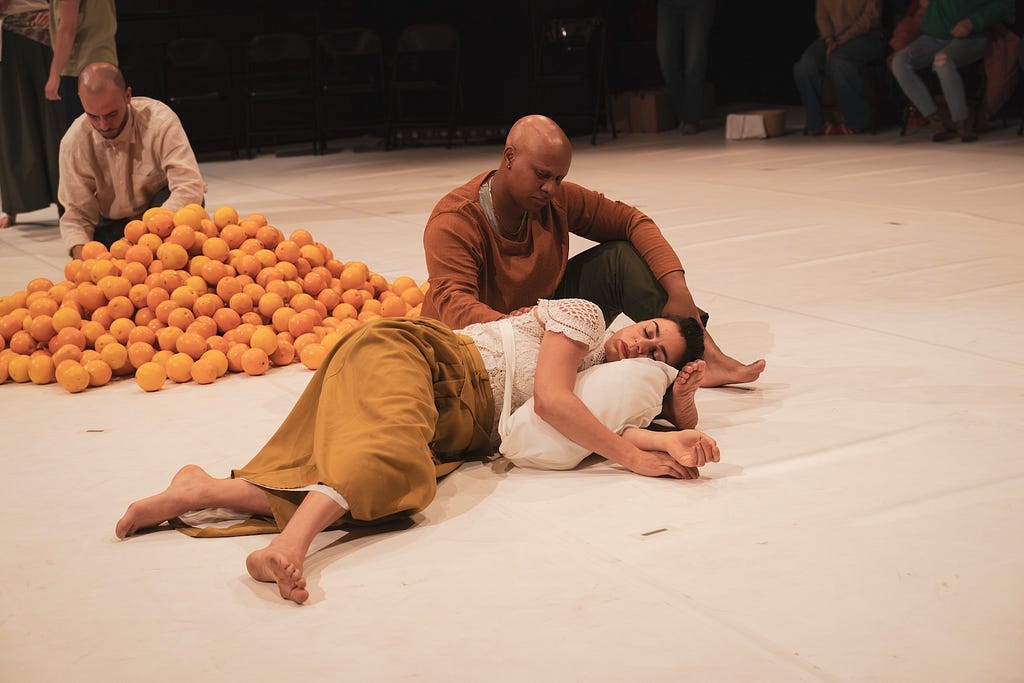
The audience who opted in for participation were handed oranges to contribute to the pile. A duet of lifts and throws rolled around the perimeter. A song began: “Those were the days, my friend/We’d thought they’d never end.” Ali countered the melody in a spastic solo that looked like he was being controlled by an outside force — shoved, pushed, dropped. The participants re-joined in a traditional dabke wedding dance. Two concentric circles wound in 6/8 time, joyful and unselfconscious. Israa and Ali were lifted high on shoulders before the revelry ceded to worry. Ali disappeared. “Where is Ali?” was spoken and projected. Israa searched under the pile of oranges that evoked a pile of rubble in the new context. Vivaldi’s The Four Seasons began and the ensemble threw the audiences across the stage and ran.
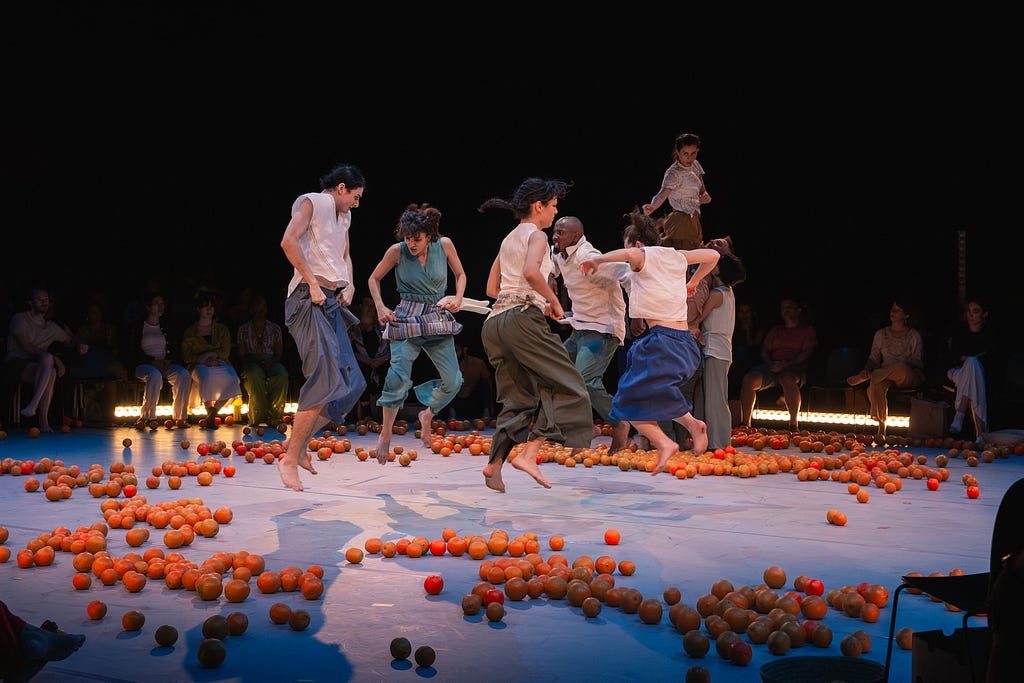
Gathering continued in a greater abstraction of dance and theater. The dancing had two primary modes. For the ostrich phrases, Samar and the dancers created vocabulary evocative of the animal — one arm stretched above a crouched body, shifting weight as if directed by the largest eyes of any land mammal. The unison, more concert dancing employed vocabulary from social and folk dances — lean back, jump, lunge, kneel, squat, paddle step. These phrases were shaggy and I think purposefully so; Gathering is theater and the performers are portraying characters, so crisp unison movement would belie their scenario.
The theatrical arc bent towards turmoil. Israa spoke intermittently of arguments with her husband, and asked questions applicable to much larger conflicts: “How did this fight even begin?”
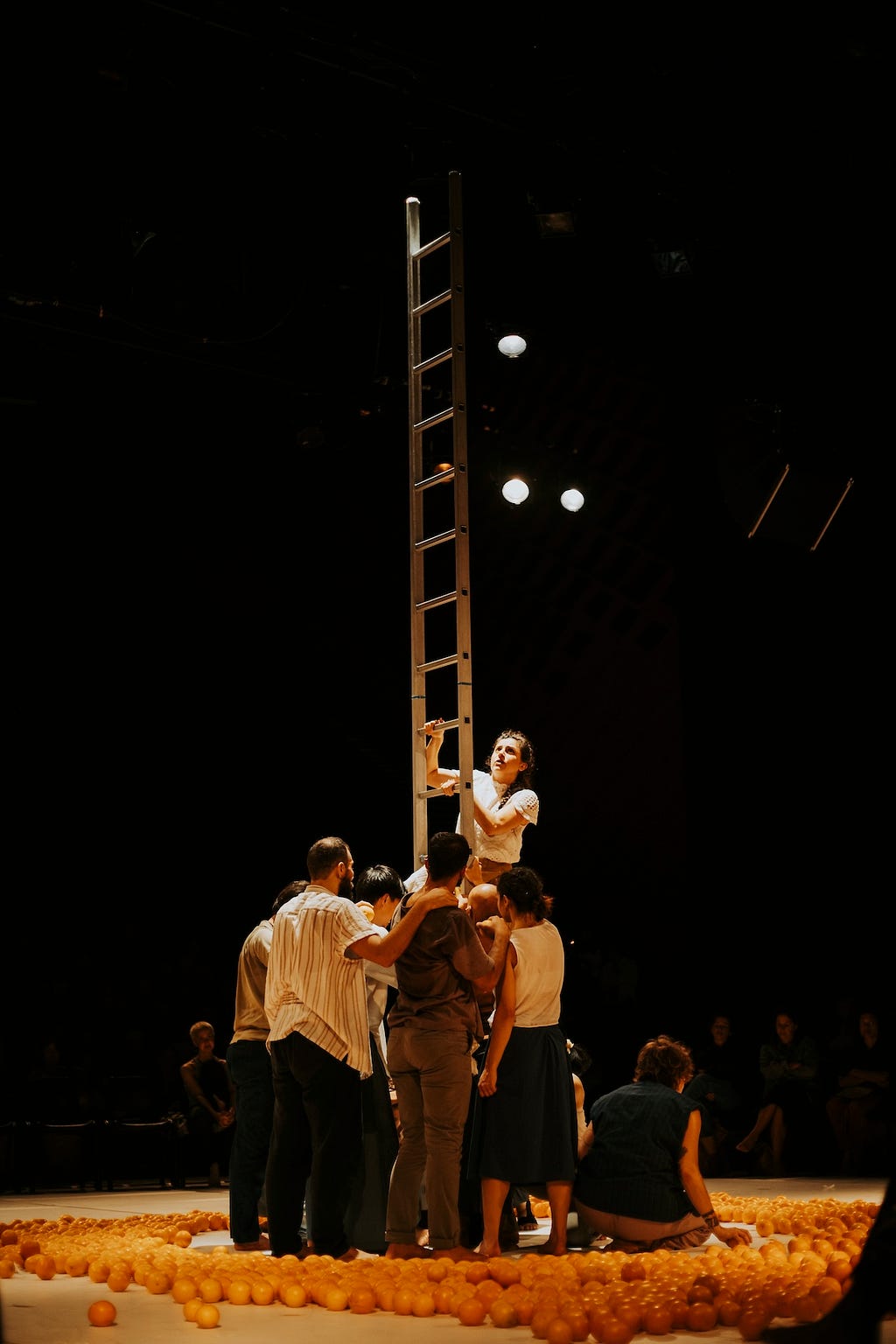
The ensemble took turns sharing anecdotes of the bride. Another refrain was sung, “How do we say goodbye?” One dancer collapsed and was carried away atop the ladder held parallel to the floor. Israa and Ali shared a slow duet, step touching as millions of newlyweds have done and will do. Disparate actions and articulations overlapped increasingly until the sky rained oranges, the audience again contributed to a pile, and a single orange was purposefully split.
Gathering is a deeply humane and tender production that provokes wonder at our capacity for kindness and despair at the limitlessness of cycles of destruction.
Garth Grimball is a writer and dancer based in Oakland, CA. He is a contributor to Fjord Review, SF Examiner and Dance Media. He is the editor of ODC Dance Stories.
“Gathering” With Yaa Samar! Questions How We Bond And Break was originally published in ODC.dance.stories on Medium, where people are continuing the conversation by highlighting and responding to this story.