
Kristen Cosby
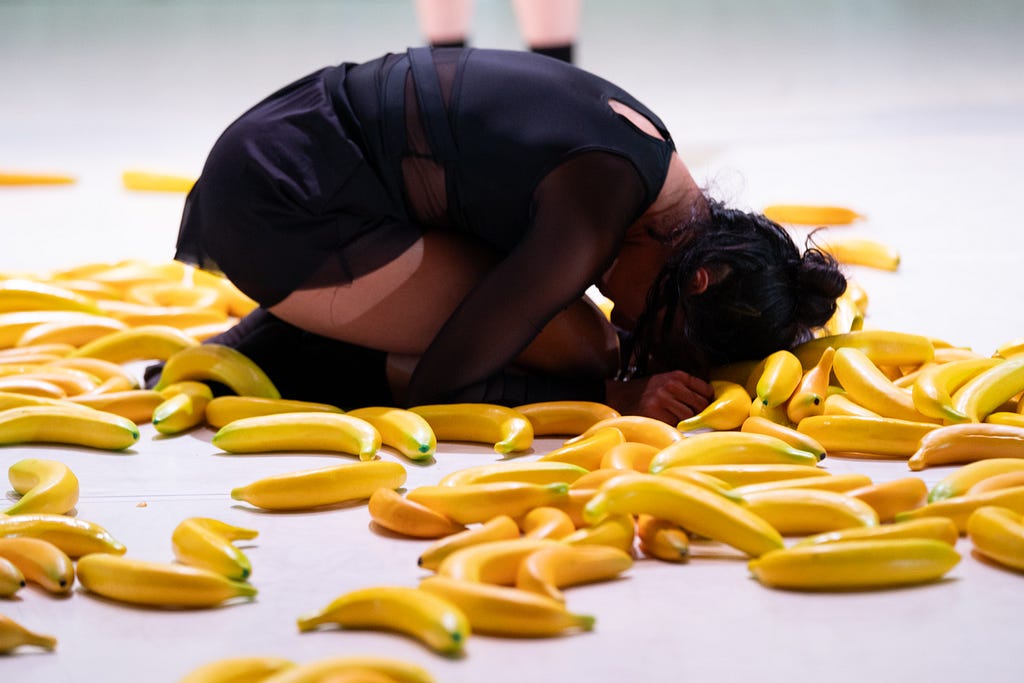
On Friday night at ODC, an audible gasp went up from the audience as a truckload of bananas dropped suddenly from the ceiling to the stage. The four dancers on stage (Madison Lindgren, Maya Mohsin, Giovana Sales Nascimento da Silva, and Giulia Sales Nascimento da Silva) screamed and fell sideways to the floor. The audience began to laugh uncontrollably. Minutes later two more bananas were tossed on stage from the audience and dancer Giovana Sales Nascimento da Silva grabbed one and lustily ate it with a near maniacal grin on her face.
String Quartet Number ATE, the newest work of choreographer Jocelyn Reyes, is culmination of two years of visions and revisions. Reyes used a mix of abstract choreographing, pantomime, and a live string quartet to create a wild emotional experience perhaps best described as dark dance comedy. Throughout the forty-five-minute piece the core ensemble dancers competed for, fought over, and helped each other avoid bananas.
This work was inspired by Reyes’ relationship to food and how it shifted into a relentless and frustrating experience after her type-2 diabetes diagnosis, but much of her history — her childhood of telenovelas, her early exposure to Shostakovich’s String Quartet №8 in C Minor, and her family’s love of comedy and laughter — ended up in the work.
Reyes brilliantly structured her inspiration around the dark, mournful, and sometimes frenetic vibrations of Shostakovich’s String Quartet №8 in C Minor. Her choreography interwove three emotional landscapes: a shadowy and sometimes agitated one told by the music, the pantomime expressed in the extreme facial expressions and gesture work of the dancers, and the choreography which bound all three narratives together and provided the abstraction necessary to keep the piece nuanced and layered.
For the entire performance, Shostakovich’s String Quartet №8 was performed live by the onstage four-person string ensemble seated upstage right in a rectangle of light. Reyes’s choreography was tightly bound to every shift of the music, and the motions of the quartet became part of the movement landscape of the piece.
“I first heard the second movement of String Quartet №8 in my performing arts high school. At the time the piece really resonated with me because it captured the chaos and relentlessness and energy of my unstable home life, but also this sense of power and resilience … … I was going to make this serious piece of dance, and I just got this idea. I was like, ‘what if a banana flew in’?” said Reyes.
The piece opened in silence, the power and resilience later provided by the music noticeably absent. With the four primary dancers laying in a pile on the floor dressed in black and the stage surrounded by white curtains, the scene was stark and deadly silent. No one in the audience seemed to breathe as a spotlight described a circle on stage. The pile of women lifted slightly and slid forward as a unit into the tight circle of light. The room remained silent. The pile lifted slightly again, as if collectively inhaling as one organism. This time they remained in one place while the spotlight expanded and contracted as if breathing with them. The dancers repeated this sequence, each time lifting a little further off the floor, until, at last they were all standing, and the quartet began to play.
Suddenly into this stark, dignified white-curtained land of dancers and musicians, someone from the audience tossed a banana. It landed on stage with a shocking, absurd, fleshy thud. And many questions that the piece set out to answer. What is that? A banana? Did someone throw a banana? Why a banana? What can banana do?
Turns out, a lot.
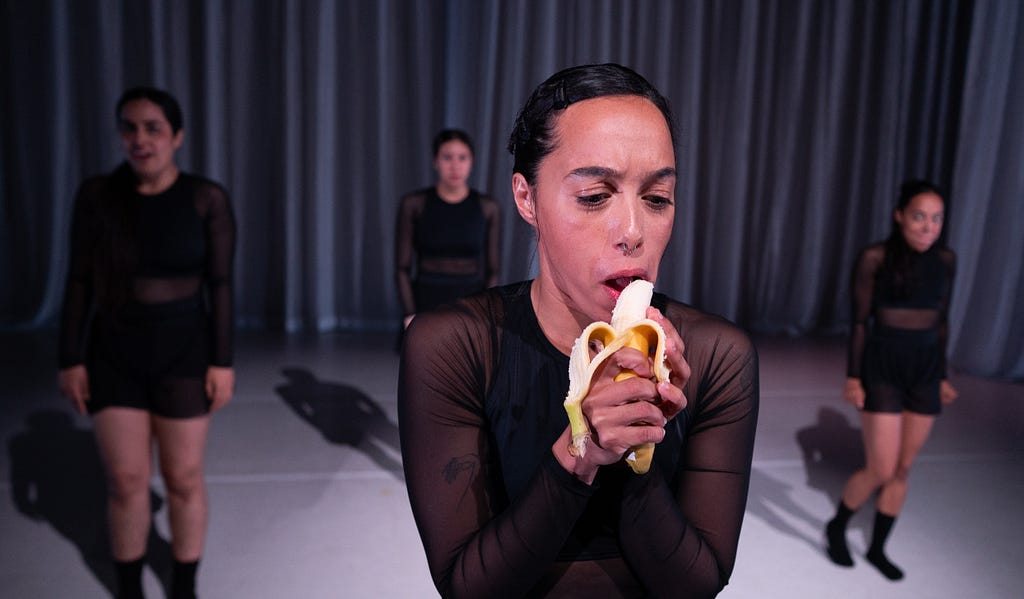
Dancer Giulia Sales Nascimento da Silva attempted to reach and eat the fruit while her fellow dancers pulled her back, then restrained each other one at a time, until Giulia reached the prized fruit and devoured it with a strange intensity — wiping her face and grinning between each bite. The success of her moment was troubled by the somber music and the intensity of her movements. Food is not always all that it seems.
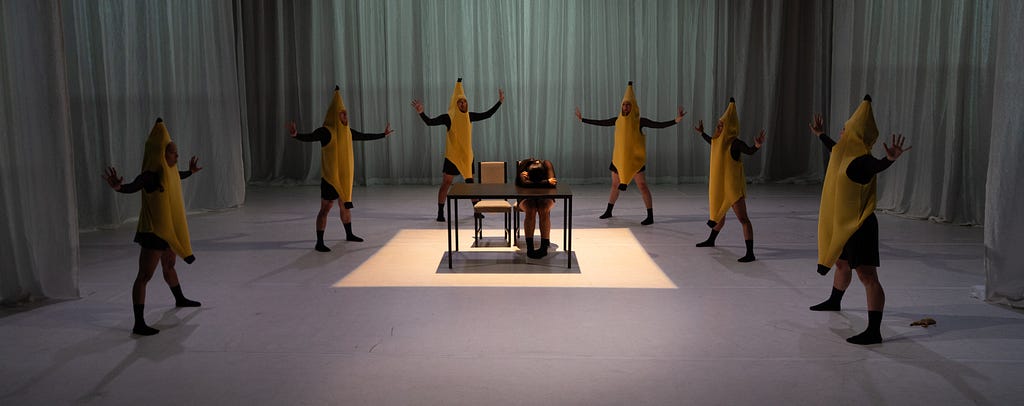
I don’t believe a woman can eat a piece of fruit on stage without the narrative suddenly exploding into something much larger than her. String Quartet Number ATE fully explores all these things, each time a character touches the banana her mood and motivation and body movement shifted. Within the performance fruit is food, knowledge, desire, which means it’s also hunger, ignorance, and yearning. The piece explores every possible emotional reaction or interaction a body could have to food in the extreme: happiness, jealously, competition, guilt, fear. And also, hilarity. At one point, human-size bananas chased dancer Maya Mohsin across the stage before she defeated them with karate-style moves.
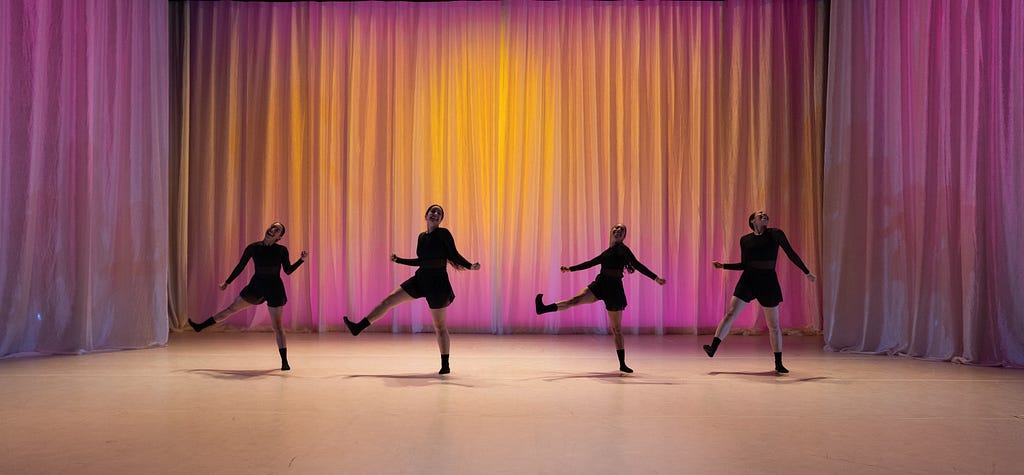
The quality and precision of every reaction and all the ensembles’ work was stunning. Their synchronicity with the musicians on stage and with each other was stunning to watch. Giulia Sales Nascimento da Silva afterwards described the core ensemble as being inside one banana but with each dancer having an energetic relationship to one musician.
I’m not always an observer who appreciates comedy or pantomime in dance, yet because of the layering and execution, this piece hurtled past all my expectations for what was possible in a piece based on a diagnosis, a quartet, and fruit. It was, literally, absolutely bananas.
Kristen Cosby is a freelance writer, editor, educator, and performer whose work has been supported by the Jan Michalski Foundation, Yaddo, MacDowell, and the Virginia Center for the Creative Arts. Her writing has appeared in literary journals, magazines, and anthologies, earning the Normal Prize in Nonfiction and a Pushcart Prize special mention, while her recent storytelling performances have been featured at The Moth, Redwood Nights, Bawdy Stories, StageWerx, and La Cocina: Voices from the Kitchen.
“String Quartet No. ATE” Is Bananas! was originally published in ODC.dance.stories on Medium, where people are continuing the conversation by highlighting and responding to this story.