
Sarah Brooks
Water Moves, directed by Amelia Rudolph, brought the wonder of vertical dance into the intimate performance space of the Joe Goode Annex, where the remarkable spectacle of dance and flight were so close you could almost reach out and touch it. The space of the Annex was made even more cozy by additional seating, a row of chairs as well as cushions on the floor, wrapping from the first row along the stage left wall. This novel arrangement fueled the excitement of the audience as they took in the set and props that filled the stage, washed in blue light. A collection of large water jugs was placed along the walls, as was a small table on which sat a glass pitcher full of water and two drinking glasses. At several points throughout the performance, a dancer would casually stop at the table for a drink. A program note titled “Water Statistics” included these lines:
“Women and girls spend two hundred million hours each day collecting water”
“Five gallons: over forty pounds.”
At the center of the stage hung a large jug of water, suspended a few feet off the ground. Downstage right stood a curious structure, topped by bronze-colored conical shapes, resembling the horn of a gramophone. This sculpture, created by artist Todd Laby would launch the opening of the piece, when dancer Olivia Sander approached it, opened a compartment emitting a blue glow, and activated the kinetic potential of the sculpture, as the sound score began to play, the top of the sculpture began to spin.
So began the first sequence, titled Jug. Amidst operatic music, Sander proceeded into a solo that focused on floor work, incorporating one of the large jugs into the mechanics of the movement. The unwieldy size and weight complicated simple rolling and sliding across the floor. This sequence, making a dance of the very effort of moving the jug, familiarized the audience with the ways that the physical mass of the objects could be incorporated into and impact the physics of the choreography. This could look like a grounding force, for a moment Sander lay on her back with the jug resting on her ribcage, or a powerful momentum, demonstrated when Sander stood, clutching the handle of the jug, swinging the weighty pendulum back and forth.
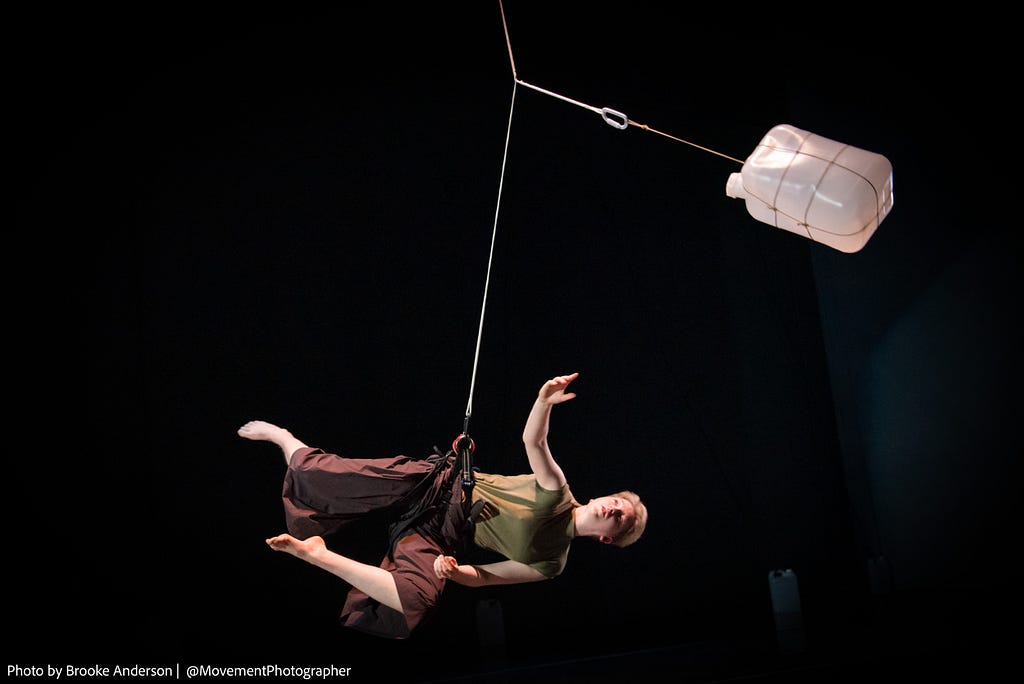
Next, Faith Elder attached their harness to the rope hanging at centerstage, alongside the hanging jug. They hugged the jug, tucking their legs into their center to hover and spin. This solo built upon the dynamics of the first, but moving this dynamic of weight and movement between the body and the jug from the ground to a standing level. The rigging meant that Elder could surrender their weight to hang and swing, or stand on their feet, lifting the jug to take its weight. Gradually the tension escalated as Elder progressed into full out, low-flying choreography. As the soundscape became more distorted, dancer and water jug soared through the space, orbiting one another with nerve-wracking speed. All the turbulent, whirling energy dissipated as quickly as it had emerged with the sequence concluding as it began: Elder hugging the jug, spinning.
The next sequence, Floating, built up the scale of the work, as three dancers ascended ropes along the stage right wall. The upper half of the back wall of the stage was illuminated with projections, designed by Andrew Lydon, that gave the scene a monumental sense of space, the impression of a landscape, of an open horizon, amidst the intimate and enclosed structure of the black box theater. The trio high on the wall seemed to braid their movements together to create an interlocking, rippling architecture. The timing was punctuated by the pulsating rhythm organically created by the pendulum swing of the dancers bounding off the wall. A soft, floaty landing was accompanied by twinkling, metallic music, imbuing the atmosphere with a distinct textural quality. Two more dancers entered as the music escalated and the cast of 5 dancers, moving across the stage and through the air, filled the stage with a dazzling controlled chaos.
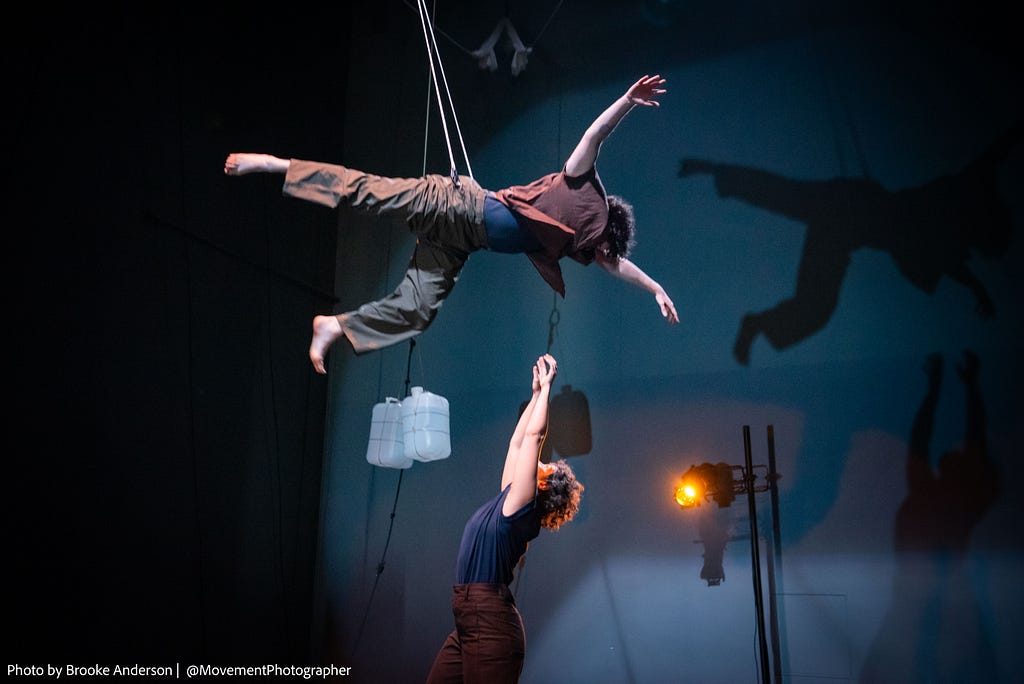
The third section, Source Water Counterbalance, was a memorable duet, most prominently featuring B Dean, who was suspended from a rig in the center of the stage counterbalanced by two large jugs hanging from a point in the ceiling towards the upstage right corner. This situation balanced the weight such that B could bound across the stage like an astronaut on the surface of the moon. Meanwhile, the bright white jugs, rising and falling depending on Dean’s position, offered a linear and mechanical response to the three-dimensional complexity of the dancing on the other end of the rope. The simple physics at play created limitless visual interest, but this mesmerizing physical dynamic would be elevated when Kriss Rulifson, who had been upstage, observing Dean’s movement, took a more active role, taking hold of a rope attached to the hanging jugs, first offering steady support, but soon more power and lift. With the relational dynamic this rig produced, simple physical tasks took on a surprisingly poignant emotional weight. As Dean attempted to climb up to reach the jugs, they slowly descended in response to the dancer’s ascent.
In a climactic moment, Rulifson used their own bodyweight to pull on their end of the rope, allowing Dean to leap and soar through the space in breathtaking flight. Swimming in blue light, enclosed in this intimate space, the stage became a tidepool teeming with life. Lighting designs by Tristan Fabiunke elevated the enchanting quality of every brilliant choreographic image. From a running start on the ground, Dean leapt towards the jugs, high overhead, on the third attempt, they finally caught hold of the ropes that held them. In this captivating final moment, Dean hovered clutching the jugs and rope, upside down, high in the air, their shadow creating a striking silhouette on the back wall. Dean turned to look down at Rulifson, then promptly released their grip to fall to the ground, where they were caught in a tender hug as soon as their feet could reach the floor.
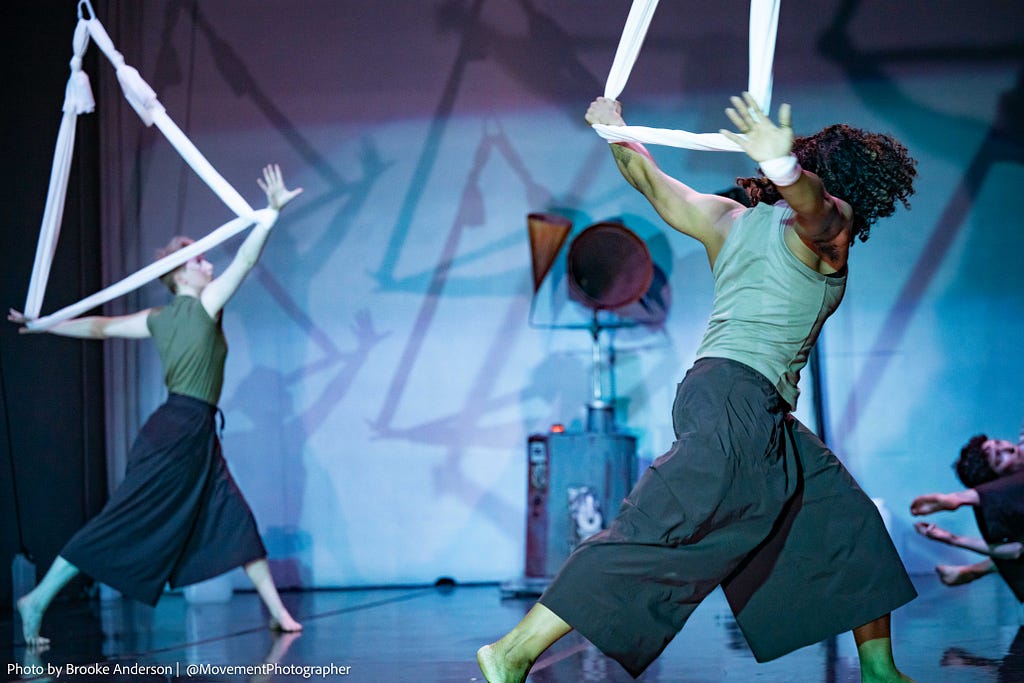
With white silk loops hanging in each corner of the stage, the final act of the performance, Sector 5, filled the space in new ways. Clarissa Dyas brought us into a dreamy and nostalgic vibe, sitting in the upstage right corner and slowly swinging. Ciarra d’Onofrio, Sander, and Rulifson each took up the remaining three corners to create a complete quartet, surrendering their weight into the hanging slings. The deliberate unison of low-flying movement cut the space in diagonal lines made by the rigging and the dancer’s bodies, crawling, reclining, hovering and swinging. In a moment of suspension, Elder entered the space, carrying a large water jug. With a swell of energy, all five dancers onstage pushed the scope of their movement to the fullest, finding the edges of the space. While ongoing tension created continuous potential through pendulum-like swings, contrast was found in moments where keeping some slack on the line allowed for sharp landings and solid endings as the weight of a body collapsed into the sling. In a moment that echoed the opening solo of the piece, Sander traversed the center of the stage with low, rolling floor work, meanwhile, the other four dancers executed similar choreography, with the support and elevation provided by the hanging slings. Mombrea’s musical score had deepened the atmosphere, texture, and immersive feeling of the work throughout the evening, but in this closing portion it created a sense of story and ordered composition, reprising elements from earlier sections in a reflective finale. Driving percussion faded into operatic vocals as the stage was flooded with golden light, this seemed to stir the dancers, who placed one large jug at the center of the stage before exiting, four carrying water jugs with them. It was as if the light of dawn were breaking into an oceanic dreamscape with the call to return to familiar daily routines, here expressed in the fundamental human issue of accessing and transporting water. The audience soaked in these final moments that slowly carried us back to the real world. Leaving the theater, though I felt the weight of my feet on the earth, my imagination was still swimming in the enchanting memory of the flight I had just witnessed.
Sarah Brooks is a multidisciplinary creative studying dance and art history at the University of San Francisco. She has received honorable mentions in USF’s undergraduate journal, Writing for a Real World, for her art history research, a passion that informs her approach as a choreographer, dramaturge and costumer.
“Water Moves” And Dancers Soar was originally published in ODC.dance.stories on Medium, where people are continuing the conversation by highlighting and responding to this story.