
Nkechi Njaka
Radio Vision, choreographed and performed by Helen Wicks, is an embodied excavation of lineage, time travel, legacy, and the history of sound and image over the last century. Rooted in a decade of ancestral research, the piece explores the life and influence of Wicks’ great-grandfather, Joe Gershenson. Gershenson was a Hollywood music supervisor during the formative years of cinema and his works expanded outward into cultural and sonic history.
With this solo work, Wicks weaves personal history with collective memory, creating a layered performance that lives at the intersection of music, movement, archives, fantasy, epigenetic inquiry and research. All through the lens of the transformation from yiddish theater, vaudeville stages and early talkies technology. Talkies changed the way films were produced and distributed, in an effort to advance cinema from silent film to synchronizing sound and moving image.
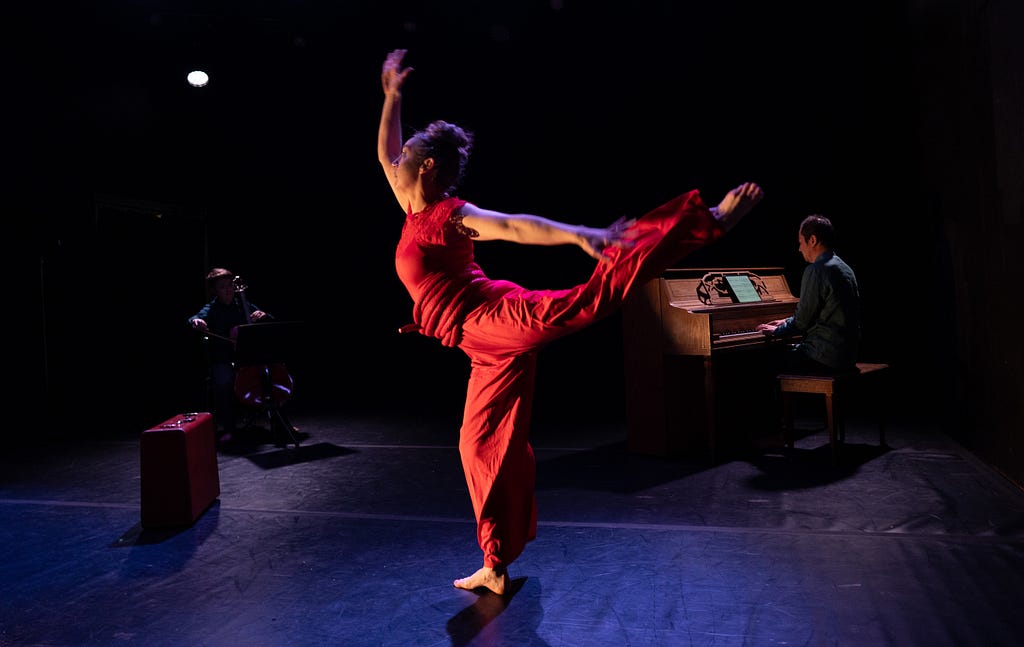
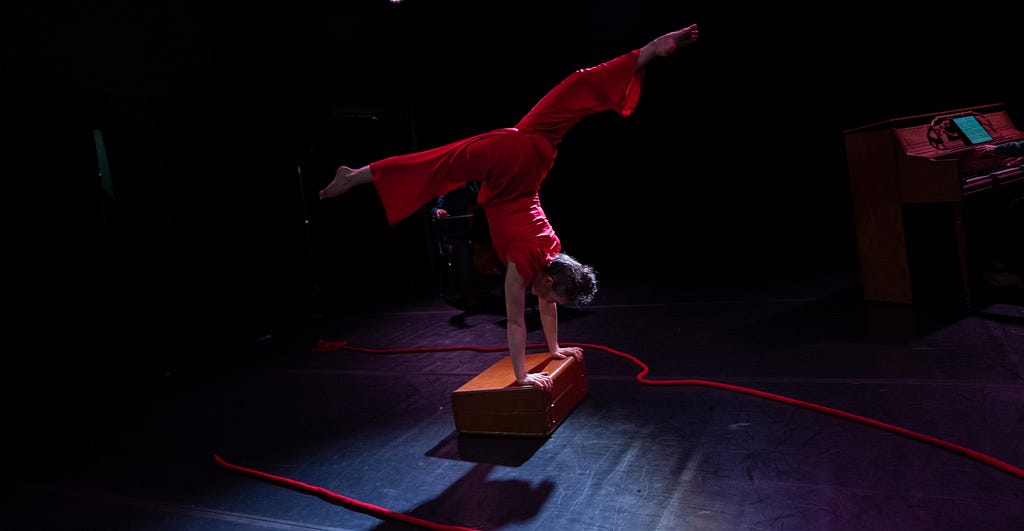
Radio Vision begins with Wicks emerging from the back curtain onto a stage with an already present pianist and cellist on stage. With her was a suitcase, a prop she kept returning to, as well as a red rope wrapped around her center which visually unfurled like an umbilical cord to make a circle on the stage that Wicks would later dance inside of. It also happened to represent the material of an analogue film. Its significance is that 5,400 feet is approximately one mile of film, which equals one hour of film.
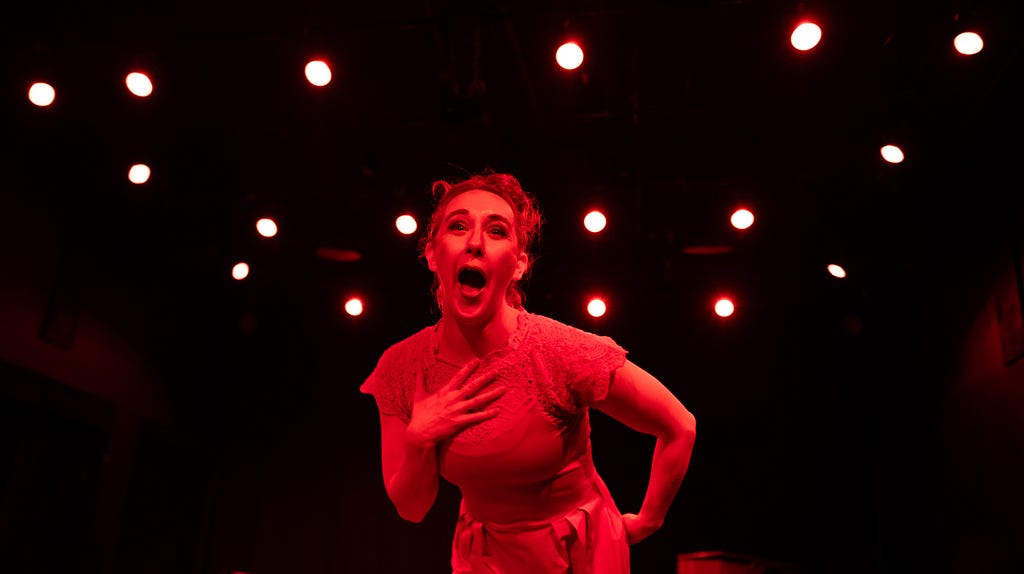
Wicks wore red, a color that represents the fantasy of what Marion Daniels wore in one of her favorite contortion acts in a 1938 a musical short titled Styles and Smiles, which was incidentally produced by Mentone Productions, which was Joe Gershenson’s production company. Wicks wore blue contouring makeup and green lipstick, an intentional choice for the audience to imagine what it was like to be on-set for a black and white film.
The work is grounded in two central musical components: a live performance of a 1914 cello and piano composition by Nadia Boulanger and a recorded sound collage by Simon Linsteadt. At about mid-show the live musicians exited the stage and were replaced with a digital sound score that mirrors the early talkies replacing vaudeville acts and live orchestras. The combination created musical layers that offered the audience an anchor during the time travel of this performance portal.
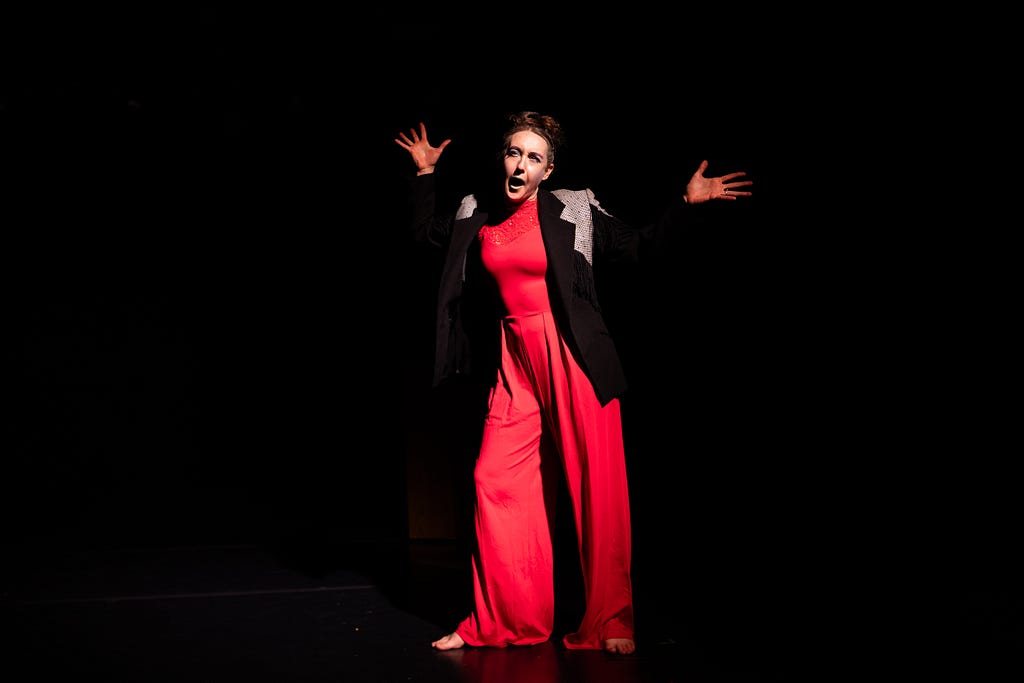
Wicks moved through these historic soundscapes as a channel of the broadcast era — moving in the spirit of early radio conductors, vaudevillian performers, and the silent language of film stars before the talkies.
Wicks’ choreographic language is rooted in physical theater, contemporary dance, and acrobatic storytelling. Through this non-linear movement and sonic journey, the Radio Vision inquires: how does performance, particularly musical performance, shape identity and entertainment across generations? How might the histories we inherit inform our bodies, our art, and our understandings of self?
When asked in the artist talkback how the process of making this work informed and/ or impacted her relationship with her Jewish identity, Wicks responded with thoughtfulness and nuance. “I am redefining and finding what Jewishness is during this time sharing this work. In pulling from the past of my great grandparents and their immigration, I have been able to reimagine identity and its complexities, which gives some sort of anchor during a time of polarization and propaganda.” Examining the past becomes an intentional and necessary way to move forward.
Wicks believes that the body is a site of research and inquiry, and has been sitting with this material for several years. Radio Vision is more than a performance — it is a living archive of what Wicks has been uncovering in her own familial history, which is transforming the way she understands herself today. This work challenges the viewer to reimagine the histories we each carry in our personal and professional lives, and how the media we consume informs the stories that shape our identities. Through music, movement, and remembering, Helen Wicks offers a visionary meditation on time, legacy, and the power of the performed gesture.
Nkechi Deanna Njaka (she/her) is a practice-based creative researcher, choreography artist, public speaker and culture writer whose work explores the intersection of embodied presence, somatic research, well-being, science, art, and social practice. She is the founder of The Compass, NDN lifestyle studio, and co-founder of the sleep app DreamWell, emphasizing mindfulness and creativity as essential for individual and global well-being.
54,000 Feet Per Hour With Helen Wicks was originally published in ODC.dance.stories on Medium, where people are continuing the conversation by highlighting and responding to this story.