
Sheldon Smith
Those of us who are or have been parents know all too well what it is to be sleep-deprived — up in the wee hours of the morning, attending to and worrying about these living beings we have brought into the world. The darkness, the shadows, the crying, and the creaky floorboards — all the senses amplified and quick to trigger into panic (or relief); the love, the sentimental tears, and the horrible boredom all happening at once… it’s a lot. It’s remarkable that we not only survive these moments but that within the rich existential experience of nocturnal parenting, we might learn some amazing things and, while possibly hallucinating, be inspired to create things other than human life.
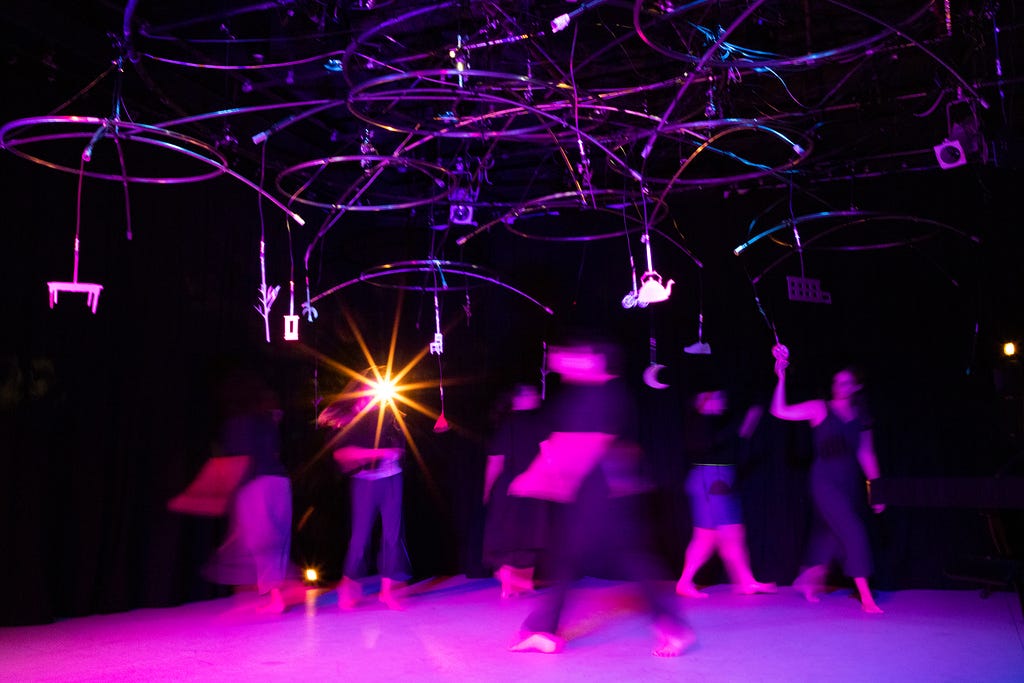
Or so I thought as I witnessed a recent performance of [] by Brooklyn-based choreographer Adrienne Westwood and composer Angélica Negrón at ODC Theater. A 50-minute work for eight dancers, [] prominently features a large interactive sound sculpture with around 20 or so hanging objects that are touch-sensitive. The sculpture itself is intriguing to look at — probably 15 feet or so in diameter — and reminds me of several oversized umbrellas broken down to their ribs, entangled, and perhaps caught by a stiff breeze in a weird kid’s cartoon. Descending from the tips of each rib is a small, two-dimensional cutout of a familiar, iconic object. I spied a teapot, a twig, a house, a table, a palm tree, and — among many other things — a prominently featured little sailboat.
As the work begins, we hear a low, droning rumble that is neither threatening nor obviously pretty in any sense — it is just there, like some sort of existential glue. As the performers enter, we immediately witness them starting to demonstrate the mechanics of the sculpture. When a hand touches an object, a sound is produced. These initial sounds all seem surprisingly digital and a bit cold; some ring out as singular, bell-like tones, while others play forth as brief flurries of minimalist arpeggios. The performers play the sculpture almost as if they are picking low-hanging fruit off a tree. Their technique seems to involve a small collection of gestural possibilities — grabbing, soft touches, stroking, and tapping. It is difficult to discern a particular pattern or rhythm, but one understands that they have all become well attuned to making space for each other’s choices.
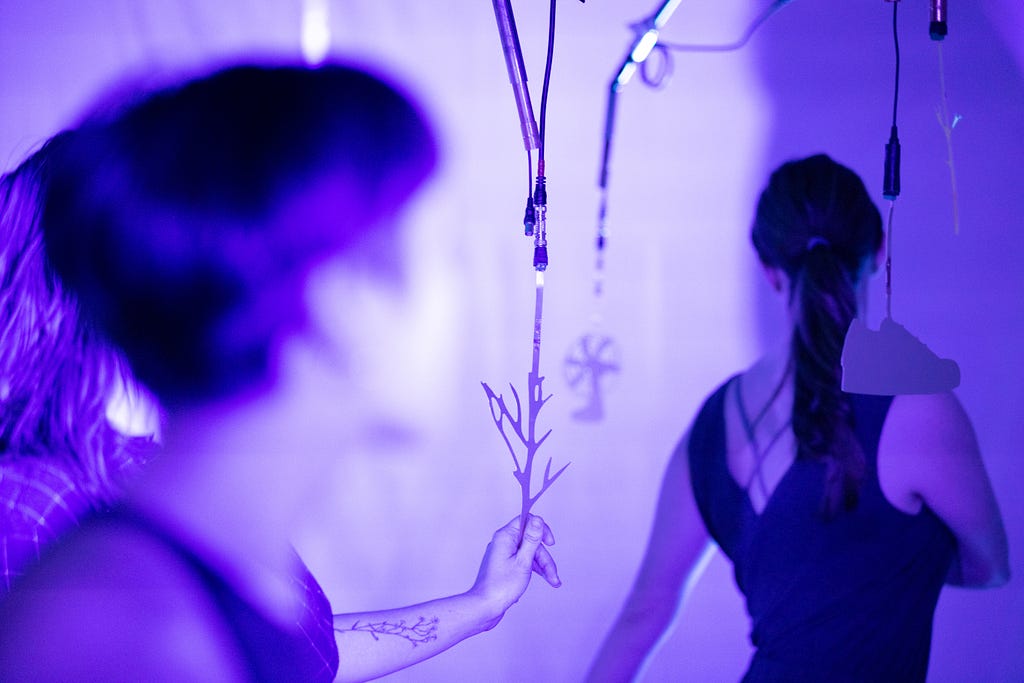
As they continue to activate the sculpture (instrument?), the group phases in and out of lovely, softly executed walking patterns. This is hitting my comfort zone in a way that almost feels retro now — gently arcing arms and low sweeping legs calling forth the best of ’90s release technique. Performed with a nonchalance that would make Trisha Brown blush, these dancers are captivating largely because they seem like human-scale humans. There is no pretense about being bigger than life. This dance is clearly trying to get at some things that are just about life itself. The title (non-title) is something of a giveaway. This dance is a small moment of whatever that stuff is in between the brackets of birth and death, made palpable through the after-midnight poetics of shadows and touch.
The work continues in something like five sections, each of a similar length. I recall a duet evading and then acquiescing to human contact — fragile, mysterious — perhaps two sisters navigating the confines of a shared bedroom in a house where too much noise or chaos could wake the ghosts of their great-grandmothers. As the duet unfolds, a third person follows fragments of the dance with a live-feed camera. It is satisfying to see close-ups of objects, expressions, and such projected onto a screen stage right. At the same time, I catch myself working too hard to unpack why the camera is necessary. And if it is, perhaps more attention could be paid to the choreography of the camera in the space? I hungered to see the camera take on more angles, levels, and subtle movement choices.
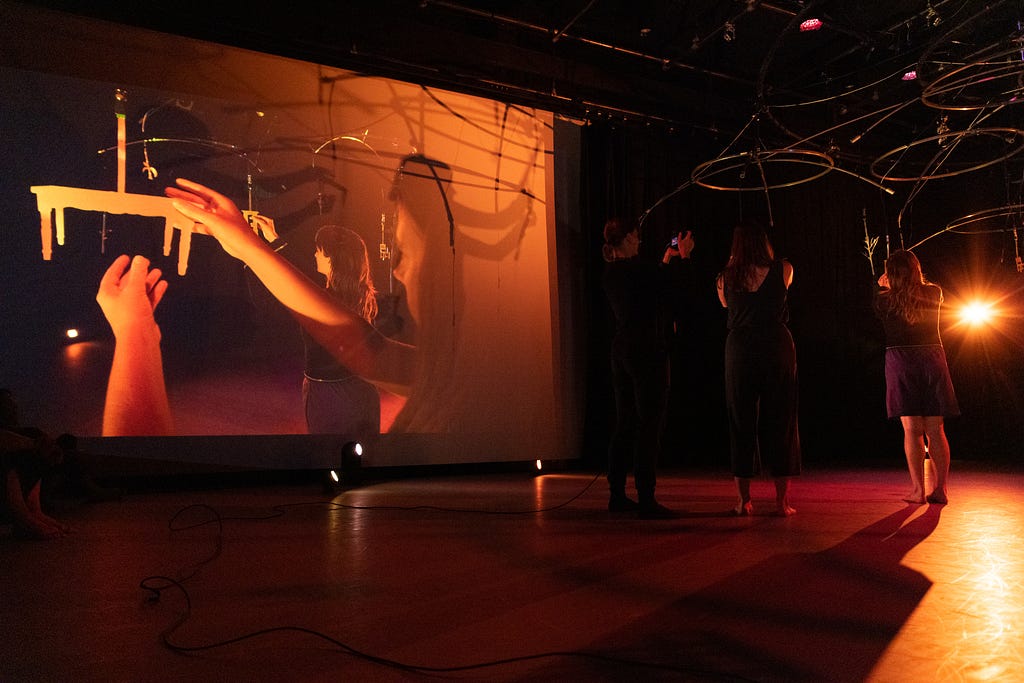
A short while later, a certain satisfaction returns as a solo dancer begins to explore the sonic possibilities of the sculpture. Not a surprising choice to let us have this moment, but gratifying to sit for ten minutes, being able to fully sense that the dancer is very much also the musician. Seemingly improvised, the dancer appears to have a clear score: stay grounded, be aware of and attracted to points in space, be patient, breathe, and make sound less than you desire. The sound palette this time includes small snippets of voice. What might be the voices of spirits trying to tell us something from another world is momentarily collapsed, fragmented, made into nothing but phonemes and nonsensical utterances.
I can’t recall the exact order of everything, but that may be part of the point. What I seem to recall as the fourth section could easily have just been one of the hallucinations I alluded to earlier. For the next several minutes (who really knows for how long), we are the baby in the bassinet — drowsy but aware of our body, reaching for the mobile above us, lit by moonlight and nightlights. Time is lugubrious, a sticky annoyance — more for the adults than for us here in this crib. Not a lot happens in this section that will rouse us from our dream state. All of the performers are present, stretching, feeling, sensing the floor and the space above. Occasional moments of unison arise and dissolve. I can’t decide whether I am watching tired contact improvisers trying to warm up or if I’m watching a Feldenkrais class. I try to turn off my critical mind and allow that it is not only okay but kind of awesome to allow for dance — like much of the sound in the piece — to be ambient.
Eventually, the group coalesces into a final section. This probably has the most energetic movement of the night — largely what feels like a recapitulation of the walking patterns from the opening, but with more license to eat up space with more abandon. There is no danger that the ritual will somehow ignite the sculpture as some sort of spark-wielding Tesla coil, yet there is something deeply ritualistic at play. There is restraint — but just barely. There is a muted ecstasy happening, but it is mixed with what might be physical pleas for the matriarch to step forth and save us from our current political hellscape. Hard to tell. The work is filled with mysteries without answers — but so is life.
Dancing continues, grasping at sound objects continues, formations briefly grow only to quickly dissipate. Lots of bodies end up once again rolling and reaching, slowly leaving a singular dancer alone in a spotlight, playing with the final object: a sailboat. While projections and close-up video continue to invite us deeper into intimate connection with the moment, the performer not only touches the sailboat but gets it gently swinging in small pendular arcs reminiscent of earlier dance movement we have seen. My cats would have loved this moment, and so do I. In something so simple is a wonderful compaction of metaphors — the ship on troubled seas, tossed about in the night but never sinking. And a reminder that in the simplest moments in life (a child playing with a mobile) are opportunities to connect with why we are alive. To play. To create. To touch. To dance.
Sheldon Smith has been a full-time adjunct at Mills College since 2008. Originally from Omaha, Nebraska, he discovered a love of experimentalism and electronic music while becoming the first-ever dance major at Colorado College. He went on to receive an MFA in dance at the University of Illinois Urbana-Champaign, where he wrote a thesis, prior to the internet era, speculating on an emerging form of dance that might radically innovate through swiftly evolving technologies.
Adrienne Westwood & Angélica Negrón Pull And Release Time was originally published in ODC.dance.stories on Medium, where people are continuing the conversation by highlighting and responding to this story.