

Emily Hansel
On October 13th, audience members at ODC Theater waited in excited anticipation for AXIS Dance Company’s 2024 Home Season, a performance whose scale has not been matched since the company’s 2022 season at the same venue. The program, overarchingly titled, Ecos, opened with Piel de Luna, an athletic and virtuosic quartet choreographed by AXIS Artistic Director, Nadia Adame. This piece featured open audio description, which I (a seeing and hearing person) experienced alongside open captions projected on the cyc. The prerecorded audio description was done by two voices, and as time passed, the rhythm of these two voices became part of the music accompanying the choreography. The voices sometimes overlapped and eventually became metered so that by the end of the piece, the audio description evolved to sound more like a performance by spoken word poets or rappers. While listening to both the music and the voices and watching both the dancers and the captions, all elements in harmony, I felt like I was experiencing a new artistic medium.
The dancers, whose smiling faces and energetic bodies connoted playfulness and curiosity, were skilled at making tricky movement and complicated partnering appear incredibly easeful. Amid precisely rehearsed lifts, weight-sharing, and unison, the piece was centered around a hole-filled cylinder that cast circles of light all over the theater. At the heart of Piel de Luna, Anna Gichan and Julie Hasushi danced a riveting duet, which highlighted the prowess and versatility of both dancers.
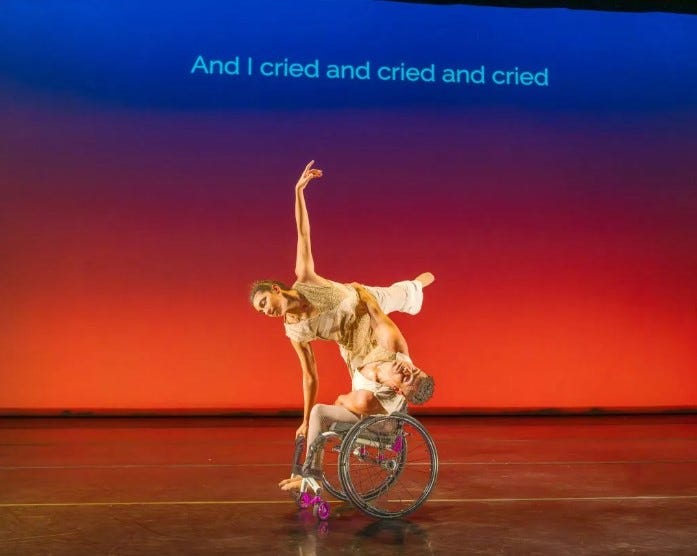
Up next was Harmony of Souls, choreographed by dazaun soleyn and performed by Zara Anwar and JanpiStar. These two dancers embodied a distinct physical aesthetic that was notably different from the first piece, frequently moving their bodies in staccato rhythms that countered the music’s slow and sustained nature. They danced according to some carefully crafted logic that was the artists’ own, and which the audience was not privy to. They alternated between moments of interconnectedness, like a sustained lift where both dancers’ limbs were thoroughly entangled in each other’s, and moments of independence, solo dancing separately from each other with more internal focus. I understood there to be purpose behind their actions without understanding any precise, literal meaning — though evidently there were themes of mutual support and trust juxtaposed with moments of fierce individuality and separateness.
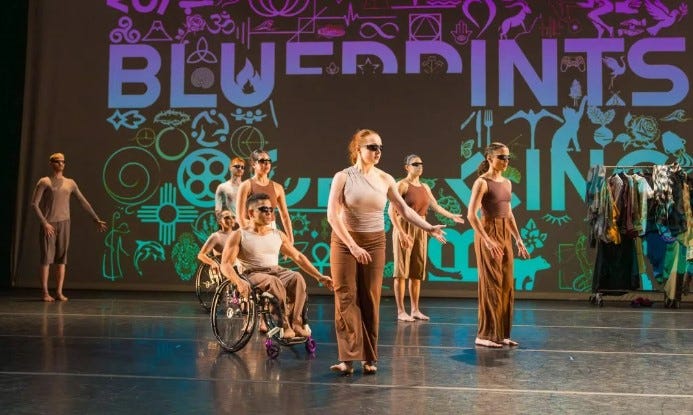
Following intermission, Jorge Crecis’s work Blueprints of being began with a laidback, prerecorded voiceover that mentioned this piece was an homage to dancers and the often difficult lives they endure. Just as the voice pointed out that we couldn’t tell when the piece actually began, I realized it was already in full swing. I watched the dancers casually crossing the space, wheeling around costume racks, while I listened to their overlapping chatter of getting ready.
The more formal, dance-y sections of this piece were separated by clothing-rack-ography — both visibly and audibly conspicuous — as well as improvisational scores enacted in real time that were used to determine something about what was going to happen next. At one point, each of the eleven dancers (seven AXIS dancers were joined by four guest artists from Post:ballet) picked a colorful ball from a container and, as they discovered what color they’d grabbed, learned who was going to be doing what in the next section.
In transitional moments like this one, the performers dropped the energy or facade of performance and I got to witness them be their authentic, playful, casual selves. But I also got to see them shine in awesome, highly virtuosic dance sequences that felt fresh, surprising, and unique. Given how well the movement vocabulary suited the performers, and based on the stories that were spoken, signed, and captioned throughout the piece, I can tell Crecis used these dancers’ real experiences to shape the work.
In one section, JanpiStar and Moscelyne ParkeHarrison had a dramatic and secretive exchange, both speaking coyly into microphones. In another, Crystaldawn Bell pulled focus to downstage right, staring the audience down from behind sunglasses while hitting a precise gesture sequence in the cool, understated demeanor that she’s known for. Meanwhile, the group flocked around the stage in unison and Gichan, stage left, signed in ASL to tell the story of a dancer’s hip surgery and evolving gender identity.
Near the end of the piece, the dancers conducted an almost parseable score of counting out loud, freezing in the space, putting costume pieces onto mannequins, and calling out the unofficial titles of the piece’s various sections. Each section was repeated/referenced in a highly abbreviated, sped up way and I realized that the mannequins that had been onstage and adjusted slightly throughout the piece had been demarcating the order of the show we just saw. Sure enough, in the last few seconds of the piece, a dancer announced that the way the mannequins had just been rearranged in front of us had determined the order of tomorrow’s performance. These final moments of Blueprints gave me the satisfying feeling that I’d solved a mystery that was being hinted at the whole time.
I am in awe of Crecis’s craft. Blueprints of being was a highly effective, functional, and fully called-for blend of theater and dance that was a privilege to experience. The choreography had breath and seemed totally alive from ambiguous start to gratifying finish. I only hope that this wonderfully smart, creative piece doesn’t idolize the dancer’s struggle in a way that perpetuates patterns of harm, but instead demonstrates that extremely skilled artists like these deserve better from the systems that surround them.
Emily Hansel is a San Francisco-based dancer, choreographer, dance teacher, arts administrator, and artist advocate.
AXIS Dance Company Creates Connections In Three Works was originally published in ODC.dance.stories on Medium, where people are continuing the conversation by highlighting and responding to this story.