
Nkechi Njaka
At ODC Theater, FACT/SF’s The Waves, under the direction of Charlie Slender-White set the stage for the audience to get swept up in a program that was an expansive and impressionistic reflection on various types of waves we encounter.
The Waves leans deeply into the philosophical terrain of “The Waves,” a novel written by Virginia Woolf. It’s a work that resists plot in favor of interiority, where six voices move in and out of focus like tides, each shaping and dissolving the other. In this choreographic translation, Woolf’s stream-of-consciousness becomes a kinesthetic language where identity is something continually rehearsed, revised, and undone. The dance was a duet between the dancers and the text, offering the insights that states of being are not fixed but tidal, that time is not linear but cyclical, and that meaning emerges not from singular moments but from their repetition and return.
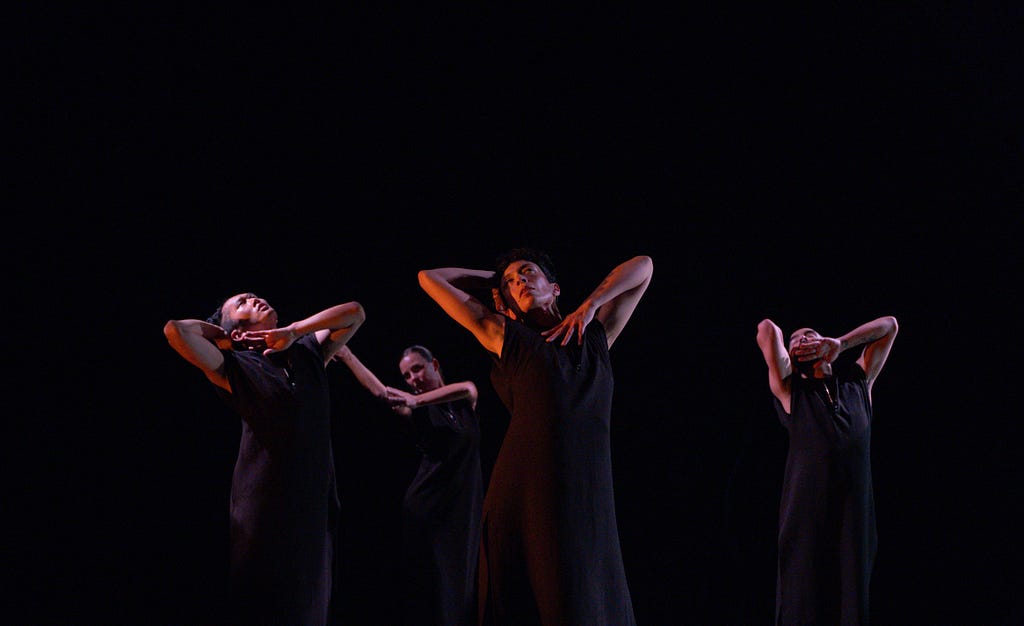
Costumed in black tunics, the four dancers LizAnne Roman Roberts, Keanu Brady, Erin Coyne, and Jonathan Kim appeared almost as vessels rather than individual characters. Like Woolf’s Bernard, Susan, Jinny, Louis, Neville, and Rhoda the dancers cycled through configurations: solo, duet, ensemble, and back again. One moment a body felt distinct and sharply outlined; the next, it was absorbed into the group, its beginnings and ends blurry. This constant reorganization echoed the novel’s central inquiry: where does the self end and the collective begin?
The dancers did not portray specific characters so much as states of being like grief, longing, entangled, estrangement — and each passed through one another. There was an ease to this coming and going, the way the tide does. In Woolf’s text, each voice speaks alone yet is always in relation; here, each body moved independently yet remained tethered to the group’s evolving and devolving structures.
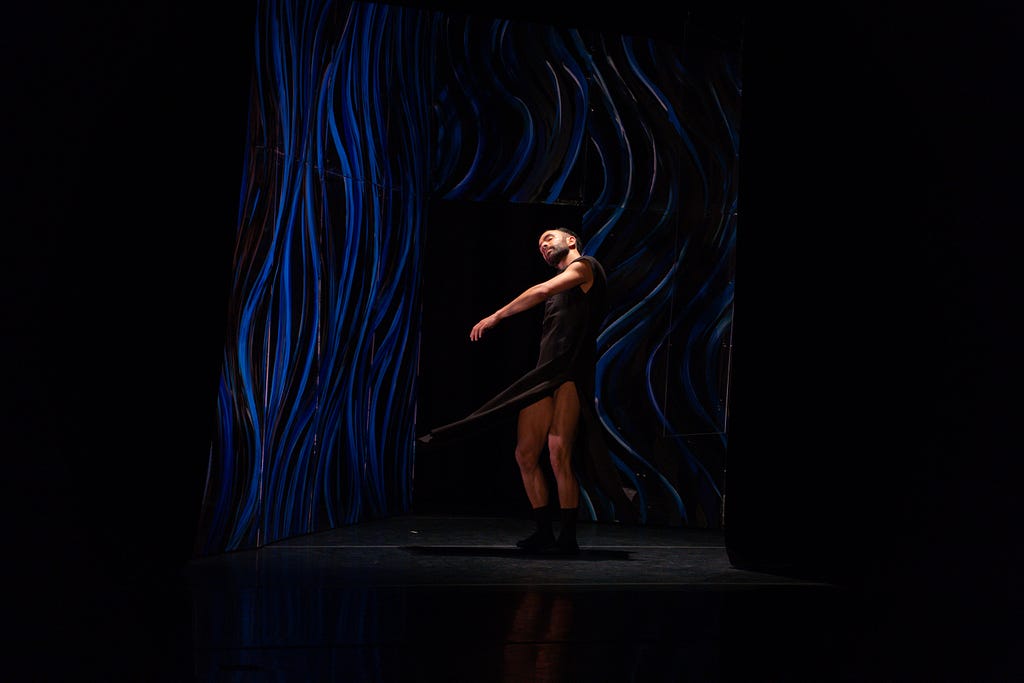
The movement and the organization of movement were fluid, like water, and the staging reinforced this fluidity. A sectioned-off portion of the stage, lit like a contained black box with a colorful backdrop, operated as a kind of interior spacer. When dancers entered this space, it felt as though we were being pulled deeper into a private consciousness, a soliloquy rendered in movement. Then, just as quickly, they would re-emerge into the shared space, rejoining the collective current. There was also an aquarium tank front stage with water in it, lit by a fluorescent light.
Del Medoff’s lighting design played a crucial dramaturgical role. Sudden blackouts would interrupt the action mid-phrase, yet the dancers continued moving in darkness. The audience could hear them and also see parts of them moving. When the lights returned, the scene would shift with it with new spatial relationships and new emotional textures. It almost was like turning a page and encountering the same voices but in a different time and place. These transitions carried the sensation of chapters without any real narrative markers, perhaps an attempt to mirror Woolf’s nonlinear structure within the book. Life, in both the novel and the dance, is a series of shifts that create meaning rather than one singular moment of sequential events.
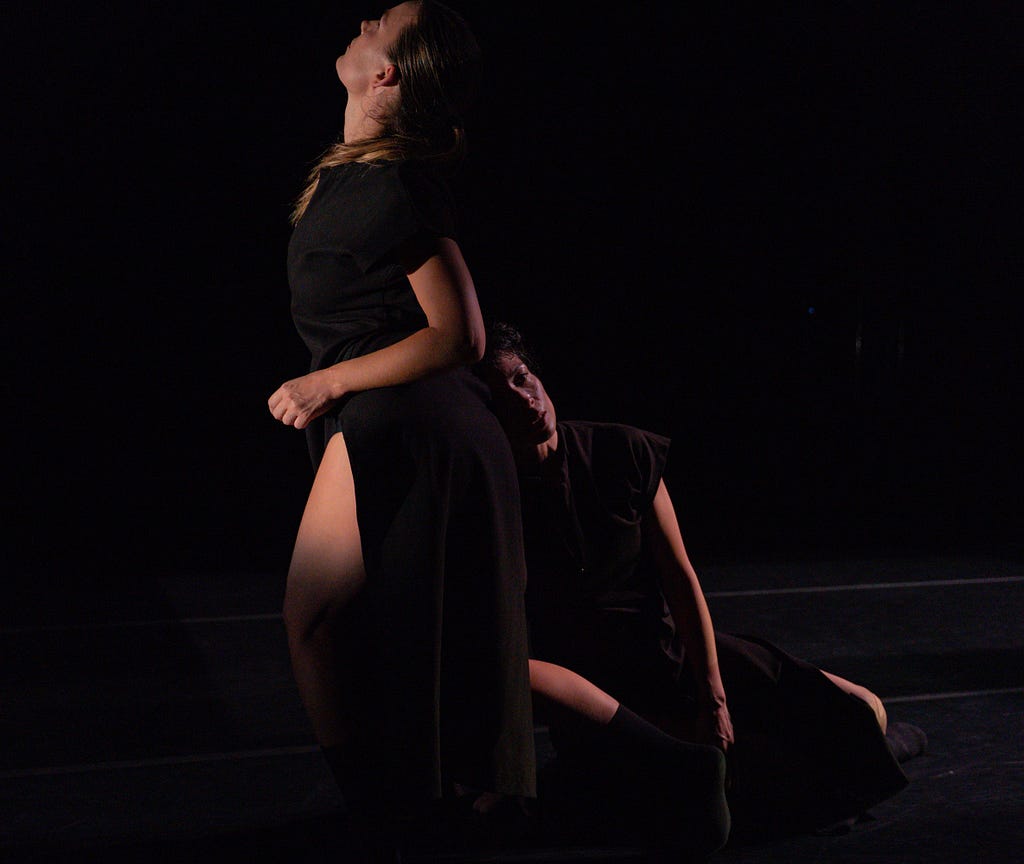
In addition to its fluidity, the movement itself was strikingly physical as well as grounded, insistent, and at times relentless. There was no intermission. Repetition threaded through the choreography, phrases cycling again and again with subtle variation. It often felt like it could be the same dance over and over again. Thus, returning to the imagery, materiality and forms of water: waves cresting, breaking, and reforming — patterns that feel familiar yet never identical while also being meditative. This repetition became almost trance-like, drawing the audience into a durational experience where meaning accumulated slowly.
Set to the orchestral compositions of Max Richter, the soundscape expanded and contracted alongside the choreography. At moments, the music swelled to something stormy and engulfing, presumably mirroring the emotional turbulence of Woolf’s characters. At other times, the score softened into sparse, cyclical phrases, holding space for introspection.
By the end, the effect is less like watching a story unfold and more like existing in a shared field of perception where light, sound, and movement converge into something ephemeral yet deeply felt. Like Woolf’s sea, the dance leaves an imprint that lingers, receding even as it continues to echo.
Nkechi Deanna Njaka (she/her) is a practice-based creative researcher, choreography artist, public speaker and culture writer whose work explores the intersection of embodied presence, somatic research, well-being, science, art, and social practice. She is the founder of The Compass, NDN lifestyle studio, and co-founder of the sleep app DreamWell, emphasizing mindfulness and creativity as essential for individual and global well-being.
FACT/SF Dives Deep Into “The Waves” was originally published in ODC.dance.stories on Medium, where people are continuing the conversation by highlighting and responding to this story.