
Nkechi Njaka
For two decades, the Black Choreographers Festival: Here & Now has been an important pillar in San Francisco’s dance community. Celebrating the brilliant, resilient, and cultural significance of Black dance, the festival provides a meaningful platform for Black choreographers to present their work, share their stories, and expand the landscape of contemporary dance. Co-founded by laura elaine ellis and Kendra Kimbrough Barnes, the vision has always been one of uplifting communities. As BCF embarks on its 20-year mark, it is crucial to recognize the festival’s deep-rooted impact in shaping the Bay Area’s dance scene — particularly through its long-standing relationship with Dance Mission Theater in the Mission District.
“As a culture and as a people, in terms of what we create, there is much more to say about our narratives and our journey that can be held in one kind of space” said ellis. “This storytelling needs to exist. It’s VITAL that we have safe spaces to be creative, to express, and to tell our narratives. That’s why BCF continues to be important to our community here in the Bay Area.”
Since its inception, the festival has partnered with Dance Mission Theater, a space known for its commitment to social practice, allyship, community, and diverse representation in the arts. In the historically vibrant Mission District, Dance Mission Theater has been a home and sanctuary for marginalized voices, making it a fitting partnership for a festival that uplifts Black dance. This collaboration has allowed generations of Black dancers and choreographers to cultivate and present work in a community-driven space, cultivating a sense of inclusion, belonging, and continuity in an ever-changing city.
According to Gabriele Christian, a choreographer in this year’s festival, “Black Dance is any form of movement practice that considers both the centered body or bodies of attention and the peripheral bodies of whiteness, as all part of the same choreography. For me, white dance attempts to distinguish and establish walls and lines, boundaries and surveillance on a body doing movement, while black dance is about the epiphany and the release and the collectivism of acknowledging that every witness is also a dancer.”
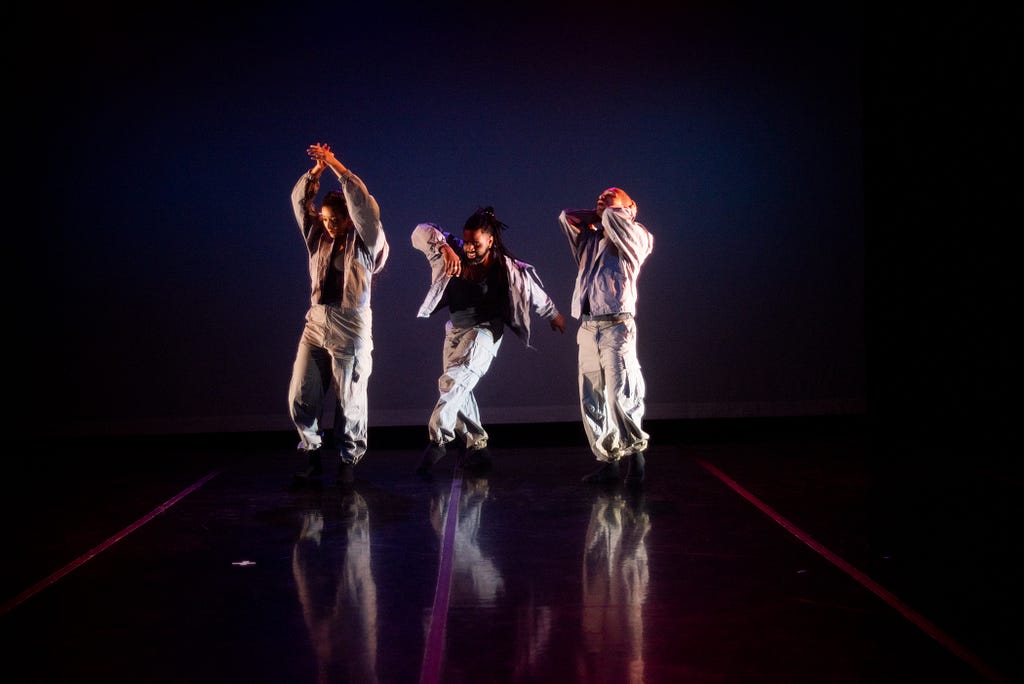
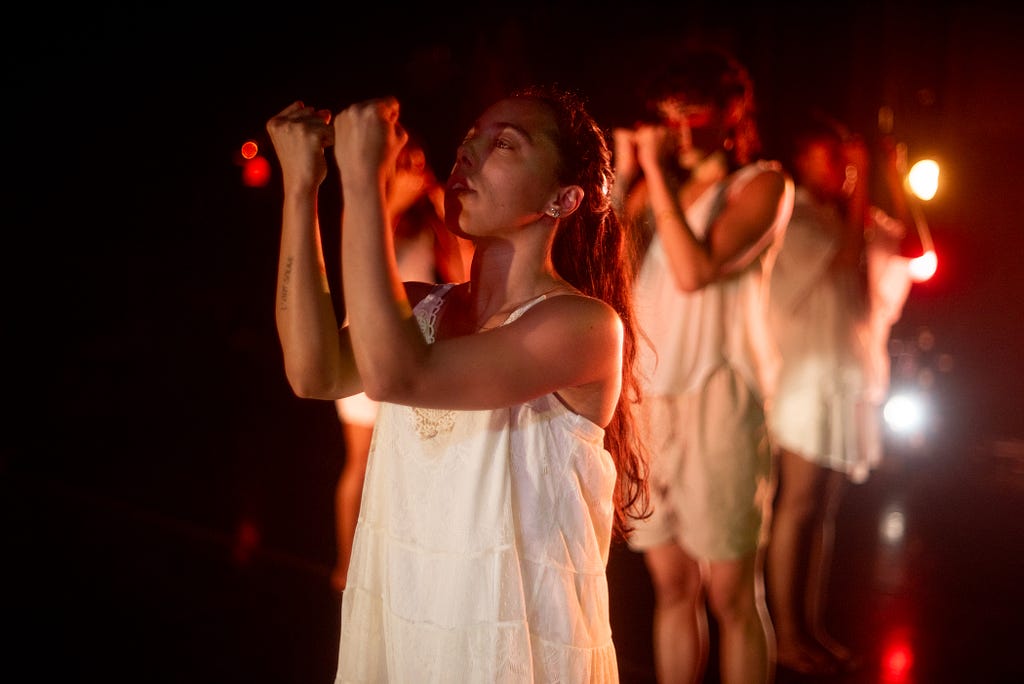
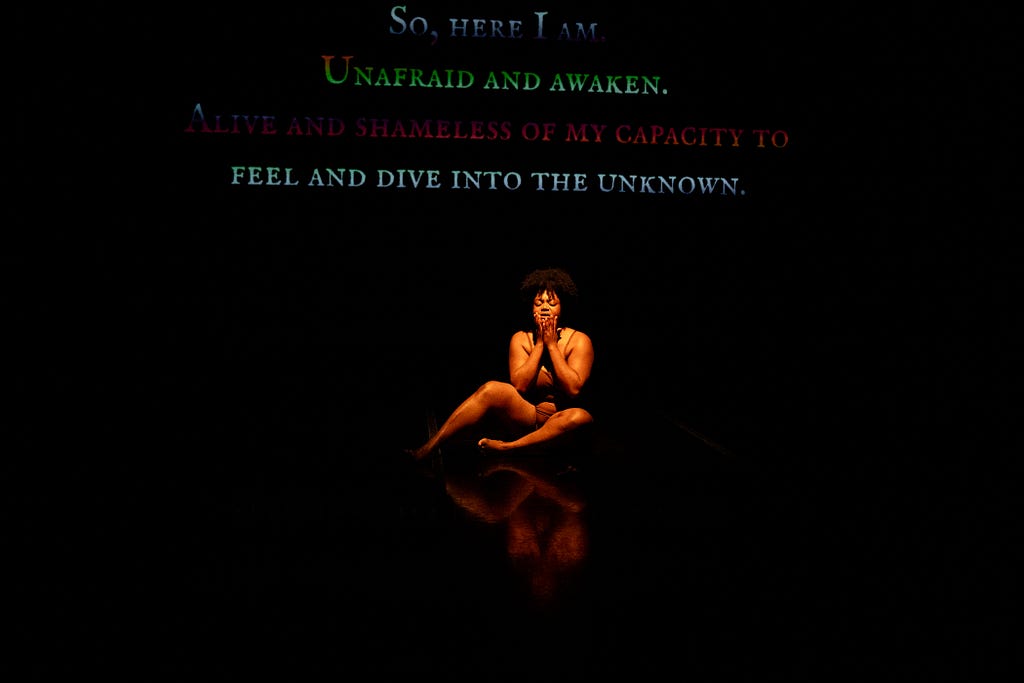
This year there were nine works shown by a collection of established and emerging artists. The themes of the works centered around visibility, identity, healing, lineage, ancestry, ritual, affirmation, and agency. With titles such as Diary of a Black Woman by dominique lesleyann; May We Heal? by: dazaun soleyn; I Always Saw You by William Brewton Fowler Jr.; Love: Reclamation by Sriba Kwadjovie; and Start Over by Aja Randall and Patricia West, there was a clear direction around recognizing a lived experience that might not always be given space to express. There was a clear connection between the works, particularly the first and last pieces. “I want it to feel like a journey. I think it’s special when the ending connects to the beginning. I love having a circular cohesion,” ellis shared of her curatorial practice in organizing the show order.
The evening opened with TYRONE (work-in-progress), choreographed and performed by Clarissa Rivera Dyas. This new work was created through BCF’s Artist Mentoring Program (AMP), under mentor Joanna Haigood. The score included audio from what sounded like recordings from a financial institution for a late payment or a declined credit card. The artist faced the back of the stage wearing a hood and regardless of the movement and direction danced, the audience did not see their face. The audience was taken on a stylist journey, where the movement felt more rigid at the start evolving to more fluid movements that included the use of the floor, ending in areal movements. The artist did not face the audience until near the end of the piece, where they removed their clothing and danced with an areal ring suspended from a one-point rig for the entire dance. The dancer ran and then swung in suspension creating the illusion that time had been suspended. During the end of the show at an artist talk back, Dyas reflected that “This process has been about being with myself. I always work from the body — body first. Whatever it is that I am reckoning with, where does it live and how does it live? And how does it want to be embodied? These questions come from my body. And this piece, particularly, I was dancing with a lot of ghosts, past lives, past selves and future selves.”
The evening closed with BLUR (work-in-progress), choreographed by Gabriele Christian, with contributions from the cast/ dance artists: Hodari Blue, Gabriele Christian, Audrey Johnson, Laila Shabazz, Zekarias Musele Thompson, Zubiri Wilburn. This work in progress was in response to some work Christian had been doing for many years with Jess Curtis (the late choreographer and founder of Jess Curtis/Gravity), that centered disability, blind and visually impaired communities while integrating access. Christian was interested in exploring a version of their many years of dancing in the dark with — instead — all Black artists, with the question “How might that change the texture of the darkness that we’re inside of?” The piece started with all the artists standing in a line in low light, wearing black facing the audience. This and the very end of the dance were the only time the audience ever saw the dancer’s faces or bodies. The lights dimmed to a very low to no visibility. What the audience was left with were the sounds and feelings of the dancers moving through space. Eventually, small fluorescent lights were added but not enough to make out full shapes or phrases of dance sequences. When asked about the choreographic process, Christian’s reflection included, “This piece is such a refusal. Perhaps you were frustrated or felt a hate from not being able to see something — which I think is a tension, an existence for many people in this world. What happens when we get to acknowledge the folks who occupy the dark for and with us, exposed to each other at the beginning as we were in my piece with brief eye contact in the light? We get to reveal ourselves as some higher form in the dark by purposefully eliminating a sense of singular presence or virtuosity. Less hiding than amplifying by erasing our visual markers of difference.”
San Francisco has long been a hub for artistic innovation, and Black dance has played an essential role in this important legacy. Historically, Black choreographers have used movement and dance as a powerful means of resistance, activism, storytelling, and cultural preservation. From Afro-diasporic traditions to cutting-edge contemporary and fusion works, Black dance reflects both the struggles and triumphs of Black communities. In a city that has experienced waves of gentrification and displacement, spaces like the Black Choreographers Festival are more critical than ever in ensuring that Black artists continue to be seen, supported, and celebrated. As the Black Choreographers Festival reaches this milestone, it not only honors the past but also looks toward the future. Its legacy ensures that Black dance remains an integral part of San Francisco’s cultural fabric, continuing to inspire, educate, and innovate for years to come and beyond the city parameters.
Nkechi Deanna Njaka (she/her) is a practice-based creative researcher, choreography artist, public speaker and culture writer whose work explores the intersection of embodied presence, somatic research, well-being, science, art, and social practice. She is the founder of The Compass, NDN lifestyle studio, and co-founder of the sleep app DreamWell, emphasizing mindfulness and creativity as essential for individual and global well-being.
The Importance of Black Dance in SF: Celebrating 20 Years of the Black Choreographers Festival was originally published in ODC.dance.stories on Medium, where people are continuing the conversation by highlighting and responding to this story.