
Sarah Brooks
Reminiscence celebrated the history of the ODC Dance Jam with a mixed bill of new and returning works. The night opened with a world premiere by Douglas Gillespie titled outside; in. Set to a musical score by Gustavo Santaolalla, the piece opened with full company of 6 dancers, all wearing dark blues, greens, and earth tones, divided in pairs, creating three vignettes on the stage.
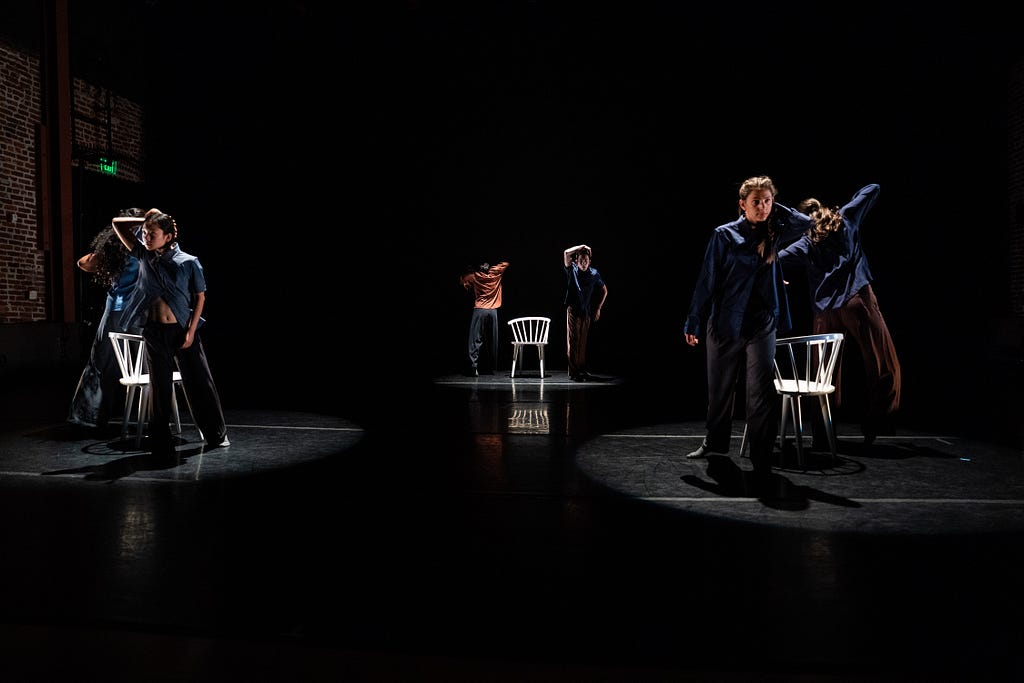
Three white chairs, each in its own pool of light, created an island on the stage where each pair of dancers created shapes, sharing weight with one another, integrating the chair as a tool to vary their levels. Choreographing for this teenage company of dancers allowed Gillespie to shape the choreography around technical skills the dancers were developing through his teaching. This was recognizable in frequent explorations of contemporary partnering. At times this feature seemed to inhibit the creative potential of the choreography; this, combined with a very literal approach to musical timing, contributed to a feeling of predictability. The final duet of the piece, danced by Nina Delos Reyes-Webb and Rylan-Christian Pon was the most memorable, creating a captivating peak of energy just before the final blackout.
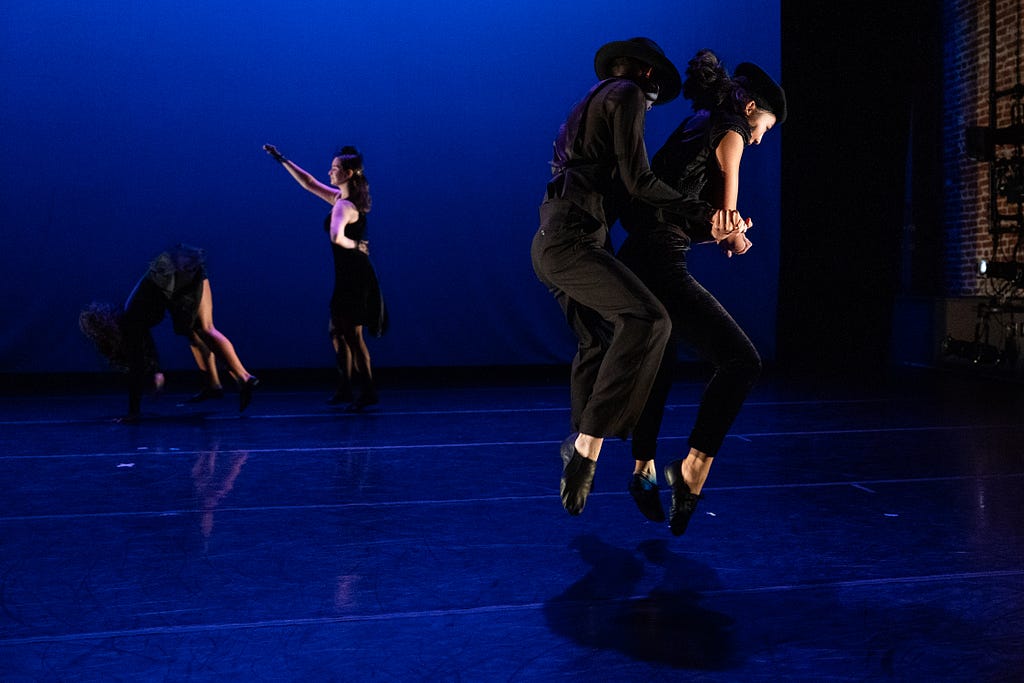
The second work of the evening, Kimi Okada’s Foreign Postmark, originally choreographed in 2011, was a jazzy romp set to the music of the Cory Combs Jazz trio. Eccentric black costumes conveyed a quirky sensibility that suited the choreography and music and evoked the stylization of a vintage Disney cartoon. The material, with a theater jazz style reminiscent of Twyla Tharp, gave room for the dancers to make playful choices in their performance and expression.
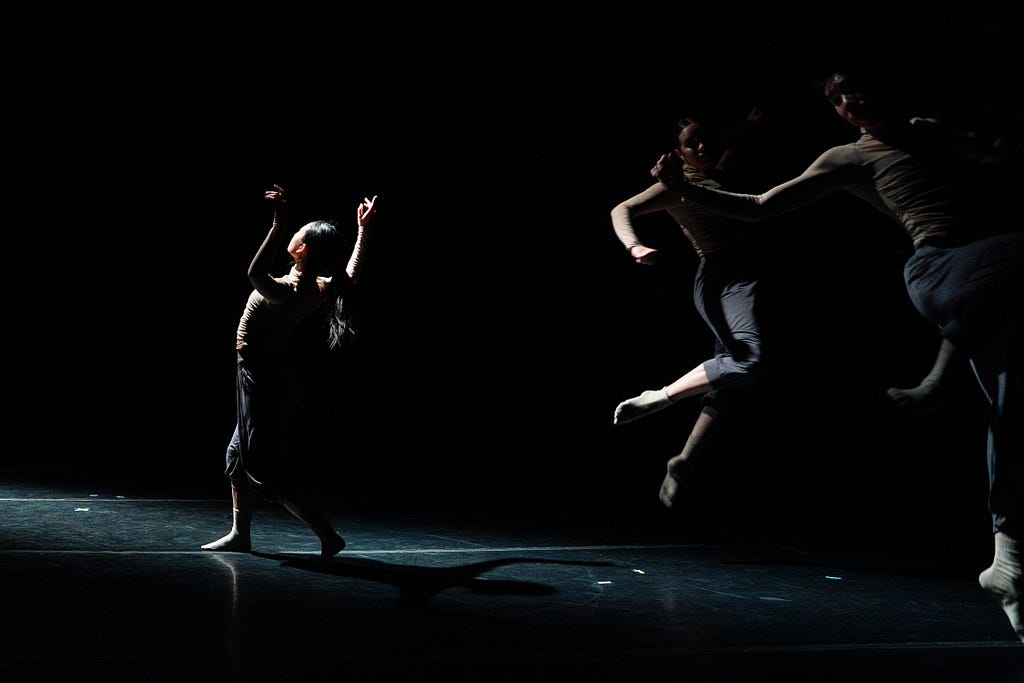
Deep Ascent, originally choreographed by Babatunji in 2025 was a standout piece of the evening, highlighting the dancers’ technical skills without feeling showy or detracting from the focus of the piece. The opening moments revealed the dancers, scattered across the back of the stage, wearing matching grey shirts with flowy tan pants, under soft blue light that felt like the early morning. Each dancer took a turn diving towards the center of the group, where white spotlights formed a bright pool of focus, to execute a brief sequence of airy, gravity-defying floor work. Anyone familiar with Johnson’s work would recognize this sense of buoyancy from his own dancing. The cast’s ability to capture this weightless quality attests to their own talent and to his skill as a teacher. Those opening moments set the tone for the entire piece, which maintained a satisfying rate of change from one idea to the next and continued to give each dancer moments to shine. The musical accompaniment, “Hold Mine Haender” by Efterklang, fit the tone of the piece with a dreamy, moody, longing feeling.
The strength of these young dancers was well displayed as they expertly achieved the flow between breaking-inspired floor material and contemporary dance vocabulary, even tackling challenging lifts with confidence. Subtlety of performance and sophistication of choreography showcased the students’ technical capacity without ever feeling like “tricks”: a momentary floating a handstand or sweeping leg into a shoulder stand felt causally architectural rather than ostentatious. The last moments created a captivating visual that received audible gasps from the crowd as the vignette disappeared into a blackout. Nina Delos Reyes-Webb was lifted over the heads of the group and slowly flipped head over heels, making several rotations as if floating in outer space. This moment felt like something out of Alice in Wonderland, but the fantasy didn’t rely on illusion. The mechanics of the lift were on full display: Reyes-Webb balanced her weight through her pelvis onto another dancer’s shoulders, before falling into the arms of waiting dancers. There was no visible stiffness or awkwardness in the execution, rather, relaxed steadiness and grounded stage presence imbued this moment with the enchantment of technical mastery.
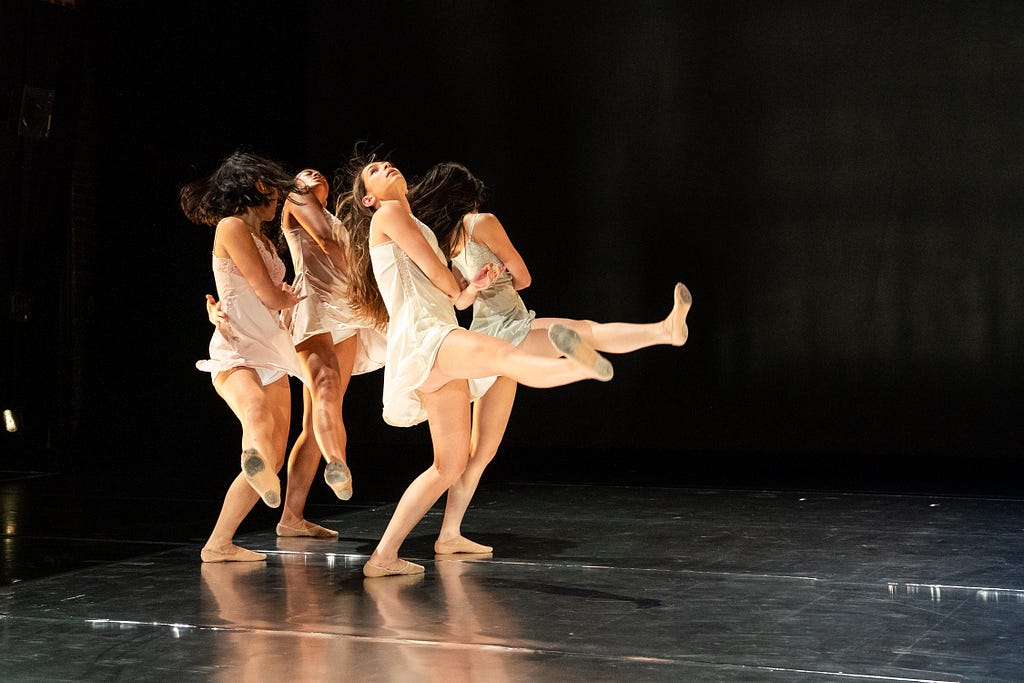
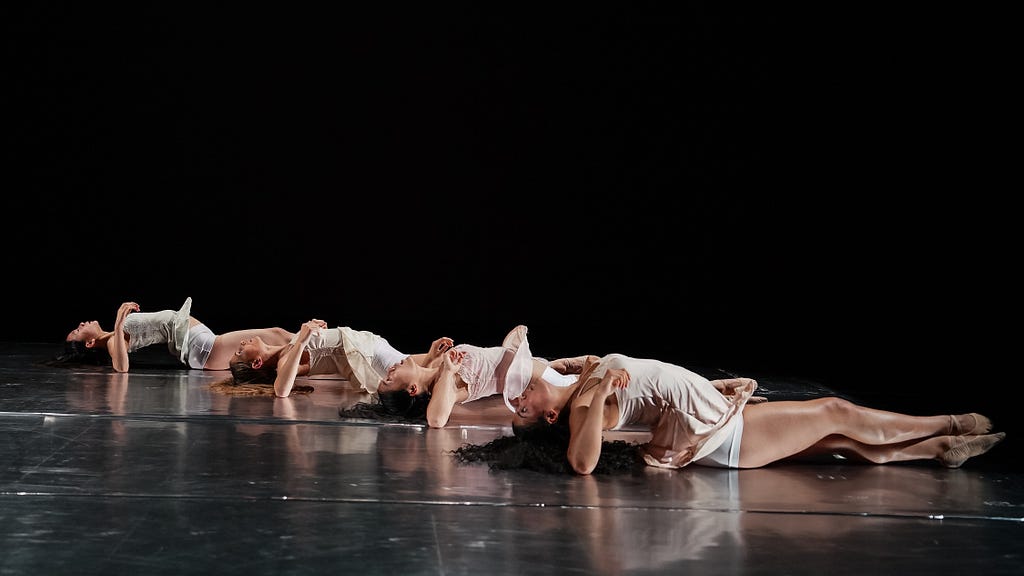
The most memorable piece of the night was Brenda Way’s Breathing Underwater, originally choreographed for the ODC professional company in 2012, with a musical score by Zoe Keating. The audience’s attention was immediately captured as the piece began with a wistful song performed a capella by Ella Ford, demonstrating her musical theater training and capacity as a multitalented performer. The central area of the stage was highlighted by a reflective square surface, where most of the choreography would take place. Ella’s song was followed by a rhythmic sequence, beginning with Ruby Chen, Nina Delos Reyes-Webb, and Ever Keegstra, laying on the floor and repeating a series of gestures and sharp audible breaths. Ford soon joined in, and the phrase established a clear sense of the weighted physicality that would continue through the piece. Arms reaching upward to fall back down, arched backs bridging away from the floor only to collapse back onto the shimmering surface- all emphasized a naturalistic, tactile engagement with gravity. The repetition of the phrase added a sense of the quotidian, routine, and daily life. As the choreography progressed, the movements fluctuated between highly energized, structured modern dance vocabulary and a loose, pedestrian physicality employed in casual gestures, or full-bodied release through collapse, swinging, and shaking. This dynamic contrast is challenging to embody, highly trained dancers can struggle to modulate between such disparate levels of tension, but this cast achieved it seamlessly.
The quartet of teenage dancers reshaped the story of this piece to be more specific and imbued with a raw vulnerability. Originally created for a cast of adult professionals Breathing Underwater explored social dynamics between women, but when danced by 15- to 18-year-olds, this became a story about adolescence and young womanhood. The dancers wore their hair down (which made for fabulous Pina Bausch-esque hairography) with pastel-colored slip dresses that had been altered to give a hoopskirt-like structure to the hem. This made for a feminine but uncanny silhouette, something not quite fitting in either a child’s dress-up bin or an adult woman’s wardrobe. The choreography emphasized this awkwardness: the dancers periodically tugged at their hems, trying to smooth and straighten the garments. Strong eye contact and moments of stillness carried the storytelling power in this piece. While the dancers held hands to create chains of physical connection, relationships were complicated through their exchange of glances, and hard stares into the audience drove home the theme of being seen. This felt highly potent coming from these young performers, simultaneously embodying both the desire to be seen with recoil from exposure and vulnerability. In looks at the audience and one another, they were at once reaching for connection, next offering a harsh look and pushing each other away. The consistent focus and subtlety of expression that were maintained by all dancers in this piece demonstrated a striking level of maturity and confidence. Even in technically challenging moments in the choreography, their ability to stay in character made the imperfections a part of the work. Fast petit allegro towards the end of the piece seemed to push the dancers at the edge of their ballet technique. I have heard dance teachers talk about technique in terms of honesty: describing clarity of position and placement as an integrity between your body, the floor, gravity. This may be true, but on an expressive level, the honesty of what I saw in this piece would have been undermined if danced with the polish of professionals in perfect unison, with every assemble landing in a perfectly tight crossed fifth position, and every mid-air coupe glued at the ankle. Effortlessness would have broken from the established world of the piece. The honesty and humanity of this piece came from the embracing the tactile, weighted, reality of the body, and the energy of breath. This work, and the devotion and authenticity that the dancers brought it, told a story about young womanhood, about encountering gendered social expectations and ideals of beauty, and of pursuing ambition and adult dreams amidst the friction and discomfort of adolescence.
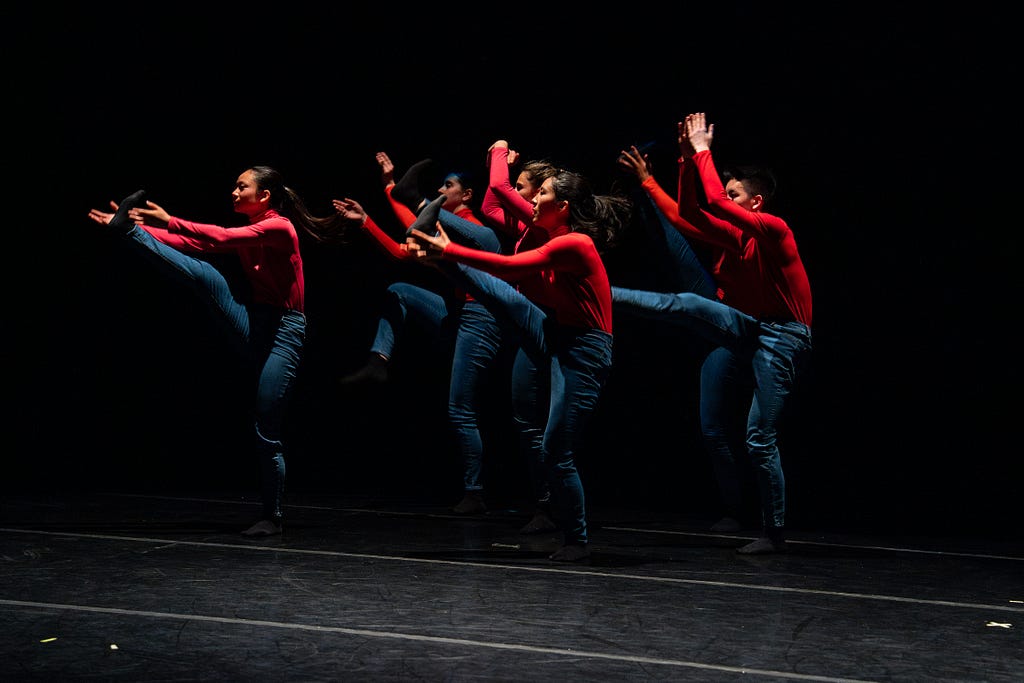
Dexandro Montalvo’s Specifically Particular, from 2018, made for a delightful, high-energy finale that captured a unique electricity compared with the rest of the program. The music, “Adir Adirim” by Balkan Beat Box and Victoria Hanna, paired naturally with bold, crisp lighting design and sleek, red and black costumes. Montalvo’s choreography blends contemporary and hip-hop vocabularies, requiring the dancers to engage precise form and isolations while still accessing a relaxed, bouncy energy. Ever Keegstra and Ruby Chen maintained a captivating coolness in their performance quality, while maintaining the same razor-sharp musicality that the entire company displayed in this piece.
Sarah Brooks is a multidisciplinary creative studying dance and art history at the University of San Francisco. She has received honorable mentions in USF’s undergraduate journal, Writing for a Real World, for her art history research, a passion that informs her approach as a choreographer, dramaturge and costumer.
ODC Dance Jam Reminisces & Moves Forward was originally published in ODC.dance.stories on Medium, where people are continuing the conversation by highlighting and responding to this story.