

Sariel Golomb
We are welcomed onto the bright stage by the artist herself, mic’d and in street clothes. Upstage hang three white banners dense with illogical text and annotated in colorful ink. One reads, “REVENGE SCORE: ‘AN ABBREVIATION OF THE TREATY OF PARIS 1898’ with TWO OPTIONS FOR– 1) americans and 2) computers to Perform.” Below it is a platform of cinderblocks with wood posts haphazardly driven in, reminiscent of the makeshift architecture of transitional encampments that have long occupied the front pages of newspapers. A sheet of plywood serves as the cinderblock podium’s backdrop, where a photo is tacked: the receding doorways of a home’s interior, a painting of Jesus above the first doorframe. Downstage, sweeping over the first few rows of seats, are a neat patchwork of brand-new souvenir “Puerto Rico” beach towels.

In Yanira Castro’s I came here to weep, there is an internal il-logic to artefacts and their placement in space– both familiar in their materiality and already in the process of deconstruction. This holds true for the open invitation to help ourselves to the space– to explore, sit where and when we please, take part or withdraw– for we know the invitation holds deeper implications for how we show up in other senses. Culminating ODC’s ten-day State of Play Festival, this west-coast premiere by the New York-based Borikén choreographer exemplifies her intermedia collaging of installation, technology, and community participation. The work is premised on the territorial possession of Puerto Rico through the 1898 Treaty of Paris, which ceded the former Spanish colonies of Puerto Rico and Guam to the U.S., but it somberly alludes to the recent devastation of Hurricane Maria and what it means to grieve, and pick back up on the practice of living, bereft of infrastructure. Upon these sites of history, broader questions take form concerning the meaning of community, citizenship, annexation, possession, and dispossession as processes both political and psychic.
How does one begin to understand such immense historical processes? By way of inane entry, we try role-play: Castro guides us in an abstract team game of annexation, placing and offering beach chairs over the beach towel landscape, then sprawling our bodies across the chairs and each other. She offers frenetic instruction: discomfort is useful. Chairs are people. But the civility of our project is inevitably not enough, and devolves, into what Castro refers to in supporting material as “a confession, an intentional undoing, an exorcism.” From our sprawled topography over the towel landscape, we observe the “revenge score” teased on the banner overhead: Castro and an accompanying computer voice scream a nonsensical string of words, letters, and syllables distilled from the Treaty of Paris. Castro writhes, seemingly vomiting the document’s words from her throat, an unholy thing of history. The foundational document, with its dumbfounding worldly implications, is exposed in its linguistic arbitrariness, its string-of-word-ness, when so unraveled.
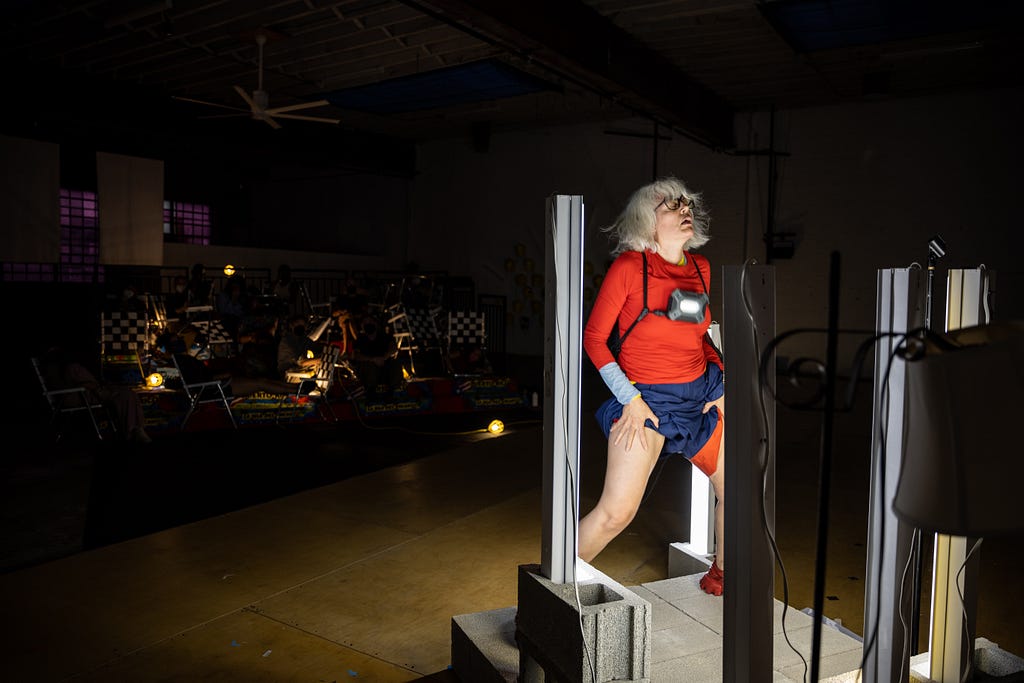
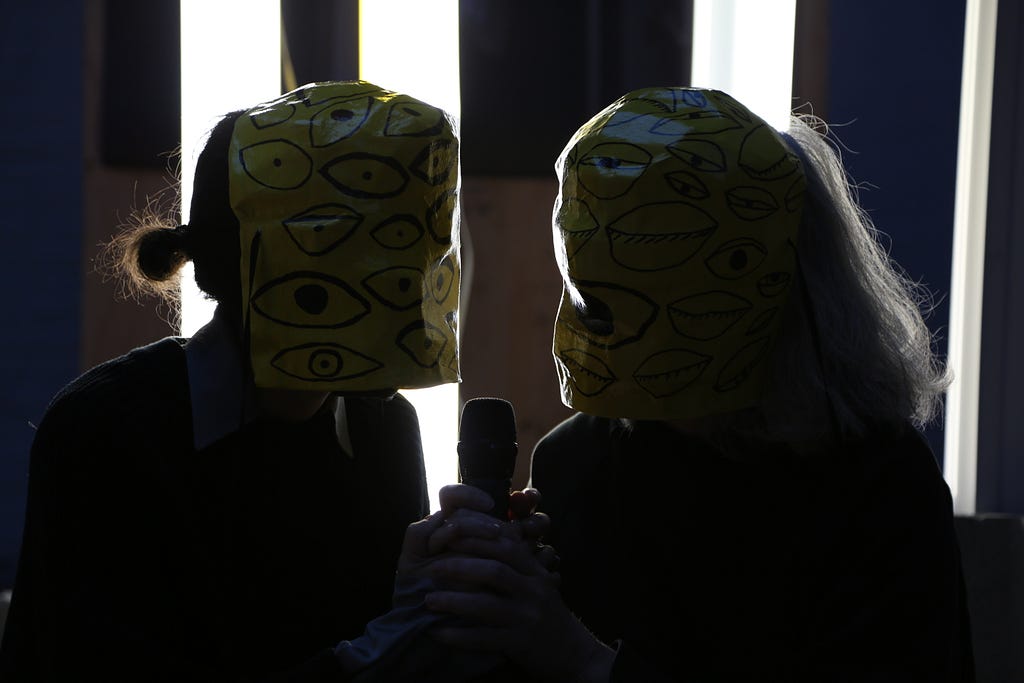
“I have complex feelings about gathering with an American public,” Castro says in a video trailer on the performance. In light of this what strikes a chord is the willing generosity and curiosity of volunteers: the desire of a performance public to do their part to complete a vision of a work. Following the exorcism, we gather close, close our eyes, and listen to the crescendo and diminution of a rain storm. We breathe and hum; we are asked to weep, though Castro alone can summon tears. She tells us, in Spanglish, that we need a ceiling, we need water, agua agua aguaguagua, food, bedsheets. Does anyone have signal? We need poder. To our feet, she instructs us to build the ceiling. Tarps and heavy-duty clips are passed around, and we construct a makeshift shelter out of the beach chairs. Some of our number climb underneath with camp lanterns. Castro, now stripped to her underwear, dances in the corner, partially shielded from view. She dons a mask, and asks someone to sit by her. Some shift to see the interaction better, others stay where they can only hear. She asks her volunteer, what was their first experience of dirt? Its sensation, taste? Who was allowed access to that patch of dirt? Was it public or private? The two share the microphone intimately, recalling.
I came here to weep asks what it means to claim nationality or be held from it at arms’ length; to be invited, by virtue of Americanness, to take part or abstain; to position ourselves so we can see what happens or shield our eyes; and to come together through a binding force that may be unity or may be social pressure. Castro writes that she questions what it means to gather, and whether assembly in and of itself entails community. As is often raised towards relational aesthetics, one is left to grapple with how assemblages brought together in the span of live performance do relate to a broader context. We readily agree to confront, embody, and undo, but the enormity of historical meaning hovers melancholically out of reach. In the process, what is hinted at are the aspects of political life as an American citizen that also register as voluntary decision rather than call to action: the privilege of buying-in and opting-out as public response to humanitarian crisis at a cognitive distance. In the space of performance, however, where we are inclined to do as others do, Castro tells us ardently: no is an action, yes is letting go into the abyss.
After they speak, Castro pulls the volunteer to their feet and begins to adorn them in an ensemble of elaborately tied Puerto Rican flags, one a forehead band, another hanging off one shoulder like a cape. She pulls out a different flag– black with white and red cursive script– to show us before mounting it to be held aloft, pointing out choice words: Sangre, revolucionario, paz. She poses the volunteer like an angel of the apocalypse, lights them from below, and sets a fan to ripple across the folds of fabric. Then, she exits.
We stay there, still and in silence, for a long time. Our volunteer valiantly holds the flag aloft. Finally, Castro’s stagehand invites them to set down their burden, and helps them off with the flags. We each decide when to leave, though it takes a few to get us going.
Sariel Golomb is an Oakland-based dancer, writer, and PhD candidate in Theater & Performance Studies at Stanford University.
A Revenge Score for Americans in Yanira Castro’s “I came here to weep” was originally published in ODC.dance.stories on Medium, where people are continuing the conversation by highlighting and responding to this story.