
Preethi Ramaprasad
“Who are we when we are not at war?”
Thus asked Surabhi Bharadwaj with her ensemble Siddhi Dance at the beginning of Finding Joy, the first part of two evening length works titled Two Folds. Described as a collaborative choreographic experience, Finding Joy used books and moving doorways as tactile props and points of departure to share dancers’ personal journeys. Laden with dynamic excerpts of ensemble choreography, I found myself hypnotized by the movement of jubilant bodies deriving happiness from being on stage together. The ensemble shared glimpses of many emotional moments ranging from nostalgia, romance, ambition, and even despair. At the end, depicting a tableau of women laughing and talking in a circle, the group ultimately realized joy in people and community.
One question I would love to see explored in further iterations of Finding Joy is how to go deeper into a narrative when the line of inquiry is derived from collaboration? For example, as facilitators of ensemble works through group tasks, how can we lay bare our stakes in a piece of choreography when dancers’ investment can sometimes be divergent and varied?
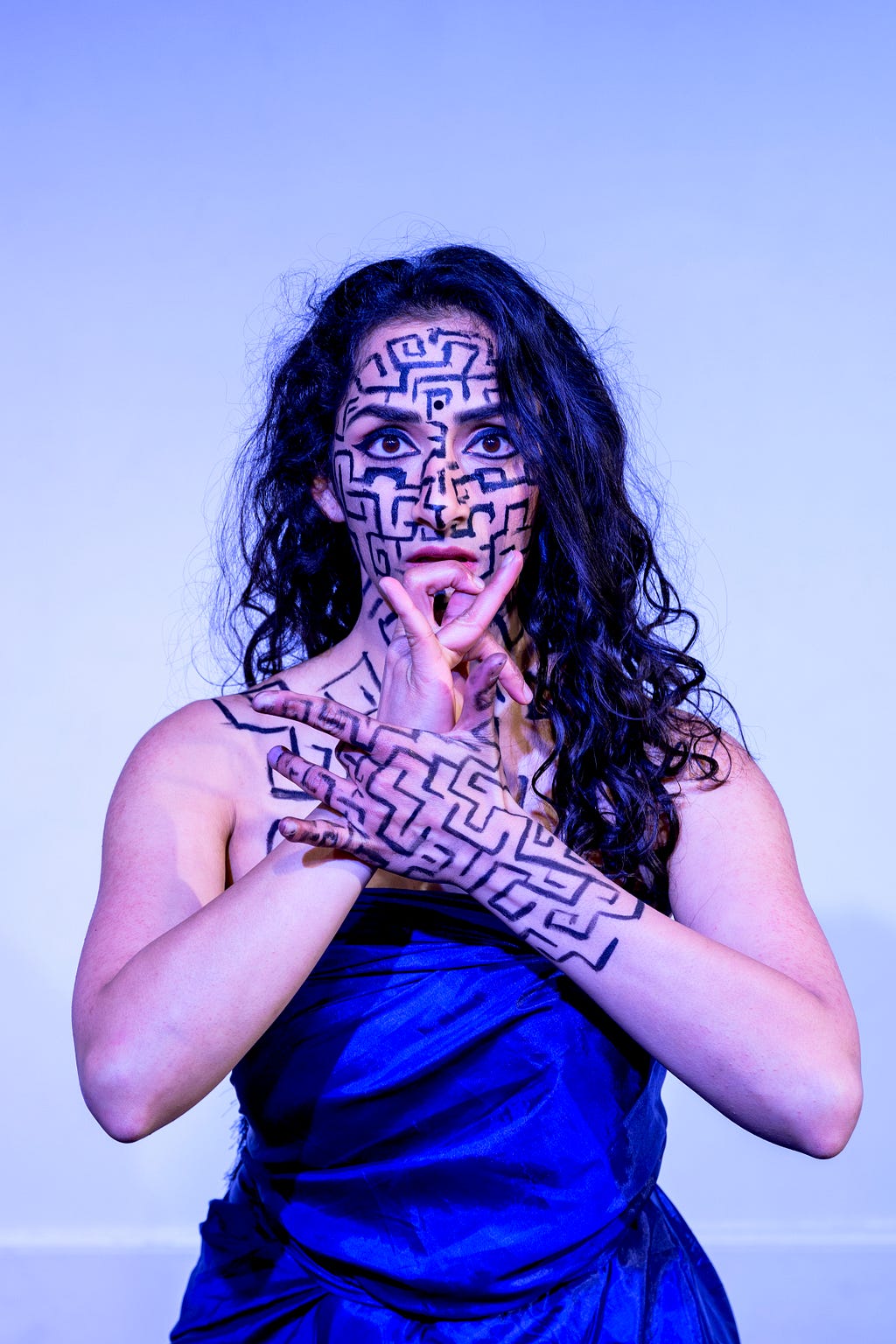
If Finding Joy was about discovery and social commentary when we are “not at war,” the second part of the evening, The Maze, was a clear critique of contemporary expectations placed on women. Bolstered by stellar technological projections by Somil Mehta, Varsha Iyengar, and Jack DiLaura, following her movements on the floor, Bharadwaj’s solo work described women’s labor through various points of life such as doing household chores and raising a child. A highlight of the show was seen when Roopa Mahadevan sang a Sanskrit verse describing the ideal woman, while Bharadwaj demonstrated its meaning through an exaggerated visual interpretation. For example, to question how “fish-like” eyes are considered beautiful, Bharadwaj donned a large pair of fake glasses. Confronting the idea of “lotus-like” feet, she shuffled across
the floor donning baby pink slippers. Mahadevan’s repetition of these descriptive terms in Sanskrit over and over again slowly led to their abstraction, highlighting for the audience the absurdity of societal bodily expectations. The excerpt was a testament to the director Veena Basavarajaiah’s approach, which focused on specificity to provide social commentary on contemporary feminism.
Presenting two evening-length works during a singular run is not an easy task, and I appreciate the labor and efforts of Bharadwaj and her team at ODC Theater. I look forward to seeing more as the choreographer further explores themes of collaboration and feminism.
Preethi Ramaprasad is a dancer, educator, researcher, and curator. She received her doctorate in Critical Dance Studies from UC Riverside.
Surabhi Bharadwaj Explores Collaboration & Feminism In Two Premieres was originally published in ODC.dance.stories on Medium, where people are continuing the conversation by highlighting and responding to this story.