
Evan Gilman
As a participant in music and in life, it can sometimes be a thrill to jump right into an experience without knowing where it will take you. Glowing pieces of glass offer us a sanitized and predetermined world, just a few brief touches away. Tap once and utter a few words, and you can be directed along the safest route to anywhere. Tap again and you can document the experience for posterity — until the heat death of the universe or a solar flare of sufficient magnitude, whichever comes first.
So I attempted to walk into Dave Malloy and William Thomas Hodgson’s Ghost Quartet without too much prior knowledge, just for the thrill. Unfortunately (or, more likely, fortunately), the universe had something else planned for me. After the most cursory search of the composer, I found that one of the original cast members at the premiere in 2014 was one of my friends from college years, Brittain Ashford. As the characters were introduced, I of course saw Veronica Renner’s portrayal of Rose Red tinted with memories of an old friend with an autoharp. But of course the piece progressed, and the talents of each player shone through old memories to make new ones.
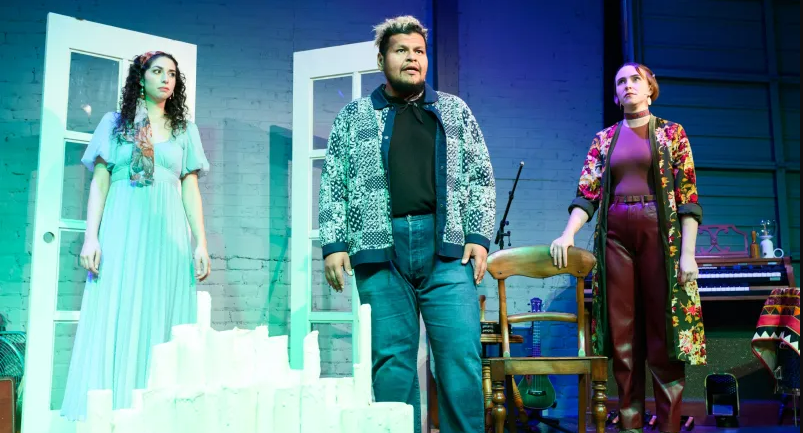
The feeling of the stage was as if stepping into a living room, the kind frequented by the more creatively driven people in my life. Victorian lampshades, a parlor organ, wicker chairs, and Persian rugs festooned with instruments of every shape. Warm lighting, and a comfortable setting to set the viewer at ease. I was ready for a close conversation between old friends, a warm and quiet chat in close quarters. But the piece started off with a strong, rousing beat. And dear reader, the story and the music didn’t seem to stop for a moment for the entire 90 minutes of the piece.
Rinde Eckert’s piano was seemingly always there, providing a solid, soulful, but transparent harmonic backing. Monica Rose Slater’s clear voice and prepared piano brought alternately thrilling, humorous, and haunting vibrations to the stage. Veronica Renner’s narrative song sung through clear as a bell, while Michael Perez’s storytelling refrains brought the structure of the piece together. Not least, Ami Nashimoto’s superior intonation and electrifying playing on the cello drove the music with a solid hand. The amount of work in simply learning the diverse stories and parts for each character / player seemed daunting, to say nothing of the energy each brought to the stage with their very presence.
The music and song ran the gamut here. Favorable comparisons could be made to anything from Gillian Welch, Tim Buckley, or even Warren Zevon’s Roland the Headless Thompson Gunner to completely contemporary stylings reliant on percussion and prepared piano pandemonium. Often the characters would go head to head, bringing the music to a crescendo or sweetly descending into darkness.
Each of the songs on the four “sides,” or chapters, of the piece called back to a theme based on a character, or created a new paradigm within the language of the piece. A veritable grimoire of styles invoked deities high and low, and consanguine with the story, ended in a murder ballad sung together with the audience.
Trying to corner this piece into fitting a preconceived notion of what music and theater can be is going to be a fruitless effort. The only way to experience it is to sit back and enjoy the ride. In the wise words of Dr. Gonzo “Don’t try and fight it. You’ll get brain bubbles, strokes, aneurysms.” Put more gently, “Try not to follow a plot or you’ll just get mad,” a source with more direct knowledge of the piece said. Sage expositions, both.
If you’re fortunate enough to see this piece, keep watch for The Astronomer, whose scenes included a complete change in lighting and mood. Look forward to the dramatic interaction of Scheherazade and Dunyazad. Raise your glass to four notable whisk(e)ys, tastefully yet playfully arranged in a good tasting order, with the vaunted and peaty Lagavulin bringing up the finale. Expect moments of levity, but also hard looks at mortality. Keep an ear to the rail for mournful renderings, but don’t be surprised if tears of joy interrupt your reverie. Make sure to watch, but look forward to participating as well.
Better yet, don’t expect anything at all. You’re in for a ride.
Evan Gilman is a musician, photographer, and coffee professional living in Oakland, CA. He has performed with Gamelan Sekar Jaya at ODC, the SF Symphony, the SF Ethnic Dance Festival, and many other engagements. His passion for both contemporary and traditional music has informed his travels, his photography, and his own compositions for guitar and percussion.
A Quartet Tête-à-Tête in Dave Malloy’s “Ghost Quartet” was originally published in ODC.dance.stories on Medium, where people are continuing the conversation by highlighting and responding to this story.