
Megan Nicely
In How to Do Nothing, Jenny Odell asserts that our hyper-connected, tech-driven world offers endless opportunities to “do,” yet this attention-grabbing economy erodes our capacity to engage with the physical world. She advocates resisting the capitalist imperative to produce, stepping away from digital distractions, and instead redirecting ourselves toward embodied presence and immediate environments. Real engagement requires cultivating stamina for a different kind of attention — not toward something, but toward nothing. In Buddhist thought, “nothing” aligns more closely with emptiness: the understanding that all phenomena, including the self, are transient assemblages of interdependent parts, devoid of fixed essence.
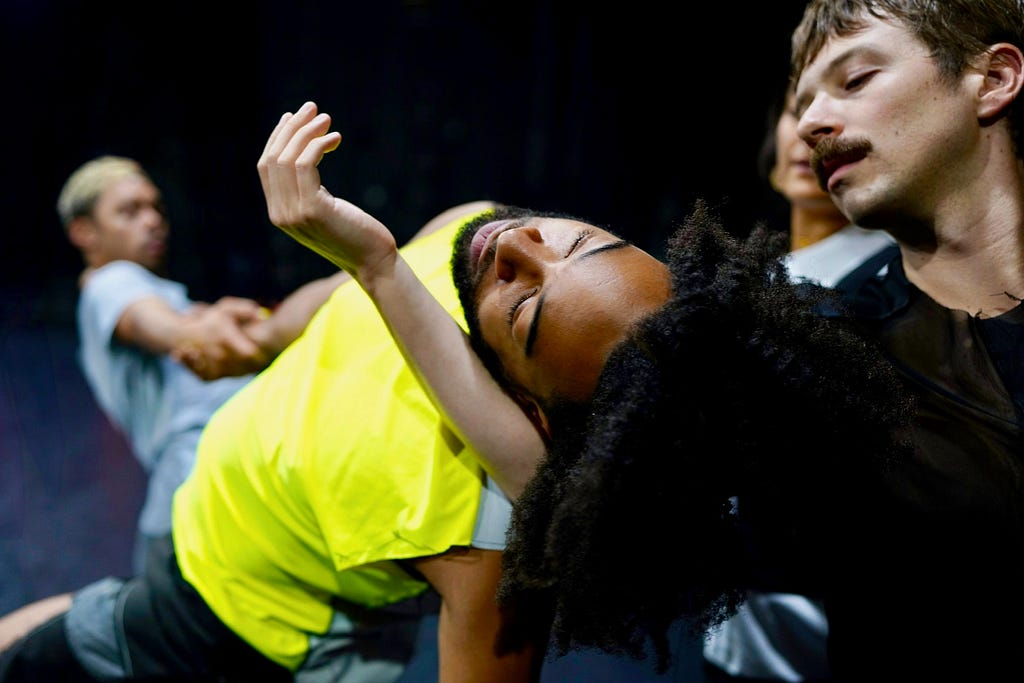
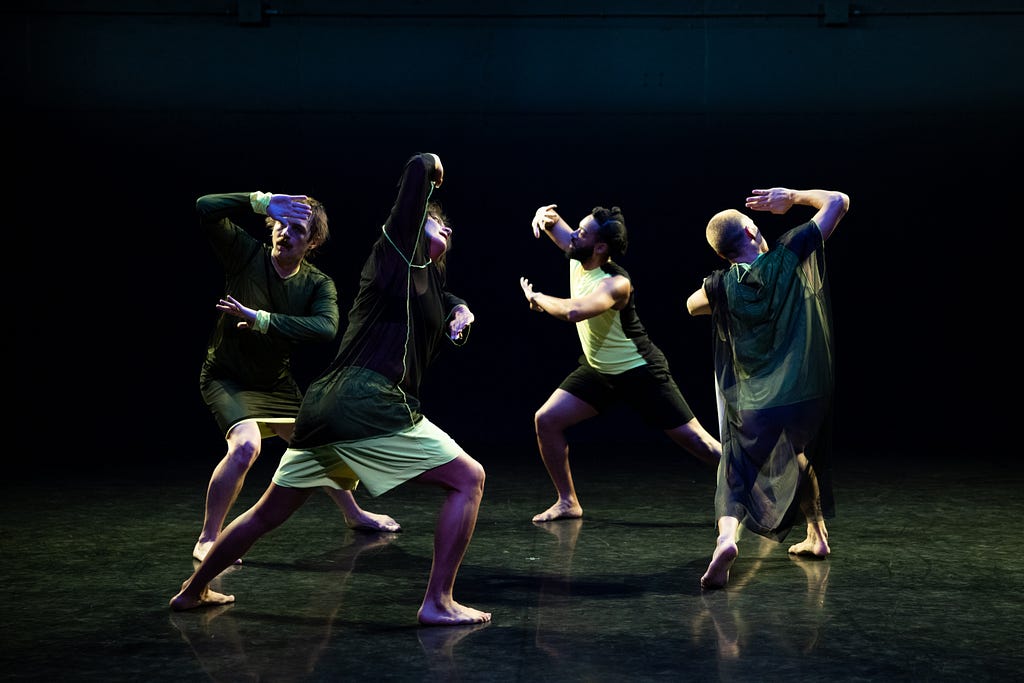
Miguel Gutierrez’s recent piece Super Nothing, performed at ODC Theater February 28-March 2, navigates this something/nothing paradox. The four dancers — Jay Carlon, Justin Faircloth, Wendell Gray II, and Evelyn Sanchez Narvaez — engage in nearly nonstop movement, accompanied by Rosana Cabán’s sound design. The visual excess produced by their hyper-mobility feels deliberately overwhelming, even as their project remains rooted in the physical body and their onstage relations rather than in digital arenas. Stylistically, technical precision is evident in the clarity of lines and acute spatial awareness, yet this virtuosity is simultaneously discarded as the forces of movement exceed set forms. Shapes temporarily arise only to be pushed beyond as dancers hurl and fall through the space, or vibrate in place. The incessant agitation supports the view that dance labor produces nothing — its product is ephemeral, even if momentarily visible.
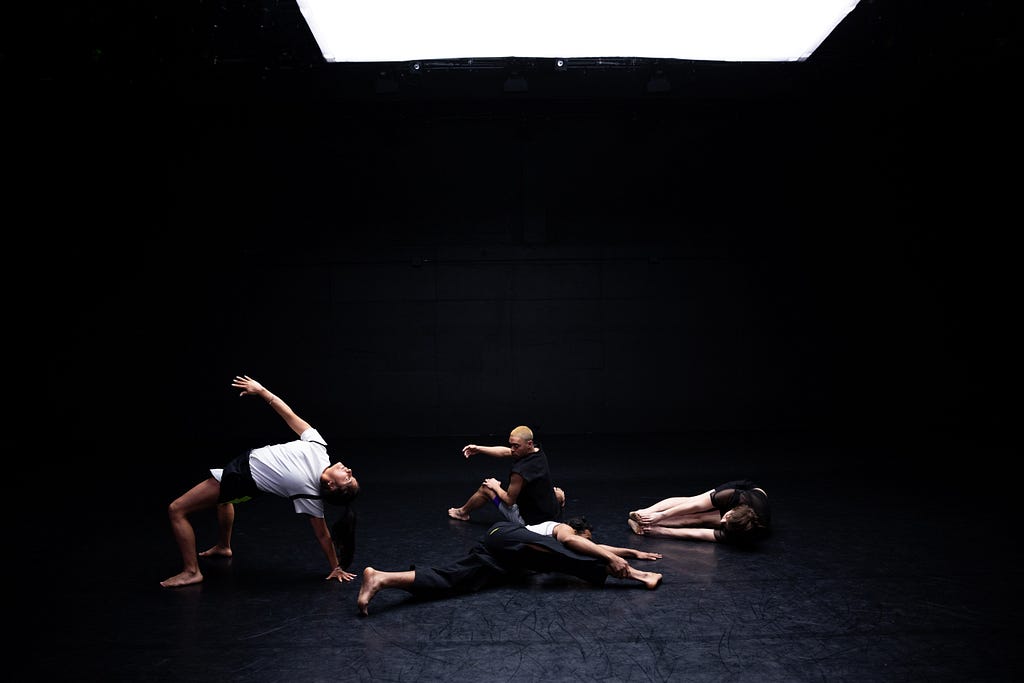
Amid this kinetic onslaught, moments of coherence emerge, suggesting that while the dancers embody a fractured mode of attention, they also remain in relation. I got the sense that a collective effort to try out options is underway, as the bodies move from one idea to the next. At one point, a dancer moves up the center aisle into the audience; at others dancers step off the front of the performance area, remain in shadow far upstage, or leave the stage completely. A mid-performance costume change results in black, grey, and neon yellow attire suggestive of safety gear, perhaps stepping up the need for care. At two points, all four dancers gather center stage, offering a brief respite that reveals their deep sense of connection. A section of repetitive unison movement near the works’ conclusion further reinforces their ability to unite. Toward the end of the piece, the dancers move downstage, individually executing gestures that vie for audience attention. Other strategies reinforce this theme as well, from the variable lighting effects that wash over the audience in shifting colors to the pre-show voice, beautifully signed by Pilar Marsh, that asks us to “pay attention” while inquiring “what will happen to us?” and “why not give all?”
However, in the piece’s final image, a different energy emerges, one that contrasts sharply with the relentless “doing” of the prior hour. The dancers are evenly spaced and effortlessly poised at the upstage periphery, arms extended horizontally and rotating slowly in the dimly lit area. Moving together with shared purpose, they slowly exit one by one through the door, stage right. The image evokes wind turbines — structures that harness kinetic energy without depletion, offering a model of sustainability that is both non-extractive and collaborative. Here, I could finally relax. The adage “less is more” resonated. Like windmills drawing power from the air, the dancers seemed to generate a new kind of attention — one that required no excess, only attunement to what was already moving through them. In this quiet shift at the piece’s conclusion, a different kind of something — or nothing — emerged.
Megan Nicely is an artist, scholar, and educator whose research involves choreographic experimentation through the medium of the body. Recent projects include the book Experimental Dance and the Somatics of Language (2023, Palgrave) and an evening of performance work titled humXn forms (2024, SFIAF). www.megannicelydance.org
Why Not Give All To “Super Nothing” was originally published in ODC.dance.stories on Medium, where people are continuing the conversation by highlighting and responding to this story.