
Garth Grimball
Alvin Ailey and Alvin Ailey American Dance Theater will forever be associated with Revelations. It is a masterwork and likely the most performed, most widely seen dance in the Modern Dance canon since the genre began over a century ago.
Due to its reputation and influence, many new works commissioned by AAADT are in conversation with Revelations whether they intend to be or not. To choreograph on AAADT is to contribute to the artistic lineage that houses Revelations.
On Wednesday, April 10, Alvin Ailey American Dance Theater presented a triple bill at Zellerbach Hall as part of their annual tour to Berkeley that did not include Revelations, but the content of each work invited comparisons.
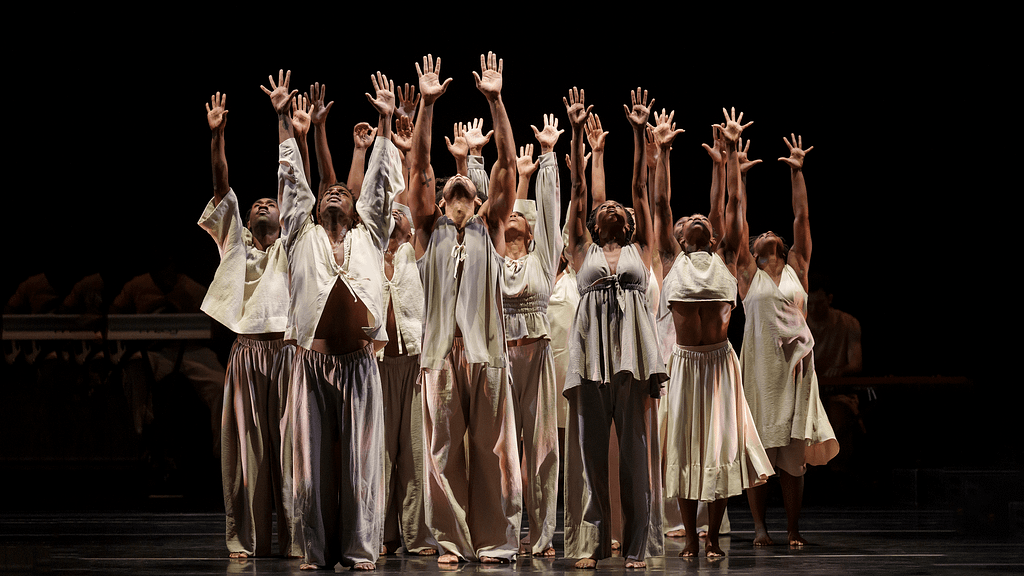
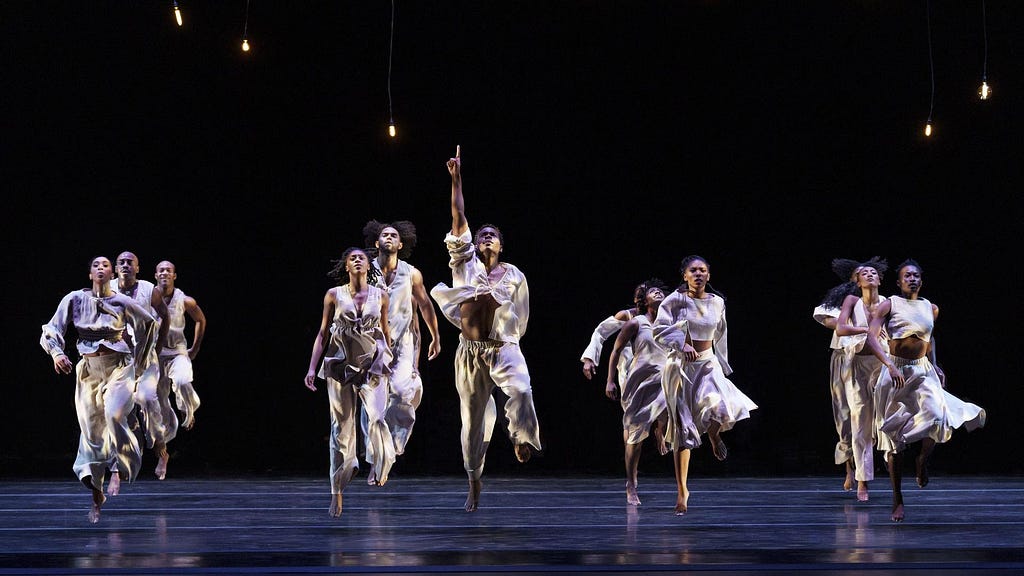
First was Sacred Songs (2024) from interim artistic director Matthew Rushing. It is an episodic group dance to music used in the original 1960 premiere of Ailey’s seminal Revelations but later omitted when the piece was edited into the current version we see today. But the original intimate recordings that prioritized the vocalists are replaced by Du’Bois A’Keen’s arrangements that sound like the praise music performed in megachurches — big drums, rocking bass lines, and singing that can fuel a rocket. The sonic effect made the dance feel both big and small; the choreography was either uplifted by or in competition with the music’s energy.
Rushing’s choreography foregrounded ensemble building. The majority of the ten sections featured either group dancing or group witnessing of soloists. Corrin Rachelle Mitchell, Christopher R. Wilson, and James Gilmer assembled in the background like three Graces as the cast of ten dancers entered the space in flowing sand-colored separates. Andre A. Vazquez’s lighting design shifted between ambers and blues. A center spot returned throughout the Sacred Songs like a halo or a pool of water. Individual bulbs lowered into the space like stars floating over the dancers.
Sacred Songs has a lot of dancing but not a lot of personality. The dancers run, leap, lunge, turn, gesture, lift, recline, prostrate, and reach to the sky. But amidst the virtuosity lacked a specific sense of humanity. Revelations is virtuosic and the choreography invites individual character from each dancer who inhabits the movements. In Sacred Songs the faith was starry bright but the personal was eclipsed.
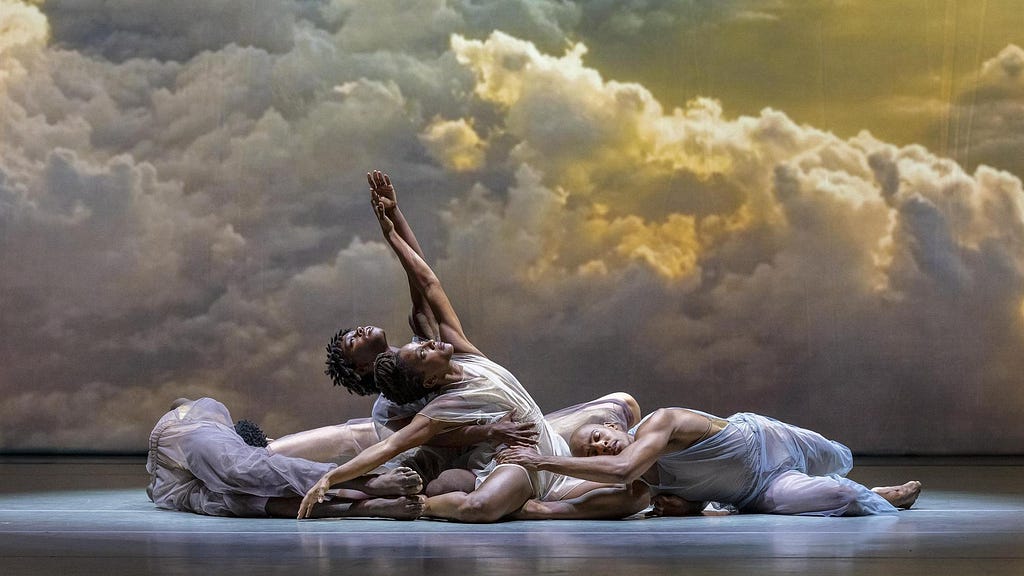
Lar Lubovitch brought a theosophical slant in his tender Many Angels (2024). In the program Lubovitch quotes Saint Thomas Aquinas’ theoretical question, “How many angels can dance on the head of a pin?” While the quotation illustrates that some questions are best answered with faith instead of logic, Many Angels unspools logically like a bobbin rolling in circles, trailing and collecting its thread. The quintet danced to Mahler’s Adagietto from Symphony №5 in C-sharp minor in front of a celestial backdrop designed by Lubovitch. Gilmer, Samantha Figgins, Miranda Quinn, Christopher R. Wilson, and Vernard J. Gilmore circled and enveloped each other. A motif of bent arms and legs developed as the dancers linked or settled from high demi-pointe into deep plie. The choreography required frequent weight shifts at a slower tempo that proved subtlety is also virtuosic.
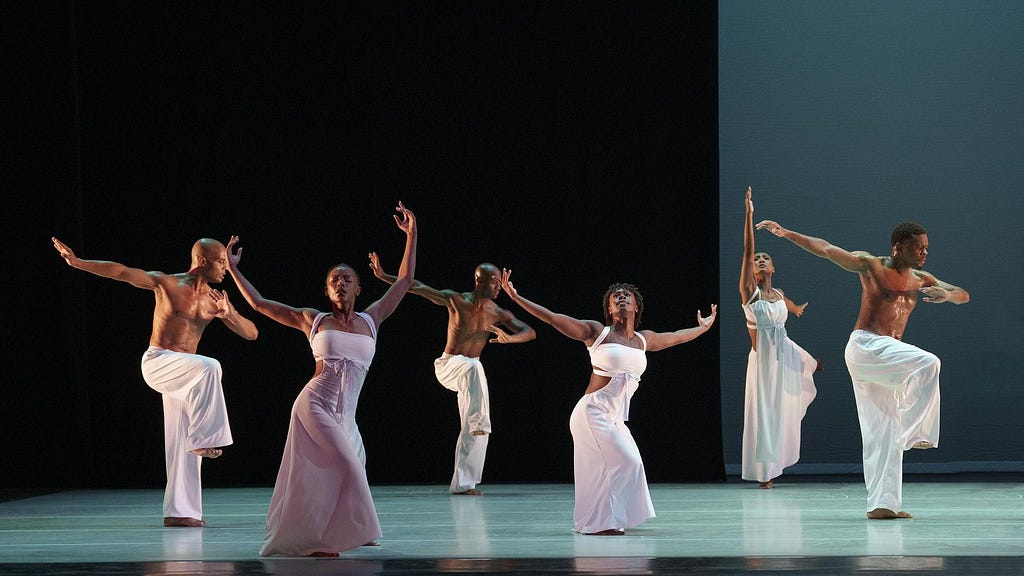
When Revelations is on a mixed-repertory program it is the closer. It is both a mission statement and the greatest crowd-pleaser. Grace (1999) by Ronald K. Brown is a worthy alternative. It does not emulate Ailey’s classic but it feels charged by the same sense of spirit. With music by Duke Ellington, Fela Kuti, Paul Johnson, and Roy Davis Jr, the 11 dancer-ensemble burst across the stage in overlapping horizontals of West African and modern dance.
The stage was bifurcated by an upstage columnar opening. Dancers entered in either red or white costumes Omatayo Wunmi Olaiya. Each dancer was seamless in transitioning from single leg balances to body rolls to leaps and turns at varying rhythms. Brown wisely did not choreograph directly to the musical phrasing of each song, but created a physical phrasing that propels the movement continually through each song.
Unlike in the previous two works, the dancers were not dancing with each other so much as they danced for the space entrusted to them. Grace finds the spirit on the dance floor.
Garth Grimball is a dance writer and artist based in Oakland, CA. He is a contributor to SF Examiner and Dance Media. He is the editor of ODC Dance Stories.
Three Paths To Rapture From Ailey (without “Revelations”) was originally published in ODC.dance.stories on Medium, where people are continuing the conversation by highlighting and responding to this story.