
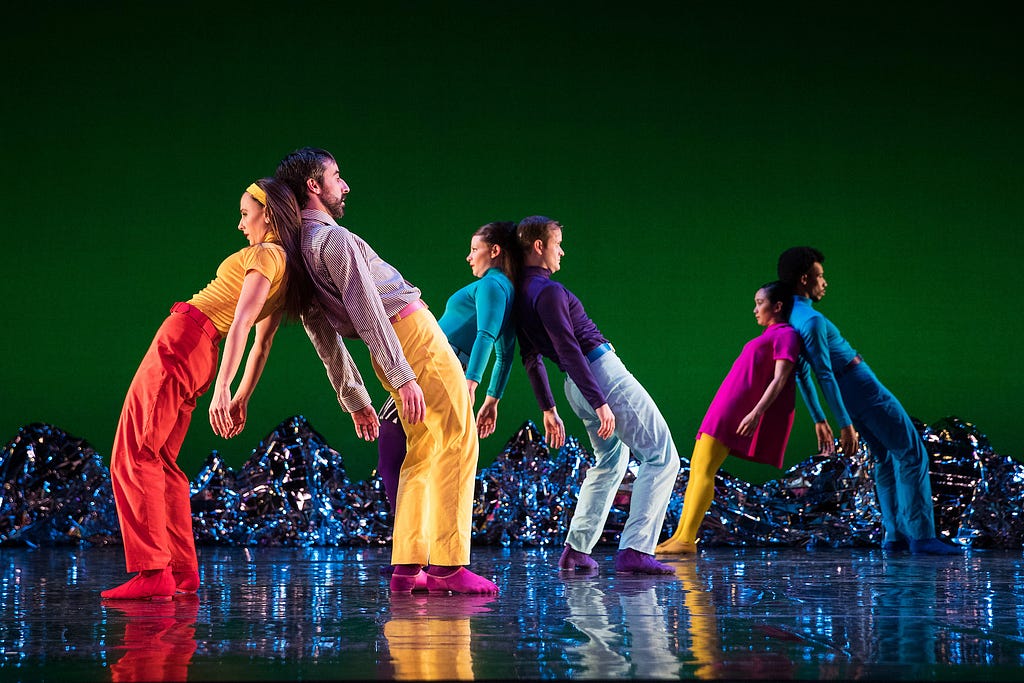
“Pepperland” — Cynical Cash Grab Or Pastiche Passion Project?
Garth Grimball
The Beatles’ eighth studio album, Sgt. Pepper’s Lonely Hearts Club Band, was a watershed moment in pop music history. Its use of early sampling technology created sonic collages akin to its iconic album cover, and it became the unofficial soundtrack to the 1967 “summer of love.” Fifty years later, Mark Morris Dance Group premiered Pepperland, and while no tribute could match the impact of the album, it is hard to say why this dance exists. Its lack of any real perspective makes it a challenge to view it as anything other than pandering to Boomer nostalgia, or, perhaps Morris just wanted to spend time in the studio with one of his favorite albums?
Morris can always be thanked for his dedication to live music, and Pepperland is no exception. The best part of the production is the interpretation and arrangement of the Fab Four’s songs with original scoring by Ethan Iverson. Rob Schwimmer, the theremin player, was a standout.
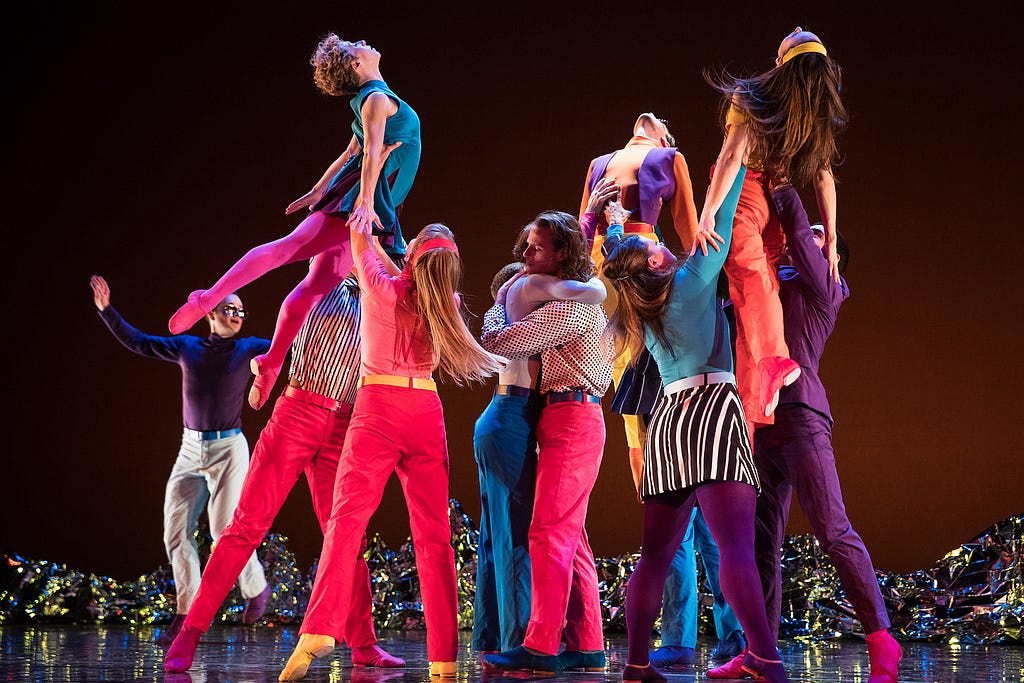
Pepperland opened with the title song. The crescendo into “Billy Sheeeeeeeears!” extended to a replication of the album cover — “And now introducing Sonny Liston, Greta Garbo, Marilyn Monroe…” as dancers walked onto stage dressed in psychedelic-colored separates with sunglasses and struck a pose.
I’ve seen MMDG easily 10 times, from the classics (L’Allegro; The Hard Nut; Mozart Dances) to opera collaborations (Acis and Galatea) to other historical reinterpretations (Spring, Spring, Spring) to works by Morris on ballet companies (Drink to me only with thine eyes), and whether you are a fan of his work or not, the man knows the craft of choreography expertly. Which is why Pepperland is so disappointing, it is lazy. The entire dance is either unison or canon with a few solos. Every group dance waffles between everyone doing the same thing at the same time or everyone doing the same thing at different times. While this type of structure is foundational to Morris’s folk dancing roots, it never revealed depths in the music, as he is famous for doing. How is it that a tribute to counter-culture could be so uniform?
As I watched it I became less convinced that Pepperland is a tribute — a love letter anchored in specifics that invites viewers to see the familiar anew — and more resigned to the dance being the equivalent of scrolling through a Google image search of the late 1960s America: a man meditating, a group doing a military crawl, so much hand holding. Again, there is no perspective as to how, what or why these references exist, they just happen in between the spritely jumps and bent-leg turns common in the MMDG repertoire.
While comparison may be critically cheap, I think it is merited in this instance. Paul Taylor’s Company B is similarly a tribute dance to pop music. Taylor choreographed peppy lindy, jitterbug and polkas to the songs of the Andrews Sisters to transport audiences to the era of WWII USA. Crucially, behind the jubilant Americana there are shadowy figures collapsing and dying; nostalgia is dangerous, do not look to the past through a rose-colored glass. This is a perspective well realized via dance.
Pepperland offers no insight. It is too busy waving at the past.
Garth Grimball is a dance writer and artist based in Oakland, CA. He is a contributor to SF Examiner and Dance Media. He is the editor of ODC Dance Stories.
“Pepperland” — Cynical Cash Grab Or Pastiche Passion Project? was originally published in ODC.dance.stories on Medium, where people are continuing the conversation by highlighting and responding to this story.