
Nkechi Njaka
SF Danceworks’ Season 8 offered more than a repertory performance. It delivered a curated experience, where each piece stood on its own while contributing to a larger conversation about the evolving shape of contemporary dance, and perhaps more specifically — the future of contemporary dance in the Bay Area. The evening featured Yue Yin’s A Measurable Existence, JA Collective’s world premiere Everything Happens Later, and the North American debut of Emma Portner’s elephant. Season 8 did not necessarily aim for cohesion through uniformity or style of movement. Instead, it embraced something more fluid and decidedly more interesting: a curatorial model of contemporary dance that prioritized difference of perspective and training.
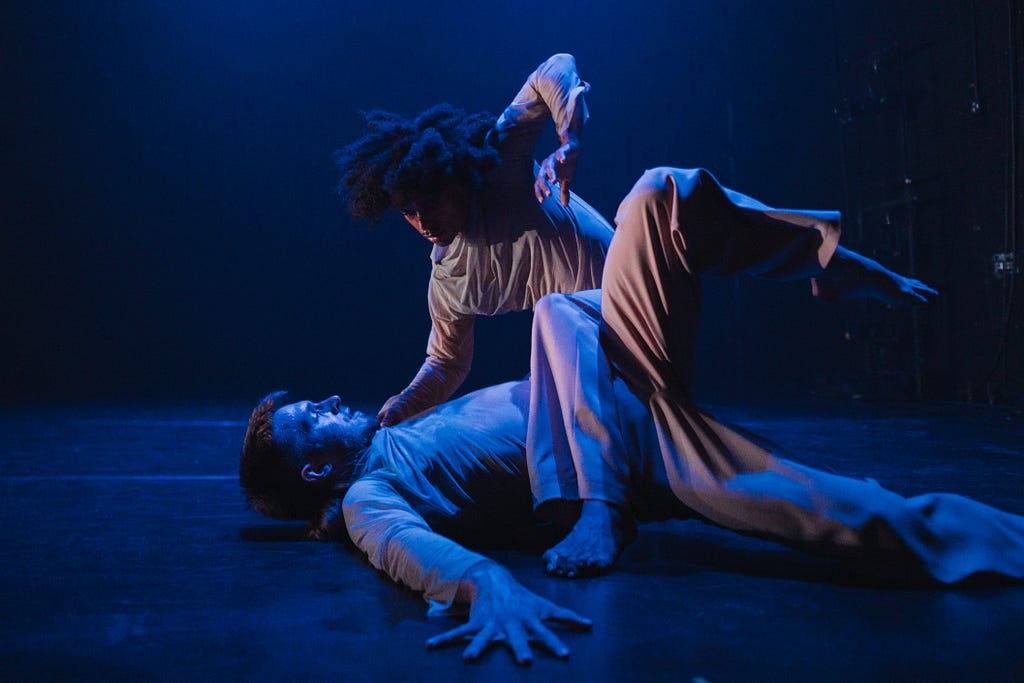
The evening began with Yue Yin’s A Measurable Existence: a thoughtful, rigorous duet performed by Nat Wilson and Ja’Moon Jones. Both wore dust colored long sleeve shirts and pants that moved unrestrictively through the demands of the movement while asking the audience how human existence is shaped, shared, and remembered through our relationships with time, space, and each other. The work was created during the pandemic in 2020, the choreography was rooted in both contemporary and Chinese folk traditions with music by Rutger Zuydervelt. It demanded endurance and precision, and the dancers moved together with athletic sensitivity — folding, lifting, and spiraling. Lighting played a significant role in framing their contact and absence. There was a striking moment about half way through where the light, a dramatic golden orange, dropped down from the rigging and filled a portion of the stage; a moment of stagecraft that instantly unified the audience in the present tense. The result was powerful, physically grounded and relentless, yet extremely tender in its inquiry.
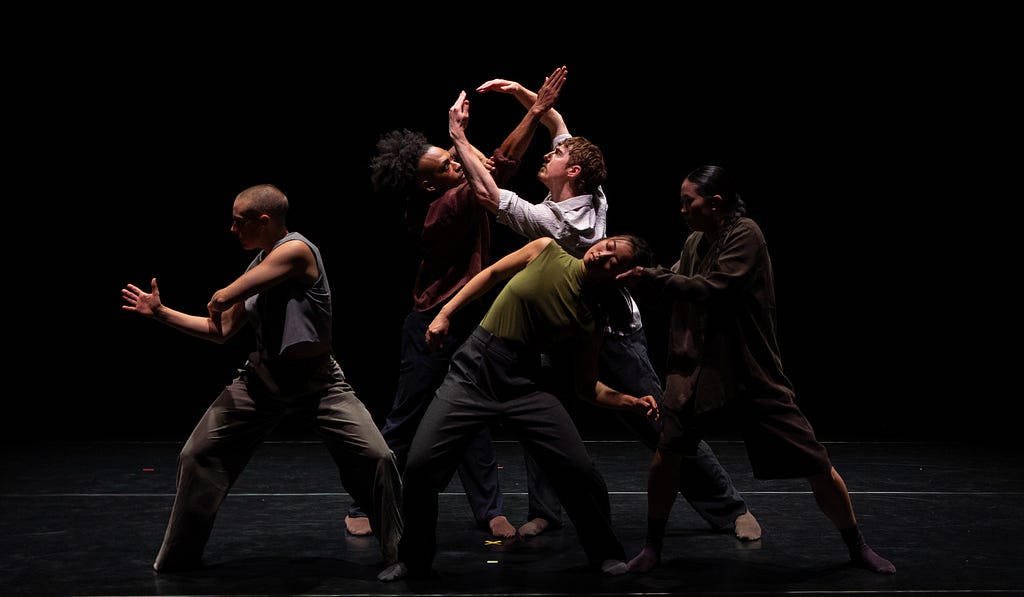
The tone shifted with JA Collective’s Everything Happens Later, which was a more playful and emotionally complex ensemble work performed by five dancers — SFDW regulars Lani Yamanaka, Emily Hansel, and Sarah Chou alongside Riley O’Flynn and Ja’Moon Jones. The movement, set to music by Daniel Mangiaracino, began with a mechanical, almost industrial sensibility — bodies ticking like gears, as though to mimic systems, organizations of transportation or time. And while that felt extremely present, a vivid humanity also existed within this structure. JA’s signature style is somehow both abstract and theatrical and found pockets of relationality in this premiere by blending impeccable unison while maintaining a loose improvisational feel. The work felt like a conversation among friends — filled with wit, tension, and moments of exquisite synchronicity. There was an unexpected musicality in the dancers’ timing, with vocabulary that were both expansive, intricate, and emotionally precise. Watching it unfold was stunning — like witnessing a coded language being built and translated in real time.
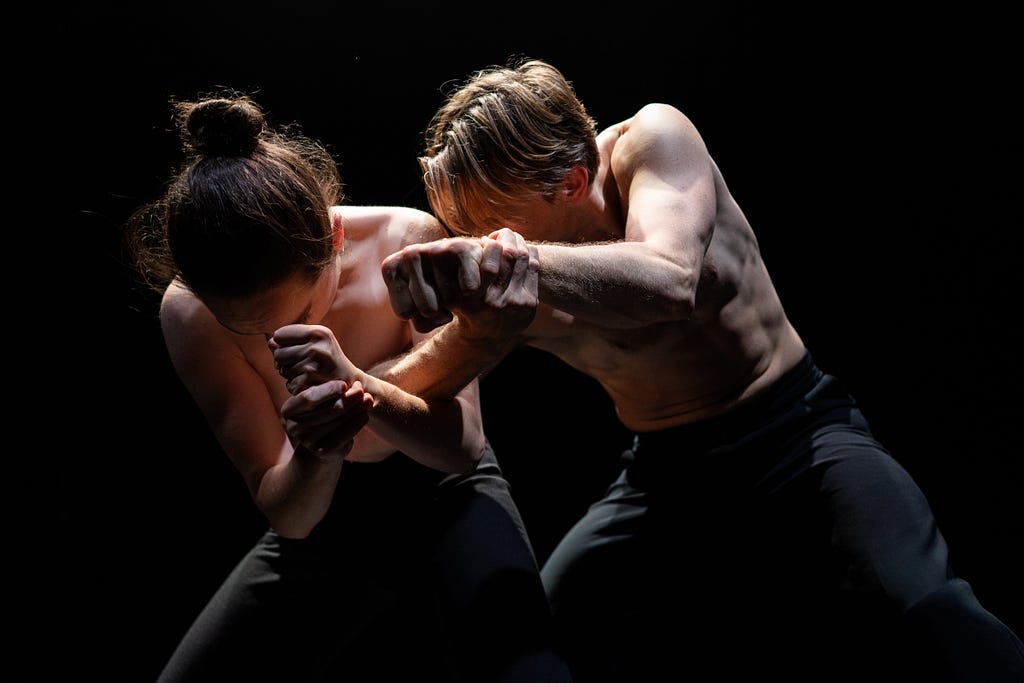
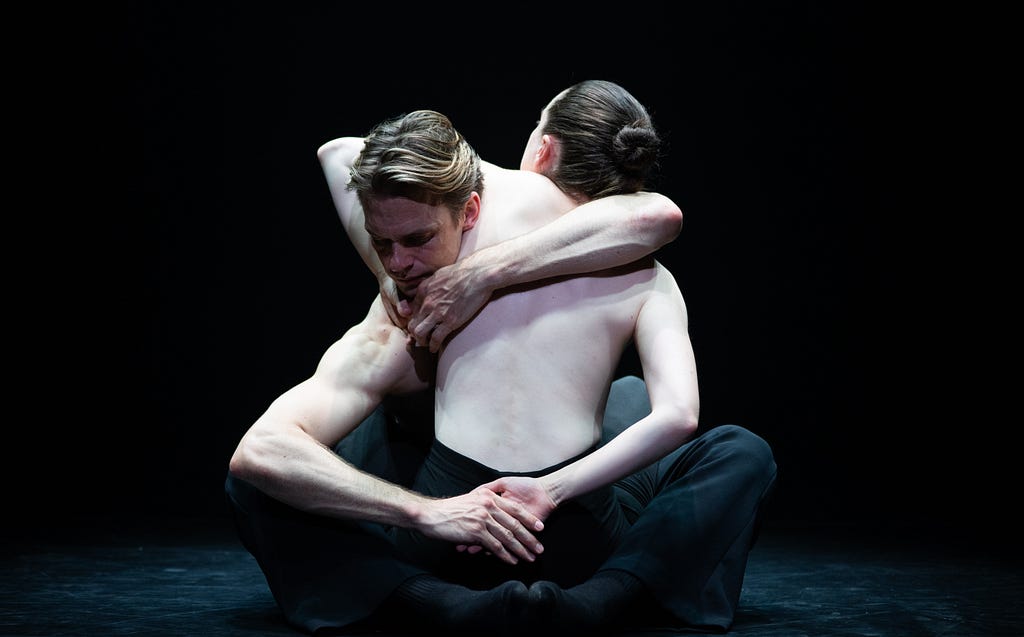
Closing the program was Emma Portner’s elephant, a duet of stunning intimacy and haunting vulnerability performed by Portner and Brett Conway. It began with the two dancers shirtless and exposed under sculpted lighting, positioned seated somewhat like a pretzel, limbs entangled. Set to the music of Alexander Mckenzie, the emotional intensity of embodiment was made that much more visible through the exposure of skin, muscle and bones. The duet eventually rose to move across the stage in a trusted conversation. Created in the wake of Portner’s diagnosis with trigeminal neuralgia, elephant became a raw investigation into pain and relational presence. The choreography was seemingly minimal at times but dense, with weight-sharing that felt simultaneously heavy and fleeting. Stillness punctuated their connection, as if silence itself carried their weight. Their duet was as much about what was withheld as what was offered. This created a captivating space of tension, surrender, and vulnerability .
What emerged across these three works was not a singular technical ethos or a unified aesthetic presented as a through line. But rather, something more fluid and expansive — a model of an evening of curated contemporary dance that prioritized diversity of perspective over uniformity of training. Rather than relying on a fixed ensemble or shared vocabulary, SF Danceworks functions like a curatorial platform. Artists were gathered around choreographic vision, not institutional belonging, and this flexibility allowed for dynamic casting, intentional partnerships, and richly textured programming. Season 8 revealed a constellation of artists and ideas — intimate, stunning, and utterly alive.
Nkechi Deanna Njaka (she/her) is a practice-based creative researcher, choreography artist, public speaker and culture writer whose work explores the intersection of embodied presence, somatic research, well-being, science, art, and social practice. She is the founder of The Compass, NDN lifestyle studio, and co-founder of the sleep app DreamWell, emphasizing mindfulness and creativity as essential for individual and global well-being.
SFDanceworks Produces A Curated Constellation Of Contemporary Voices In Season 8 was originally published in ODC.dance.stories on Medium, where people are continuing the conversation by highlighting and responding to this story.