
Garth Grimball
The 2025–2026 season marks Amy Seiwert’s first season as Smuin Ballet’s artistic director with total curatorial responsibility. Based on this fall’s triple bill program, “Extremely Close,” the company has a promising future under her direction.
Justin Peck’s Partita opened with his signature ensemble work that has the dancers dancing for each other and for the audience. Partita is set to Caroline Shaw’s Pulitzer Prize-winning a cappella composition (recorded in this program) that is inspired by the works of Sol LeWitt. Reid & Harriet’s costumes evoke LeWitt’s color blocking with monochrome separates that Brandon Stirling Baker’s lighting design imbues with a gray-scale, as if the colors come from a weathered past.
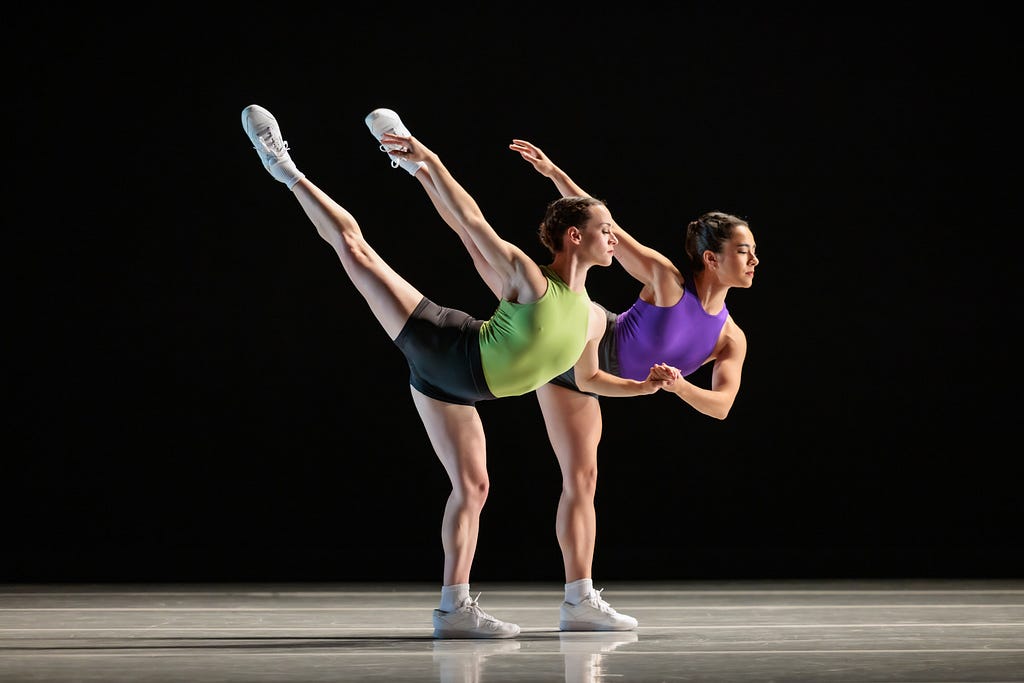
In the past few years Peck’s ballets have really leaned into his kumbaya-run-downstage-look-at-the-audience-hug-and-huddle tendencies. His choreographic craft is matched by his sentimental nature. Fortunately, Partita showcases more craft than sentiment. Shaw’s composition is brilliantly textured with vocal modulations and rhythms. The octet moves with and against the staccato vocals, sometimes leading, sometimes responding. Peck’s architectural choreography feels more muscular than usual — there are flexing arms, yes, and there is a weight to his weight shifts that exploits the possibilities of dancing in sneakers.
Gabrielle Collins and Cassidy Isaacson danced one of Peck’s best pas de deux. The choreography organizes like overlapping construction blue prints. Lines molded into folds. Support shifted from one point to many and back to one. Arms spoked out and bent inwards. Collins and Isaacson balanced alone and together.
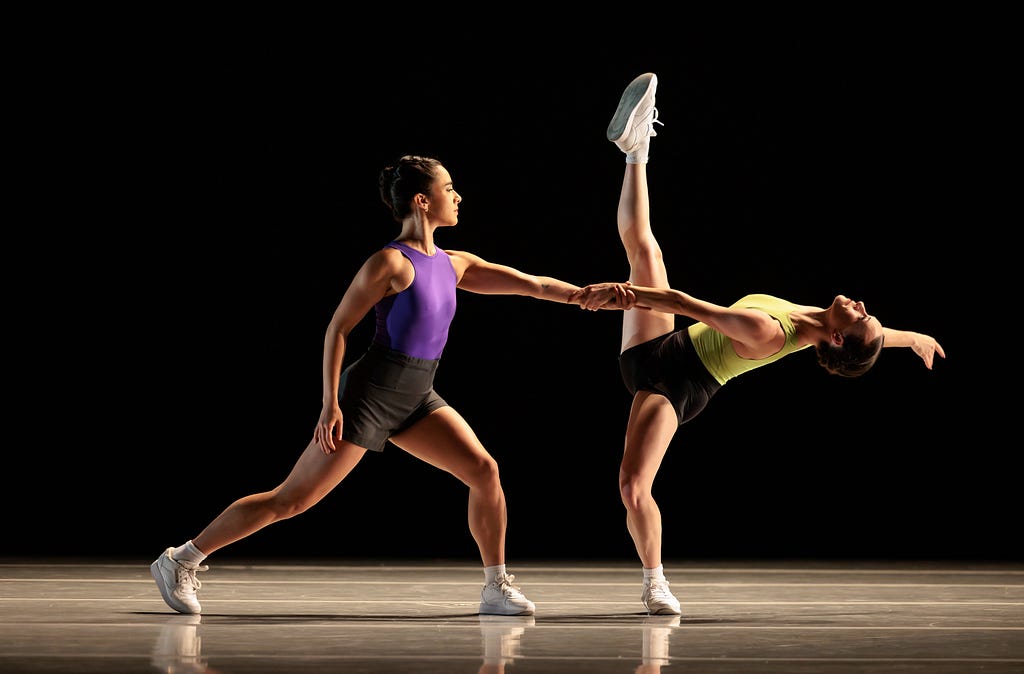
A signature style of Peck’s choreography is the speed of shifting weight. His movement changes directions like a sling shot — long pull into a blink-and-you’ll-miss-it pop. It was this quality the Smuin dancers most struggled to embody, with the exception of Maggie Carey, who anchored Partita in bravura solos in which she seemed to extend into every possible diagonal.
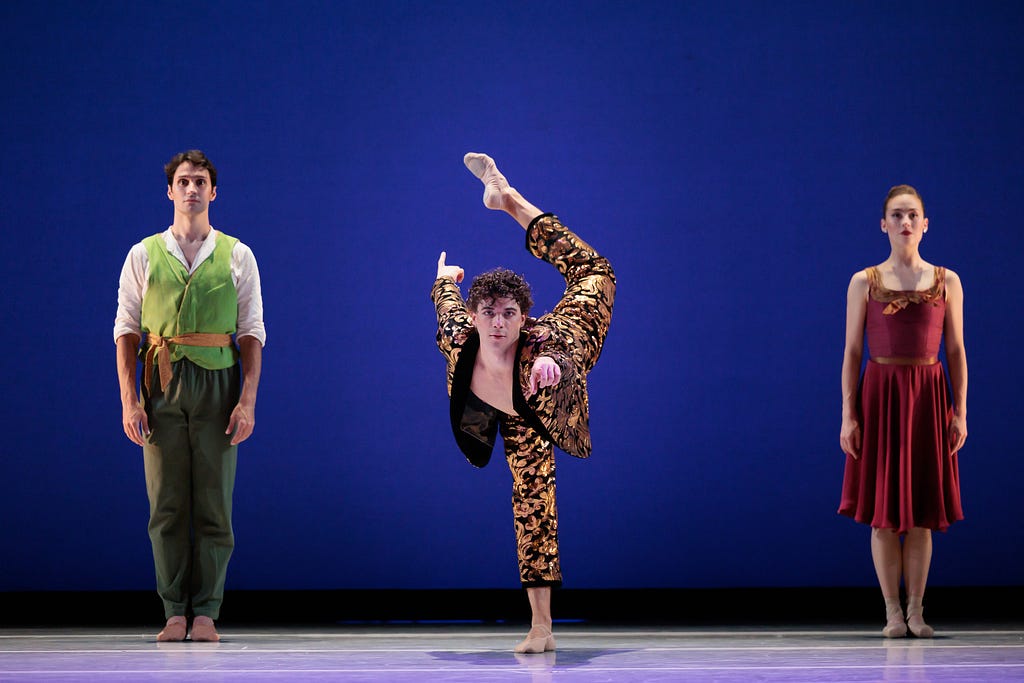
Seiwert’s A Long Night, originally made on BalletX, is a distillation of the lovers plot from A Midsummer Night’s Dream. It was the only ballet on the program with pointe shoes and followed in Smuin Ballet’s long tradition of ballets to pop music. At their worst these ballets can feel like choreographically thin cash grabs relying on a singer’s popular discography to sell tickets. At their best they explore the connective tissue in popular lyrics, melodies and narratives. A Long Night is in the latter camp. To music from Patsy Cline, Doris Day, Harry Nilsson, and more, Puck and the four lovers leapt into the Shakespearean high jinks.
Collins showed impressive control as Puck. Many of her phrases ended in balancing out of attitude turns. Dressed in a sequin suit she brought her own madcap emcee attitude to the spritely forest faery. Brennan Wall, João Sampaio, Isabel Borges, and AL Abraham were appropriately expressive as the lovers. Pop music does much of the narrative work in this distillation, so the lovers are less individual characters than they are big emotions: passion, frustration, zeal, disappointment. Seiwert excelled in balancing big reactions with partnering and musicality.
I found Seiwert’s choreography for and Wall’s performance of Hermia to be the most memorable interpretation in A Long Night. When you love someone who doesn’t love you back, the whole world feels like an unrequited partner, not just the object of your affection. Seiwert kept Hermia visibly separate from the other lovers, so the frustration and disappointment felt bigger than chasing after one man.
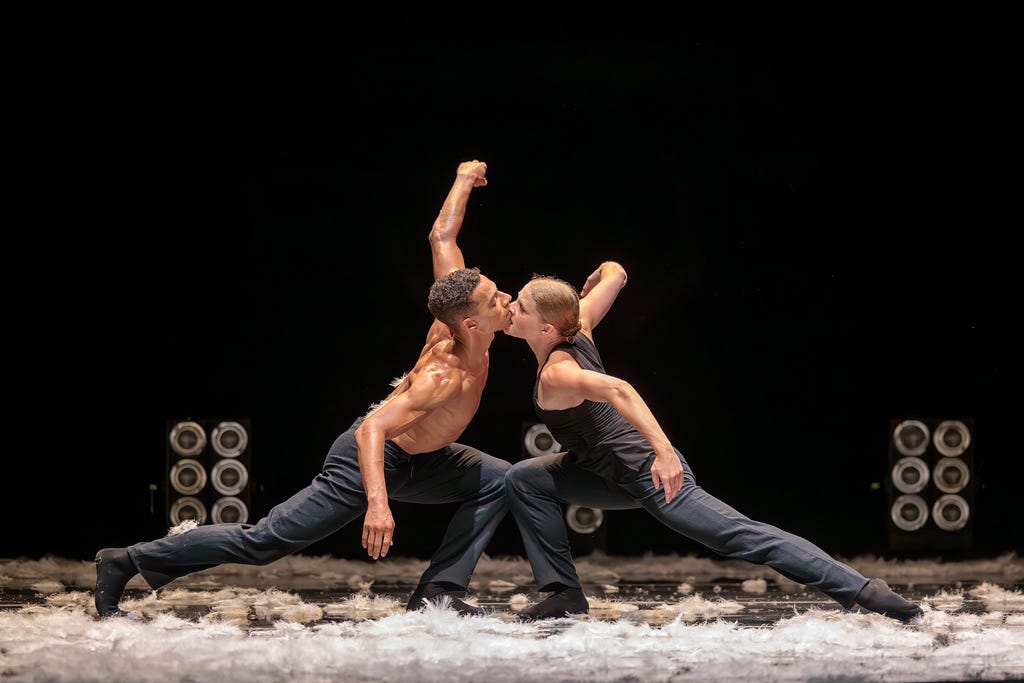
Alejandro Cerrudo’s Extremely Close closed the program. The ballet premiered in 2007 on Hubbard St Dance, and feels of a different era, but not in a bad way. Twenty years ago, Cerrudo’s career began in the cohort of Christopher Wheeldon and Trey McIntyre. Like in Extremely Close, these choreographers favored yearning ballets set to Philip Glass and other minimalist-adjacent composers.
Cerrudo’s ballet stands apart for its stagecraft. When the curtain opened the stage was covered in white feathers with more raining down. Three square white panels skated through the space. The eight dancers leapt out in front the panels or glided behind them. The spatial shifting from back to mid to foreground with the crepuscular lighting design gave the ballet a cinematic quality, like a montage rather than linear time.
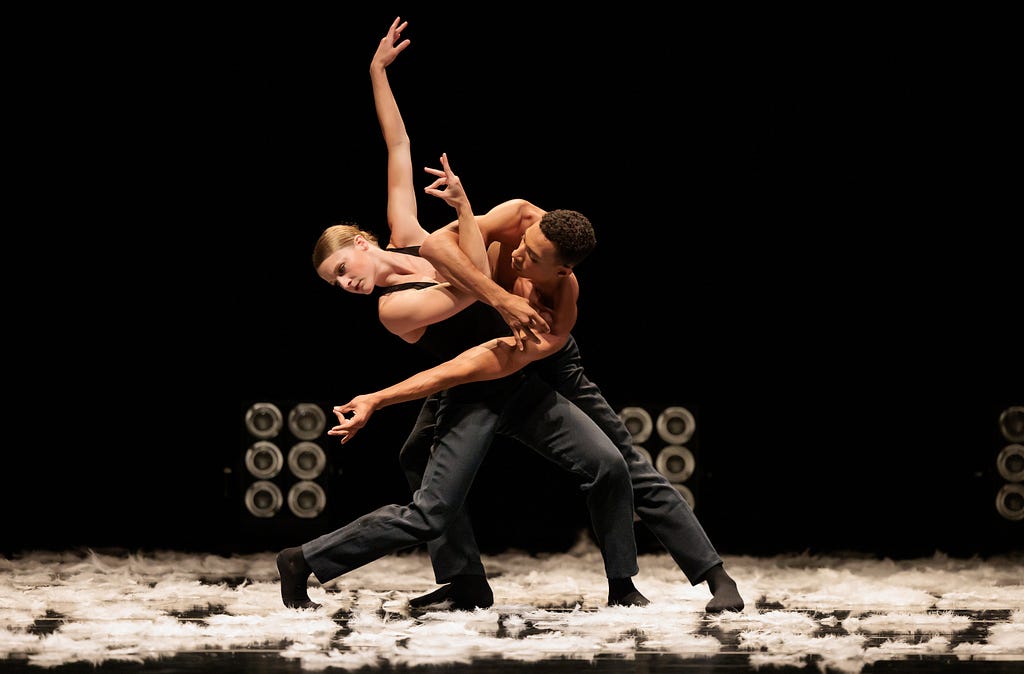
The choreography sweeps through the space bothering the feathers into action. Dancers run and coast or fall into each other’s arms to be whipped across the floor. As in Peck’s ballet, the qualitative embodiment was uneven, but the commitment was resolute. Extremely Close ends in a tender duet from Ricardo Dyer and Tess Lane in which yearning is met with resignation. The duo move in unison reaching, swiping, softly kicking before Dyer lowered Lane to the floor by her neck, and, in a moment of stagecraft better seen than described, pulls up the ground beneath them.
The identity of a dance company is more than learning and performing steps. Seiwert’s vision is ambitious. If this program is any indication of where she will take Smuin Ballet, I look forward to future seasons.
Garth Grimball is a dance writer and artist based in Oakland, CA. He is a contributor to SF Examiner and Dance Media. He is the editor of ODC Dance Stories.
Amy Seiwert Forges Ahead At Smuin Ballet was originally published in ODC.dance.stories on Medium, where people are continuing the conversation by highlighting and responding to this story.