
Nkechi Njaka
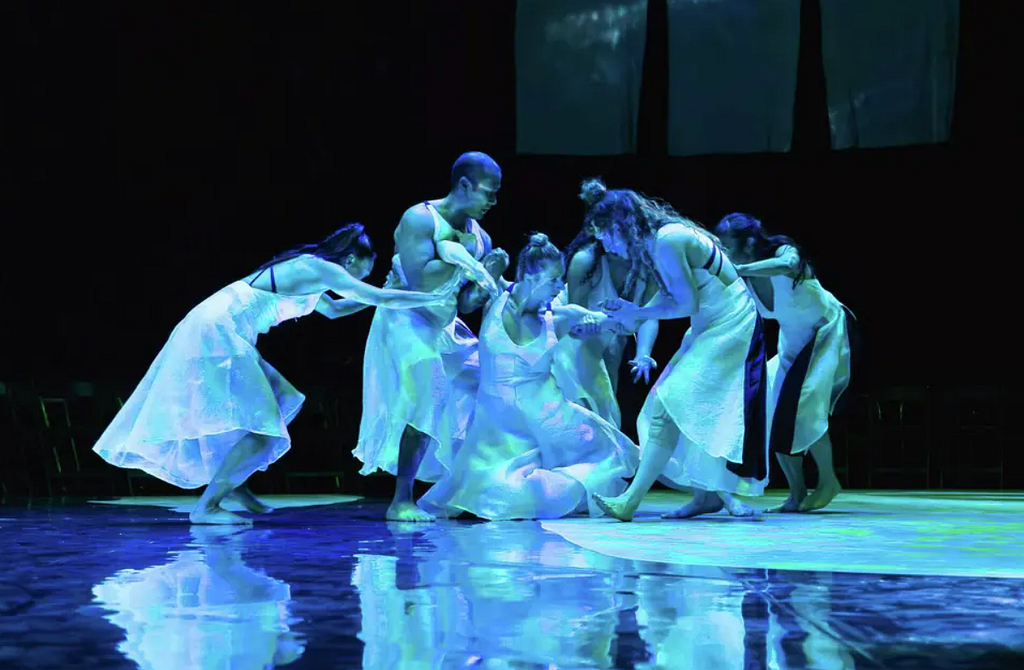
Some dances ask to be watched. WHEEL, by the Margaret Jenkins Dance Company, asks to be experienced. Presented in a site-specific, specially mounted iteration at SHACK15, WHEEL is a collective investigation into the universality of the circle — the wheel of winds, currents, memory, chance, and seasons. Along the big bay windows facing the Bay Bridge at the top of San Francisco’s historic Ferry Building, nine dancers moved to the music by Paul Dresher and Joel Davel. Through the space with physical acuity and unified determination of the dancers, this work offered an evening where movement, breath, sound, and visual architectures assembled in relationship with one another.
One of the consistent practices of Margaret Jenkins’ work is her commitment to shared leadership. This comes from a belief that the dancers are co-collaborators in the movement stories being told. In this practice, dancers contribute their own desires, instincts, and physical histories, resulting in choreography that feels porous and emergent. This collaborative ethos is fully alive in WHEEL and is noticeable in the different styles of dance that created the section of work presented. Another aspect of this ethos was felt in the dancers’ capacity to hold space for one another both while dancing and not dancing. While likely a result of performing in a white box gallery space, all members of the company remained on “stage”/ stayed in the viewers sight during the entire performance, which felt supportive to the dancers and the dance.
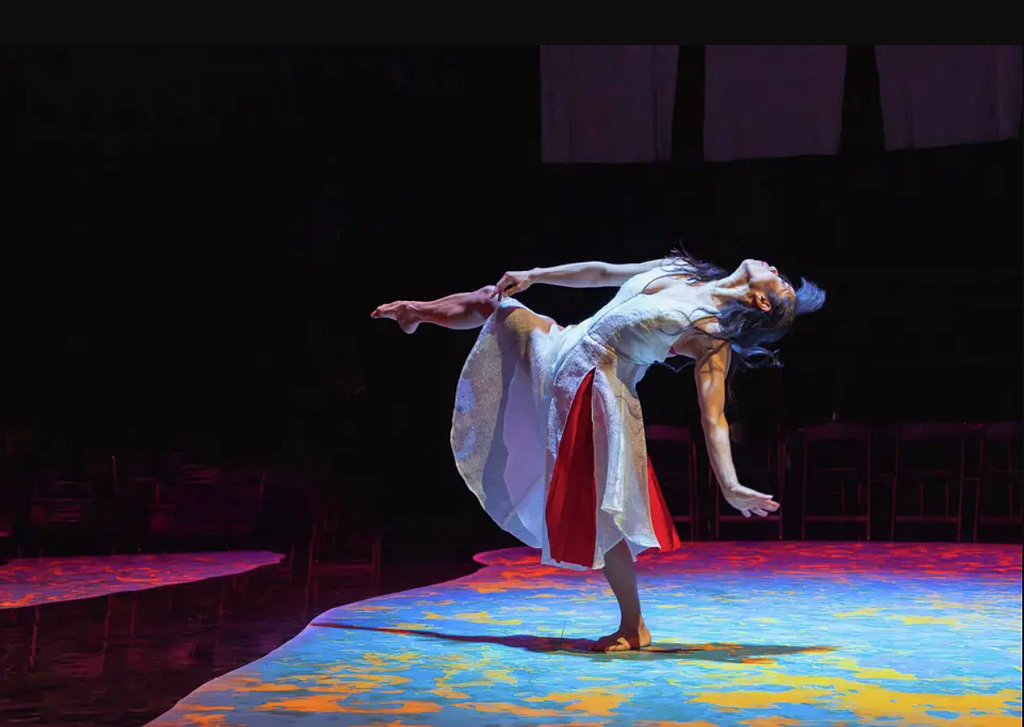
This SHACK15 iteration was performed by Allegra Bautista, Anna Greenberg Gold, Carolina (“Carro”) Czechowska, Claire Fisher-Mendez, Corey Brady, Kelly Del Rosario, Lainie Pennington, Raven Bautista, and Tristan Ching Hartmann. Together, they move as a constellation of distinct bodies, each offering a distinct voice while remaining deeply attuned to one another. All dancers wore the same strappy, white flowy dress with red fabric sewn on the sides. There were moments that included all the dancers in unison. There were also moments where a soloist was distinctly in another dance and the other dancers remained on stage in ensemble, supporting the unique expression.
Two solos in particular — Carro Czechowska’s and Anna Greenberg Gold’s — stood out as sections within the piece that held wisdom and gravity. Carro’s solo moved like a gust, pulled from somewhere remembered and somewhere fast. Long lines that felt sharp and directive, curved shapes that were clearly defined by space, her body traced the circle both as a symbol and also as a lived and moving inquiry. Anna’s solo, by contrast, felt cosmological. It was almost as though it was a conversation with space and time itself. Spiraling, folding, and unfurling, her movement felt as though it was birthed from interior landscapes. Her contribution drew on what she describes as “calling on my dancestors and ancestors as spirit guides.” Grounded in the belief that we are stardust, brought together and blown apart by time, constantly reconfigured, always beginning again, this sentiment was explored in her solo. Since the loss of her family home in the Altadena wildfire, this section has continued to evolve, expanding to hold grief, regeneration, and what she names as “the journey of a phoenix rising.”
When discussing performance more broadly, Margaret Jenkins embodies a similar curiosity. As she stated at the beginning of the performance, “I learn something every time there is a performance.” WHEEL, with its open architecture and ever-changing light, presented new dimensions for that learning. When asked what surfaced for her in this particular site-responsive process, she reflected: “The shadows of the dancers were their collaborators.”
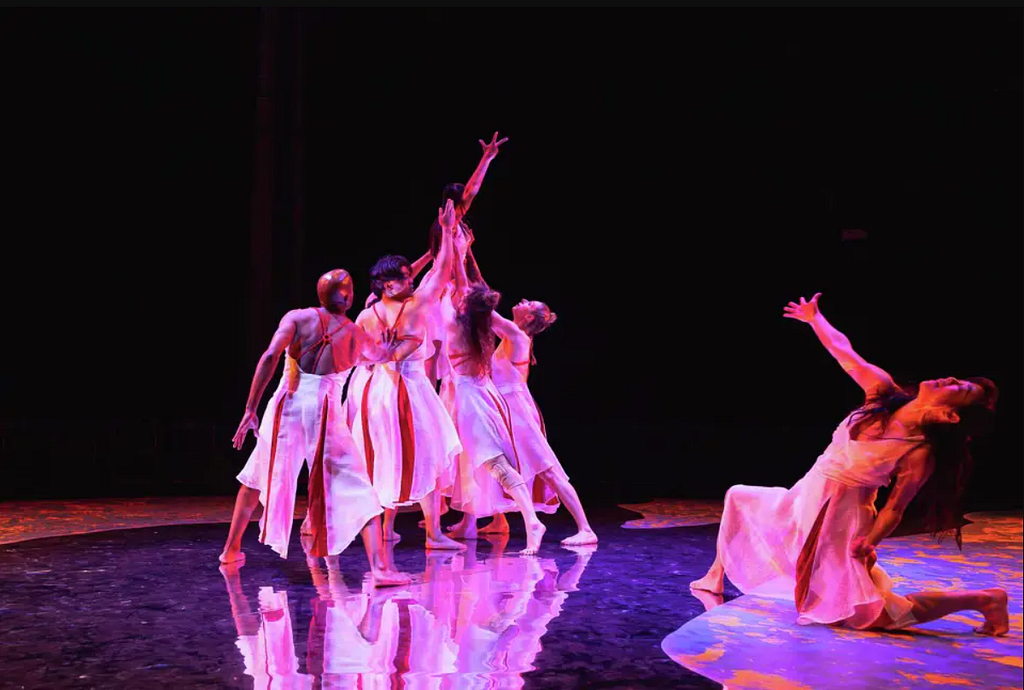
At SHACK15, this observation felt uncannily true. The dancers’ silhouettes rippled across wall, floor, and reflected in the glass, expanding the ensemble into a kind of doubled choreography. Their shadows stretched through the gallery like an extended cast — echoing, exaggerating, and sometimes even contradicting the physical bodies from which they emerged.
At SHACK15, framed by evening light and the moving reflections of the Bay, WHEEL offered something tender and radical: the opportunity to witness an art form still discovering itself in real time. True to its title, WHEEL is certainly not linear. It is a returning and a re-forming. This reminds us that time, like dance, loops. That artistry evolves, deepens, and turns with us. And that collaboration, when practiced with sincerity and care, reveals worlds we could never arrive at alone.
Even after fifty years, Jenkins is crafting new pathways while bridging generations of dancers, expanding modes of collaboration, and continuing to ask what dance can reveal about how we live and move together. For longtime followers of Jenkins’ work, the performance resonated as a continuation of her ongoing exploration of aging, time, and artistic lineage — questions she has returned to with generosity and curiosity throughout her career. For newer audiences, the evening offered a gateway into the depth of her practice: one that might be less concerned with a spectacle and is far more interested in what emerges when bodies are given space to think, feel, and respond collaboratively.
Nkechi Deanna Njaka (she/her) is a practice-based creative researcher, choreography artist, public speaker and culture writer whose work explores the intersection of embodied presence, somatic research, well-being, science, art, and social practice. She is the founder of The Compass, NDN lifestyle studio, and co-founder of the sleep app DreamWell, emphasizing mindfulness and creativity as essential for individual and global well-being.
Margaret Jenkins Dance Company Sets The “WHEEL” Spinning was originally published in ODC.dance.stories on Medium, where people are continuing the conversation by highlighting and responding to this story.