
Garth Grimball
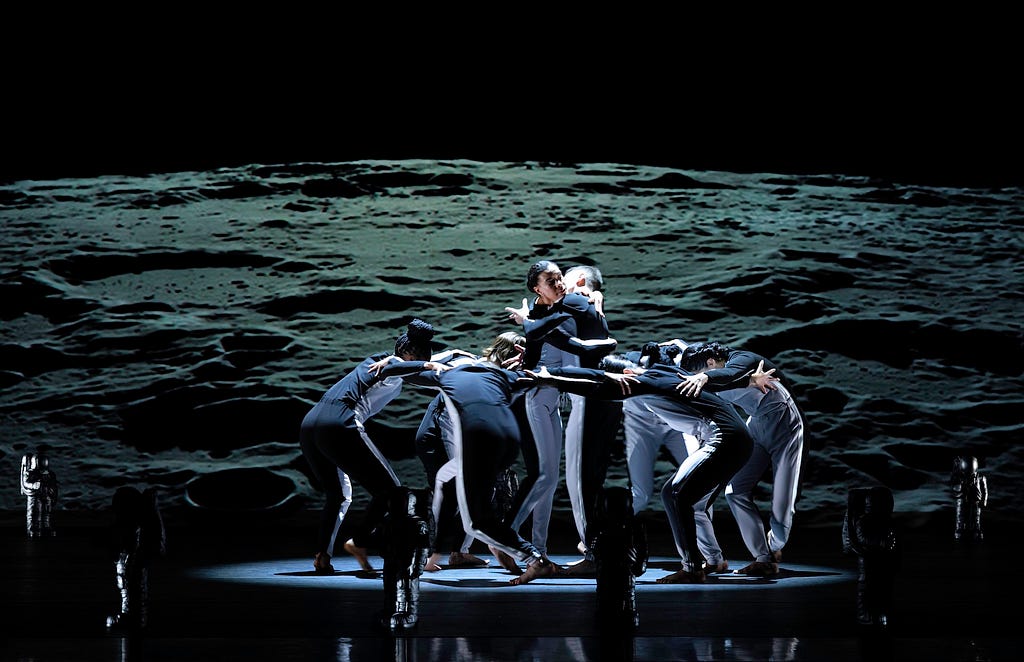
Mark Morris Dance Group returned to Zellerbach Hall on January 23–25 for the West coast premiere of MOON. The full-length nonet drew inspiration from the Golden Record — an audio recording placed aboard the two 1977 Voyager spacecrafts as a means of communicating with extraterrestrials.
MOON opened with a projection of graphic five point stars arcing across the backdrop. The focus zoomed out to reveal the arc was part of a circle and the circle of stars evolved into the presidential seal with JFK’s face smiling in the center. The graphic set the tone and focus of what was to come. MOON, like many Morris dances, finds a slant way to look at the familiar — whether it be a gesture or an archetype — and, the dance is an obscured period piece; it’s less about how the moon is perceived now and more about its place in midcentury popular consciousness.
The ensemble of nine dancers were dressed in Isaac Mizrahi jumpsuits with synched waists, all white on the front, black on the back. Tiny metallic astronaut figurines dotted the stage and were moved by the dancers into varying configurations throughout. Wendall K. Harrington’s projection design traveled from photorealistic depictions of the moon’s surface to measurement renderings to abstract cosmos.
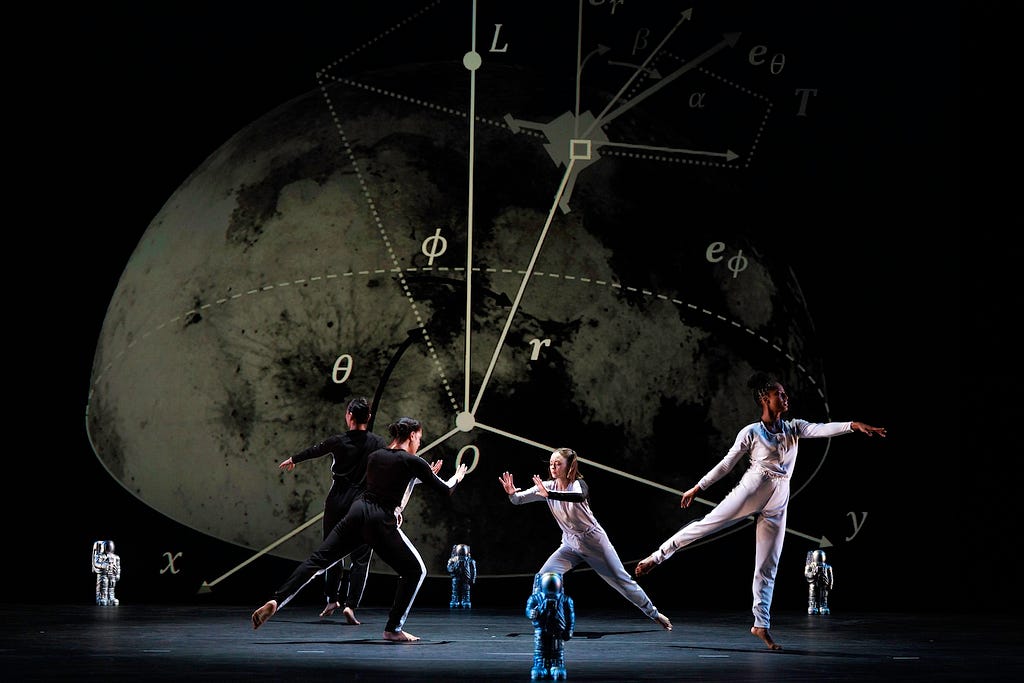
MOON has two distinct musical and choreographic tones. György Ligeti’s Musica ricercata, played live by Colin Fowler and Michael Taddei, birthed aliens, or, dancers-as-aliens. The dancers were often separated into two groups whenever Ligeti’s music played, as if they were discovering each other, uncertain, cautious but curious. The choreography left elegance for joints at awkward angles, sputtering shuffles and intense stares. These scenes of discovery ended with two opposing individuals hugging (if only suspicion resolved in hugging it out in real life).
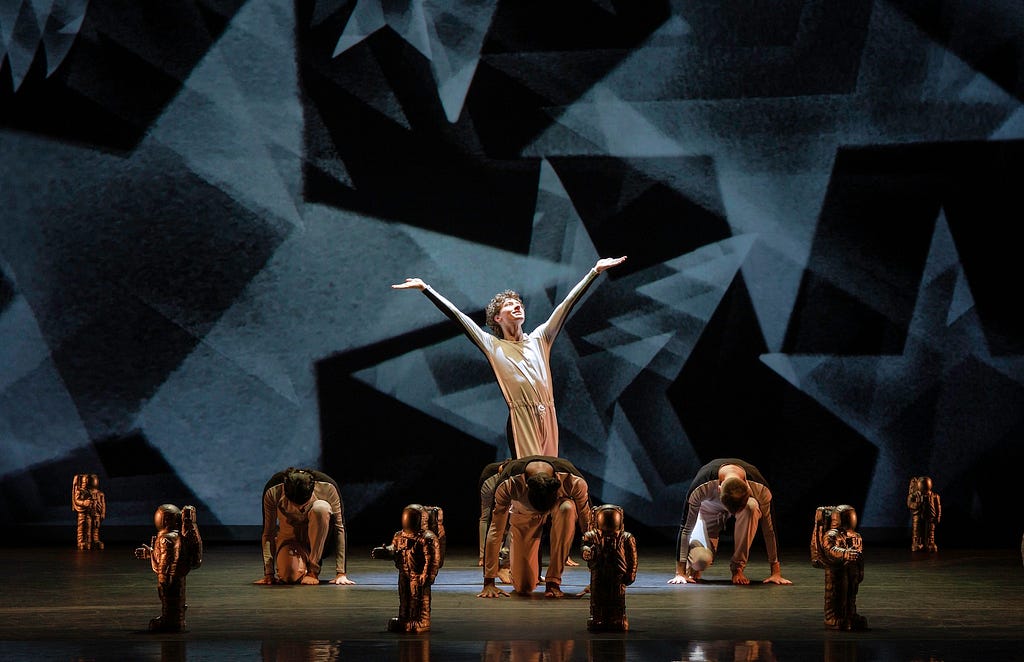
The other tone was more classic Mark Morris. The ensemble wove across the stage in alternating chasse, plie, runs, leans and reaches to lunar-related selections from the American songbook: Blue Moon; Blue Moon of Kentucky; Roll Along, Prairie Moon. These sections are decidedly performative, smiling at the audience, played to the crowd. What links the tonal shifts is the Golden Record. Interspersed throughout MOON’s score are recordings from the Record — brief hellos, snippets of descriptions, audio fuzz — information orbiting past, briefly available.
MOON is of the stronger works of late from Mark Morris Dance Group, largely thanks to a concept that has plenty of meat on the bone. But I missed the signature Morris ability to upend the familiar with subtlety: the evolving circle in Mozart Dances, or the way he uses theatrical wings for entrances and exits in Drink to me only with thine eyes. There was lots of longing in MOON but little mystique.
Garth Grimball is a dance writer and artist based in Oakland, CA. He is a contributor to Fjord Review, SF Examiner and Dance Media. He is the editor of ODC Dance Stories.
Mark Morris Dances To An Americana “MOON” was originally published in ODC.dance.stories on Medium, where people are continuing the conversation by highlighting and responding to this story.