
Garth Grimball
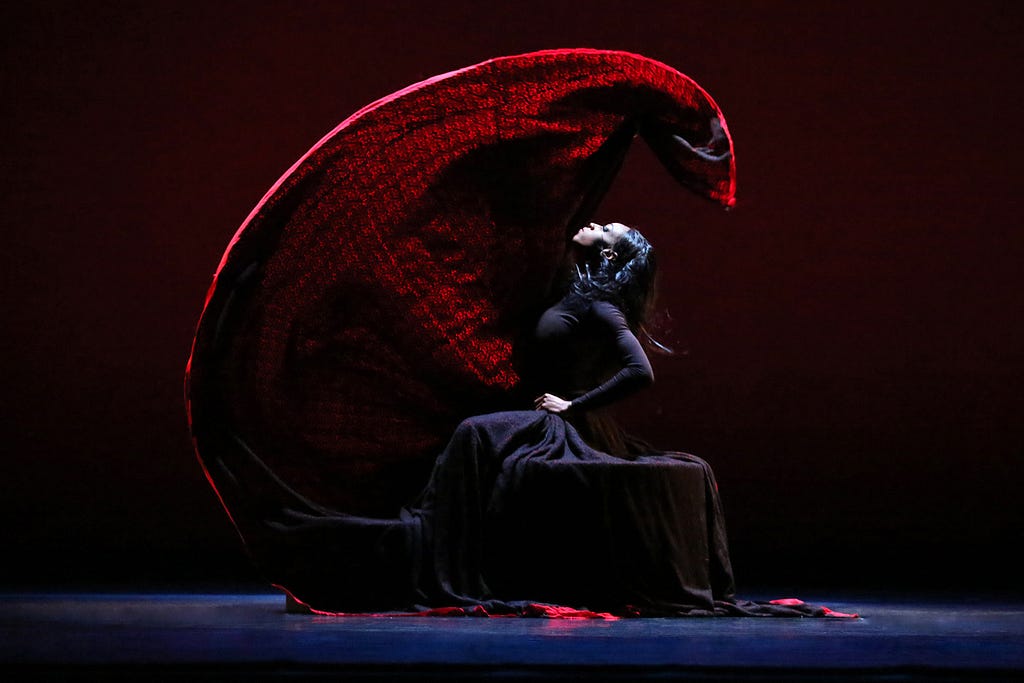
Martha Graham Dance Company, the oldest dance company in America, is celebrating its centennial with a national tour of Graham classics and new commissions. On February 14–15 at Zellerbach Hall, MGDC performed four repertory works dating from 1914 to 1947: Night Journey, Chronicle, Appalachian Spring, and Immediate Tragedy. The first program featured Baye & Asa’s Cortege (2023), and the second Jamar Roberts’s We the People (2024) and Hope Boykin’s En Masse (2025).
Graham’s works were made in the (unfortunately) rare circumstance of an artist with a full time company trained in the technique developed by the artist, featuring many roles originated by the artist, over decades. The three new works are by artists outside of the company who have (likely) 3–4 weeks to make a work with dancers unfamiliar to them (in most cases). These two scenarios produce very different outcomes. For this reason I will write about the new works and the Graham works in relation to each other, respectively, rather than based on the program order.
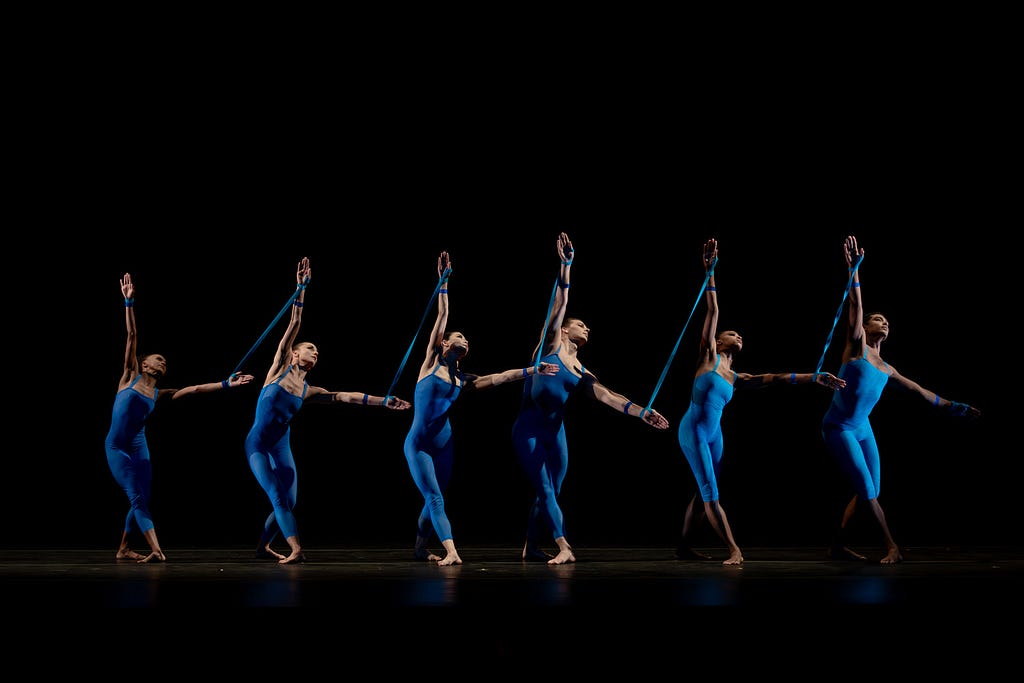
En Masse was choreographed to a suite of Leonard Bernstein compositions, one newly discovered in the archive that was likely made for Martha Graham in the 1980s. Lloyd Knight stood in a light blue spaghetti strapped unitard under a spotlight. Six dancers on the floor faced upstage resting on their bent elbows. Knight’s solos wavered between expansive reach and contractions. The sextet stood, ran into formation, and from there the dance became increasingly muddled. The choreography looked like a series of movement prompts strung together without a unifying idea. Four dancers would run around while two walked, searching. Six dancers lined up and did unison and canon arm movement. One section had jazzier music so a trio did many turns, ripples and skittering chasse. A confrontational solo would segue into the group running in a circle. The final section had the most demanding music, that the choreography struggled to meet, and brought in tap dancing steps. What En Masse has to say about social dynamics I’m uncertain, but it ended with the group running downstage to face the audience, so there’s that.
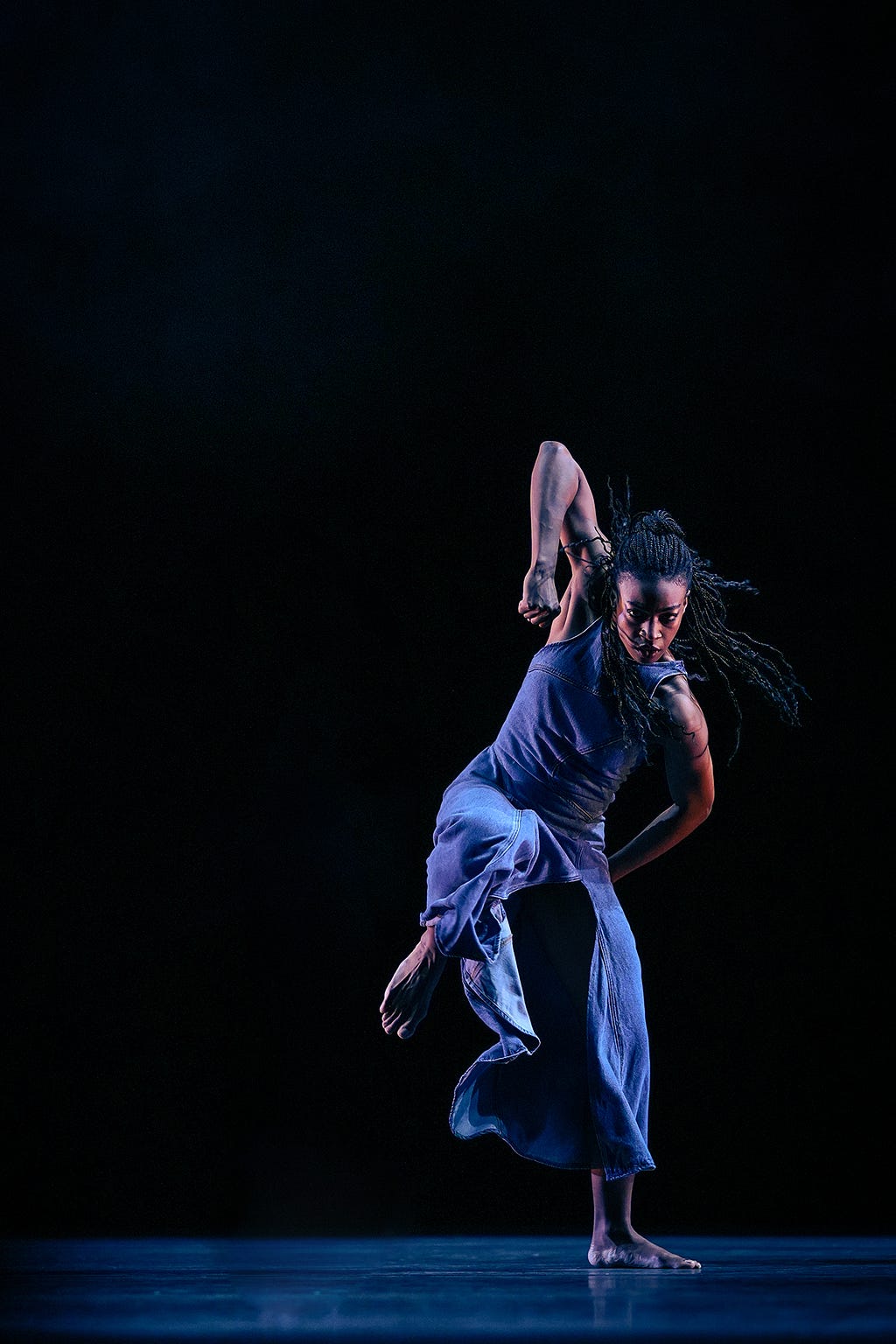
We the People was a more successful foray into individual versus group, both conceptually and choreographically. Like En Masse, this work began with a solo in a spotlight. This solo was in silence and became a motif as each of the four sections shared this staging. The solos were affecting in their ability to include personality in the movement; a reach, a deep fourth position plie, a melt, all seemed to come from the dancers’ internality. After each solo was high octane group (often unison) movement to Rhiannon Giddens music arranged by Gabe Witcher. Roberts was the resident choreographer at Alvin Ailey American Dance Theater for four years and that experience was evident in his ability to get an ensemble to dance fast and clearly, together. Dressed in various denim silhouettes, the Graham dancers spread across the stage shifting right to left, spoking and throwing their arms, hitting rhythmic beats with street dance inflections, striking a pose and melting out of it. We the People was almost entirely front facing, and while engaging, made “the people” feel monolithic rather than collectivist.
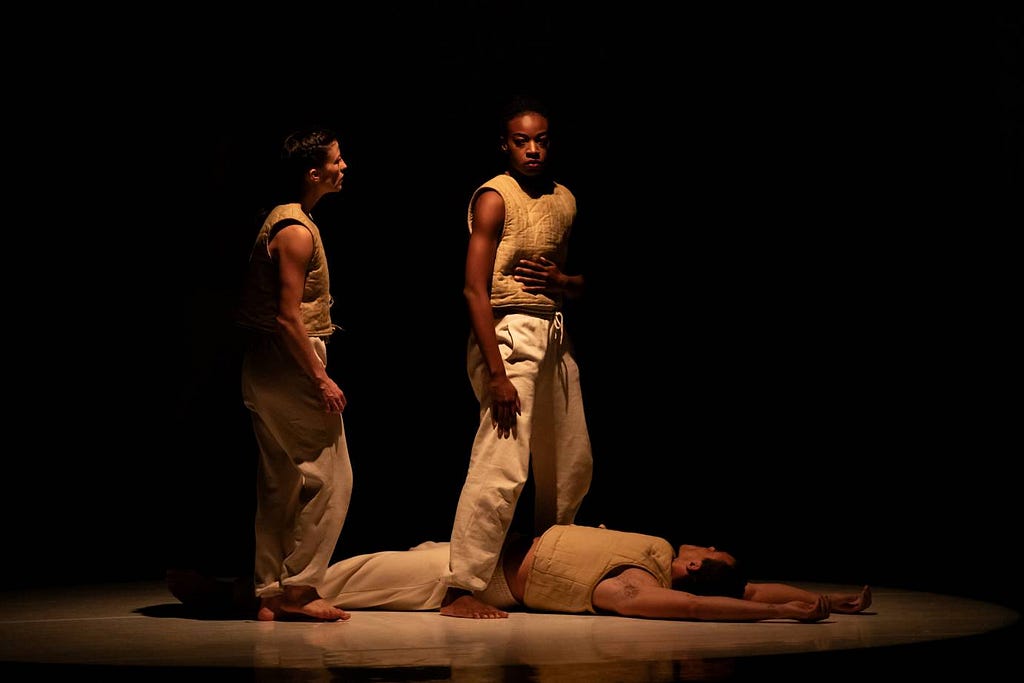
Cortege by Baye and Asa, draws inspiration from Graham’s Cortege of Eagles. Graham’s work interpreted the Trojan War through the mythical Charon, a ferryman who shepherds souls to the underworld. Baye & Asa removed mythological context in favor of a collective sharing the burden of responsibility for violence. Baye & Asa’s choreography is not postmodern in the dance historical sense (neither stylistically nor temporally), but I think their work is philosophically postmodern: there is no universal truth, only power and desire. Their dances are often driven by power conflicts, or conflicting ideas on the wielding of power. Cortege began with a striking image. A diagonal line of dancers were draped in billowing slate fabric. Once free of their shroud, the cast of eight dancers exploded into Baye & Asa’s vocabulary of conflict: pushing, pulling, lifting, tossing, collapsing. The dancers wore off-white separates until each of them donned tops evocative of bulletproof vests. When not in conflict, tableau would form — one dancer cradling another like the pieta, or a seated dancer would lift the arm of prostrate one as if checking for a pulse. Yi-Chung Chen’s lighting design, smoky and cavernous, glowed with red light in the final third of the piece; the pants bottoms looked soaked in blood as if from wading through a battlefield. Cortege evoked war artfully, but structurally it felt like it was struggling between climax and anticlimax. Violence begets violence, and, dances are discrete containers subject to the beginning-middle-end logic.
And now, for Martha Graham.
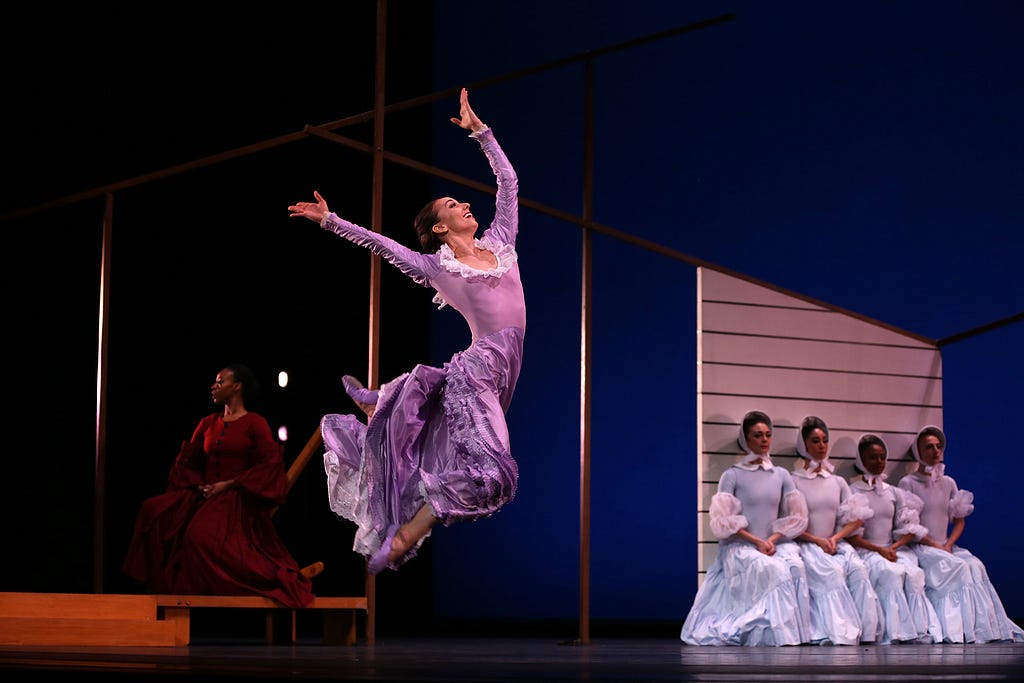
Chronicle, Appalachian Spring, and Night Journey are masterworks in the canon of American Modern Dance. Decades of criticism and scholarship leave little stone unturned on their content, so I want to focus this review on the incredible craft of choreography. In each work I was struck by how much Graham accomplished by not filling every moment or every musical note with movement. Appalachian Spring and Night Journey, specifically, have characters be still for long periods of time and often not in direct relation to each other. The confined stillnesses create spatial and temporal depth heightened by Isamu Noguchi’s sets. In Appalachian Spring the Bride sits in a rocking chair, the Pioneering Woman sits on a bench, the Preacher stands on a rock, and the Husbandman leans against a fence, sometimes seeing each other, often not. In the stillness the stage expands. The characters are so of their places that the distance between them grows.
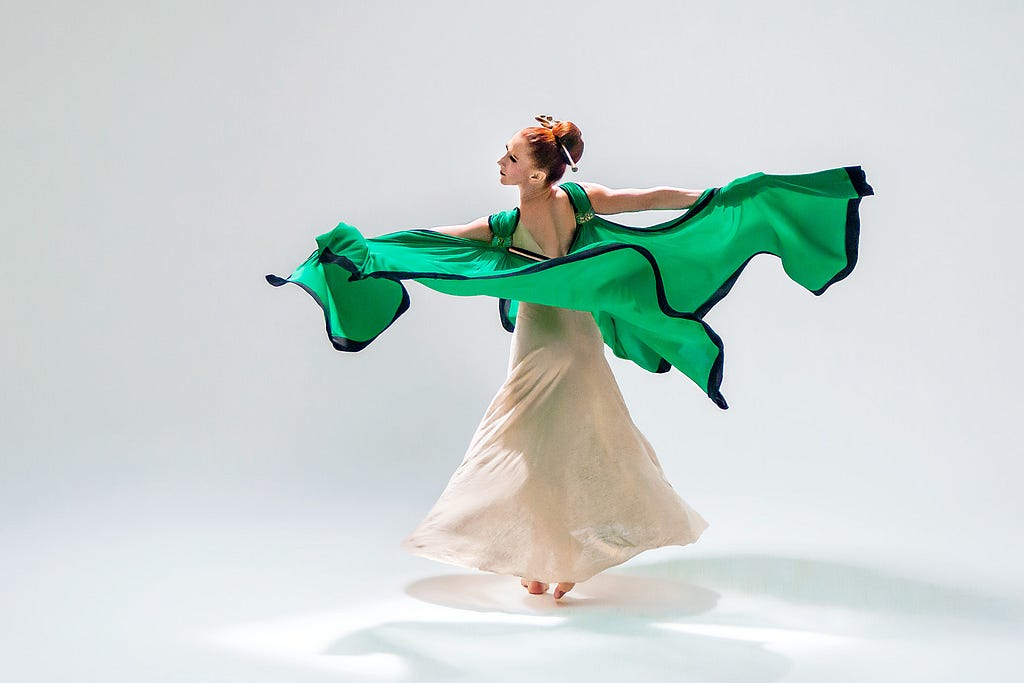
Night Journey starts at the end and flashes back to tell the tale of Jocasta and Oedipus. To achieve flashback Graham stilled either the Greek chorus quintet or the three main characters. At one point the Leader of the Chorus (danced superbly by Marzia Memoli) leaned in profile upstage right. Her presence and her stillness a signifier that the dancing between Jocasta and Oedipus was not present-tense but a memory within Jocasta. Time in Night Journey lives in the dancers’ bodies. Motion and stillness are equally revealing.
Chronicle is a non-narrative dance in three sections: Spectre, Steps in the Street, and Prelude to Action. Individually, each radiated power. Taken collectively they were incendiary. I think Steps in the Street is a masterclass in group choreography and should be taught as such. The ensemble entered in their severe, sculptural pose, step-touching across the stage. The movement vocabulary is set and evolved from there into charging leaps and postures evocative of origami. The dancers moved with and against Wallingford Riegger’s thumping score. Fore, middle and background space overlapped in a texture of counterpoint. Spectre, a solo, and Prelude to Action, a culmination of the two previous sections, are a testament to the fact the Graham was equally skilled at solo and group choreography.
The final work to be considered is a solo both old and new. Immediate Tragedy premiered in 1937. When Graham stopped performing it in the late 1930s it was forgotten and considered lost. In 2020, MGDC artistic director Janet Eilber reimagined the choreography using recently discovered photos of Graham in performance, and archival materials. It is a perfect solo structurally. Graham choreographed it in response to the atrocities of the Spanish Civil War, and the way she filtered her response into choreography was refreshingly Modern in the art historical sense. Nothing in the solo (or in any of the her works on the program, for that matter) contained the detached commentary of postmodern style, nor any sense of oscillation between earnestness and irony a la metamodernism. Even though this version of the solo was created 6 years ago, it felt true to the convictions foundational to Graham’s choreographic voice. At one point Xin Ying pointed down the diagonal and slowly her left leg lifted and circled to the front, followed by her right. It was a seemingly simple action but it felt declarative, like this is the only action to take place in this exact moment. That conviction of style, of technique, of performance quality was and is vital.
Garth Grimball is a writer and dancer based in Oakland, CA. He is a contributor to Fjord Review, SF Examiner and Dance Media. He is the editor of ODC Dance Stories.
Martha Graham At 100: Refreshingly Modern was originally published in ODC.dance.stories on Medium, where people are continuing the conversation by highlighting and responding to this story.