
Nkechi Njaka
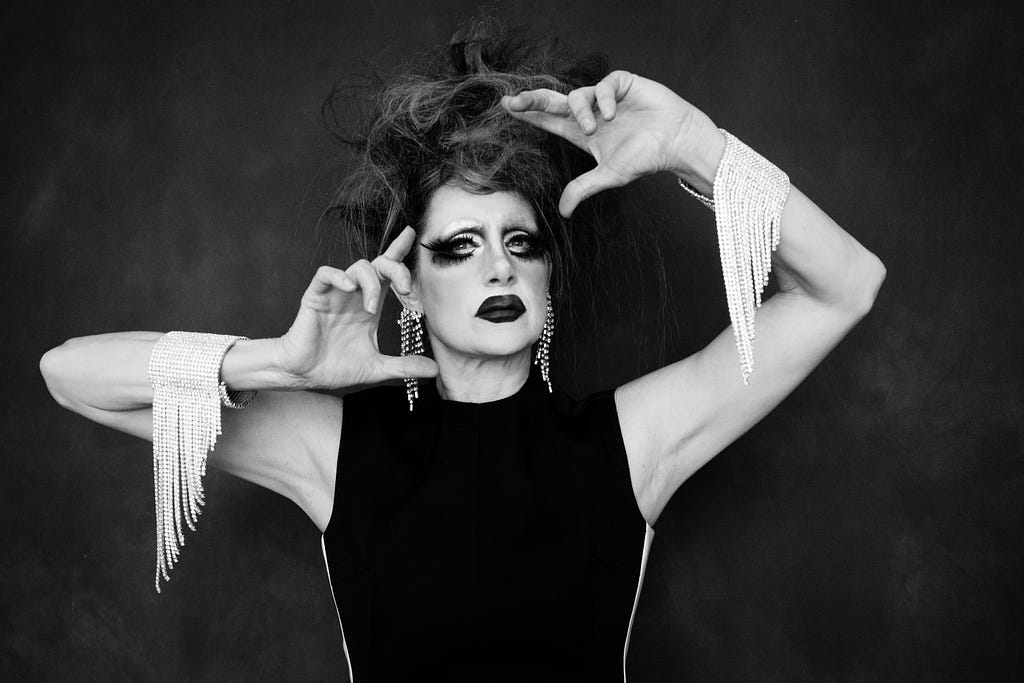
When How Do I Look? premiered April 17–19 at ODC Theater, Monique Jenkinson arrived with a full agenda to command a room in a world of identity, performativity and contradiction. Through her drag persona Fauxnique, she intentionally asks the vain, self-centered and impossible to answer question How do I look? in the title with all eyes on only her. She stretches this question until it reveals its deeper stakes — which are perception, identity, being understood, context, belonging and enoughness. The question itself insists on an admittance to the unstable space between how we perceive ourselves and how we are perceived.
Jenkinson’s practice lives at the intersection of dance, cabaret, and essay, and this work embodies that hybrid fluently. Fauxnique is both a persona and a lens for the audience. Sharpened through years of performance, cultural critique, and an embodied precision, Jenkinson has notably made history as the first cis woman crowned in a drag pageant with Pageant Title: Miss Trannyshack (2003), held in San Francisco. This is a distinction that has continued to inform her interrogation of gender, artifice, and authentic expression.
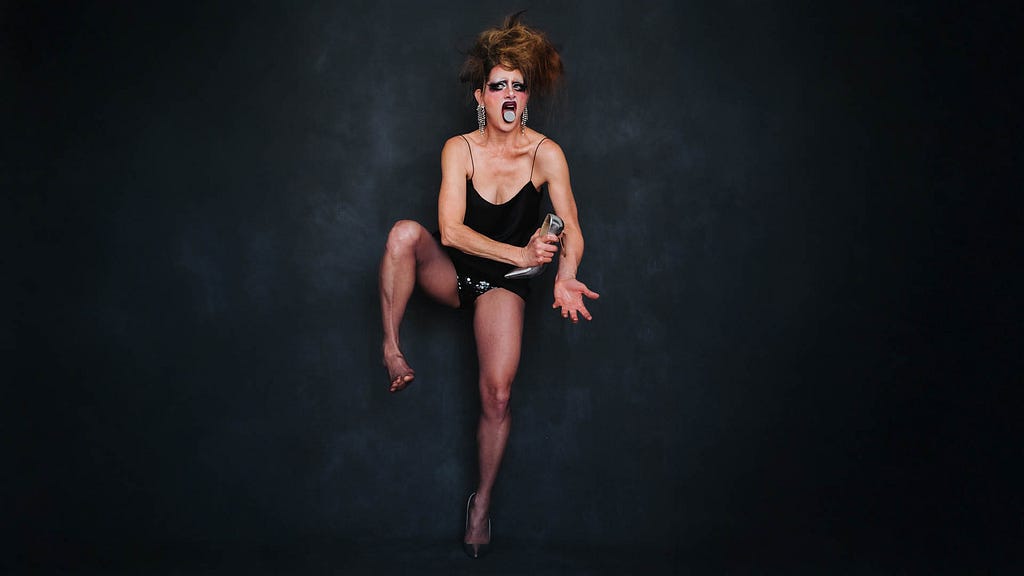
The performance opens with the house lights still on. Fauxnique is already present on stage smiling, surrounded by costumes placed deliberately across the stage with fragments of possible selves waiting to be tried on, revisited, discussed, analyzed and even performed. Moving between them, she performs a series of these identities, personas that depict her psyche, her inner critic, her shadow work — each one rendered with exaggerated traits, physicality and a sharp comedic edge. A voiceover begins to catalog her body in meticulous detail with measurements, proportions, and distances between. The tone is clinical, holds absurdity, and exposes the ways bodies are objectified, quantified, and consumed in general and more specifically in performance space.
Throughout the work, Fauxnique oscillates between exposure and concealment, sincerity and satire. A call-and-response sequence invites the audience into complicity: “I feel good,” she announces, prompting the audience to respond, “You look good.” The exchange is playful yet uneasy, revealing how easily affirmation can be scripted, used as a way to fish compliments and control self esteem and how easily this sort of external validation can be participatory in practices of self harm. When the phrase shifts towards the unkind “I feel ugly,” she interrupts the instructed pattern, refusing to let the audience mirror harm back to her. It suggests the subtle but deliberate act of control that lives within this and overtly so within the context of performance art, visibility and consent.
Visually, the work stands out in its simplicity. Costumes range from minimal (tights, and leotards) to sculptural constructions of maximalist fabrics and big silhouettes. In one of the most compelling images, Fauxnique wears a mirrored structure that reflects the audience back at themselves while her own body remains partially exposed beneath it. The gaze is reversed, redistributed. We are no longer just looking and watching, we are somehow now implicated as we can see our faces reflected back to us.
Eventually, the piece turns inward. Fauxnique stages a “roast,” but rather than opening the floor to others, she delivers the roast herself as a monologue that reads as a combination of both self-critique and shadow work that might have been done in a therapeutic setting. Even as the framing remains theatrical, the vulnerability is disarming. In another moment, she sings a cover of Pictures of Me by Elliott Smith, dressed in a clown-like costume and facing a mirror. The image is layered, distorted and borders on disturbing while the song is nostalgic — leaving some curiosity around the lyrics of the song within the context of the piece.
At times, the piece leans heavily into its own reflexivity. It speaks openly about process, therapy, and the mechanics of making, creating a meta-commentary on performance itself. This self-awareness is both a strength and a risk. The work asks: when does introspection become self-indulgence? And can naming that tension become part of the critique?
How Do I Look? does not settle the question it proposes. Instead, it sustains a tension between realization and curation, where even moments of “self-reflection” remain carefully staged. Within the very layered concept of drag (which is already a form that heightens performance as identity) distinctions between Monique Jenkinson and Fauxnique blur rather than resolve. The work names its own processes of introspection, shadowwork, self criticism, therapy, and even self-indulgence — bringing them explicitly into view. Yet this transparency does not necessarily dissolve their complexity; if anything, it raises further questions about whether naming a dynamic explicitly transforms it. Or, does naming simply reframe. The piece offers an intentional narrative while simultaneously gesturing toward its own making, leaving the audience to navigate the space between what is revealed and what remains constructed. In this way, How Do I Look? functions less as an answer than as an ongoing inquiry — one that reflects the recursive nature of looking, performing, and attempting to understand the self through both perception of self and perception of others.
Nkechi Deanna Njaka (she/her) is a practice-based creative researcher, choreography artist, public speaker and culture writer whose work explores the intersection of embodied presence, somatic research, well-being, science, art, and social practice. She is the founder of The Compass, NDN lifestyle studio, and co-founder of the sleep app DreamWell, emphasizing mindfulness and creativity as essential for individual and global well-being.
“How Do I Look?” Fauxnique Has Answers, And Questions was originally published in ODC.dance.stories on Medium, where people are continuing the conversation by highlighting and responding to this story.