
Garth Grimball
Mariana Valencia faced the audience. She told a story of a time percolating on ideas with a friend in a dance studio in 2014. They invented Jacklean. Valencia walked from stage left to right spelling the name, carving each letter into the space with her hand. Jacklean is an Ur-improviser. Jacklean’s pronouns are we and us. We and Us.
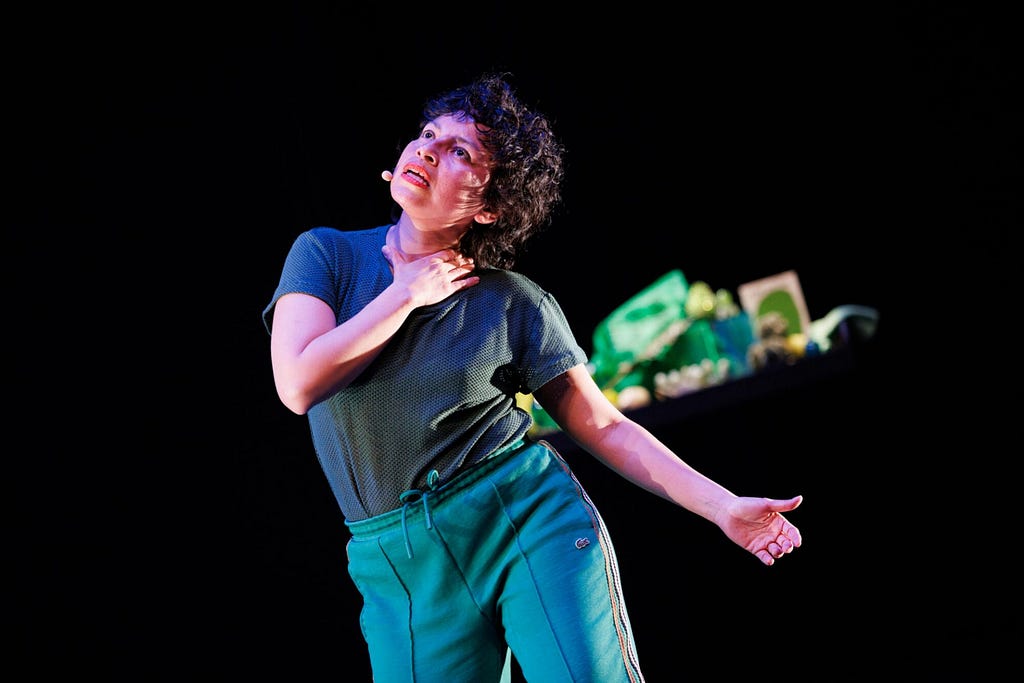
Jacklean (Jacklean), the newest work from NYC-based Valencia, closed ODC Theater’s spring season on May 1–3. The stage was anchored by a table full of green items upstage right, and Jazzy, musician and collaborator, upstage left with instrument kit. Valencia walked around in a green t-shirt and green joggers. She stepped. She stopped. She briefly did the macarena. The pacing and intention were very postmodern dance. Seeing Jazzy see Valencia eased off any self-seriousness. Her gaze was warm and playful.
Responding to improvisation is as much about noticing tactics as it is about form and content. Yes, improvisation is the form. Yes, there is specific content. And, the way in which the improviser utilizes their improv score is tactical. How do they create and release tension? Will the chances they take be legible as risky, or as controlled within a set structure?
Jacklean (Jacklean)’s form was walking and talking, mostly. Talking while locomoting, truly. Valencia spoke directly to the audience: informing us of the invention of Jacklean; offering biting realities of being a modern dancer — modern dance doesn’t make money, t-shirts make money (Jacklean branded hats were for sale in the lobby); dispensing credos like, “when you have no other power, use your body.” This monologue as dialogue was form and content. Her motor, her ability to keep moving, to keep talking was tactical. When would she stop? Did she know or would it be a surprise to her too? How much of her content repeats in each performance?
At one point Valencia described a library without books as just shelves, and Jazzy broke out in genuine laughter. The laughter was a reveal: Valencia’s stream of consciousness surprised her fellow performer, and that surprise highlighted the virtuosity of Valencia’s tactics. The form and content flowed so assuredly that it all seemed pat and rehearsed. But the flow was one of continual discovery for Valencia, for Jazzy, and for the audience.
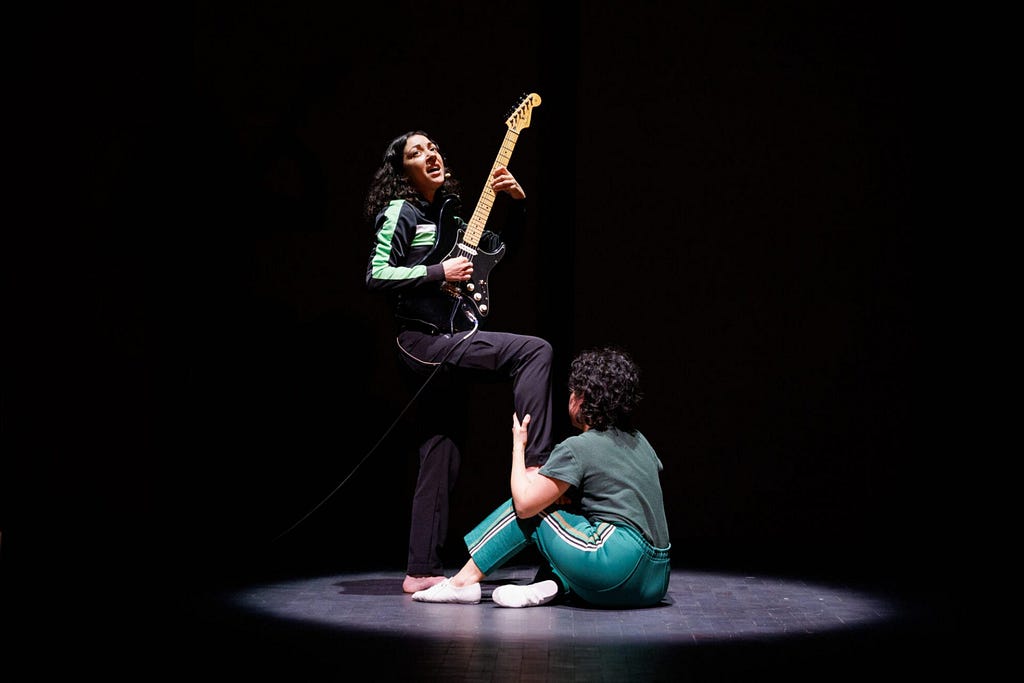
Jacklean (Jacklean) progressed to include Jazzy performing the ranchera standard Paloma Negra, the duo dancing a cumbia together, and ultimately singing a capella a refrain about success and happiness coming their way.
Valencia returned to “we and us” throughout the performance. “We,” she said as her right hand circled from her to the audience with her palm faced down. Her left hand did the opposite for “us.” Jacklean is we/us. Jacklean (Jacklean) was an alchemy between “we” the performers and “we” the audience to create an “us.”
Garth Grimball is a writer and dancer based in Oakland, CA. He is a contributor to Fjord Review, SF Examiner and Dance Media. He is the editor of ODC Dance Stories.
We Is “Jacklean (Jacklean)” Are Us was originally published in ODC.dance.stories on Medium, where people are continuing the conversation by highlighting and responding to this story.