
Kristen Cosby
Amazing dance-works occurred at Joe Goode Annex over the weekend of July 10–12, where the dance company Tether — led by Teo Lin-Bianco, Tatianna Steiner, and Ella Wright — staged a 75-minute piece entitled Escapement. A reference, the program noted, to the “device that governs the release of time in a clock.” If you haven’t seen this show, or been acquainted with Tether previously, run to get tickets to their next staging NOW. They sell out their shows, and there’s a reason. Many reasons! Escapement dramatically circled the question of what time is and how we should spend it with others. The answer was within the work: spend it in a dance theater, watching Tether’s stunningly well-rehearsed dancers.
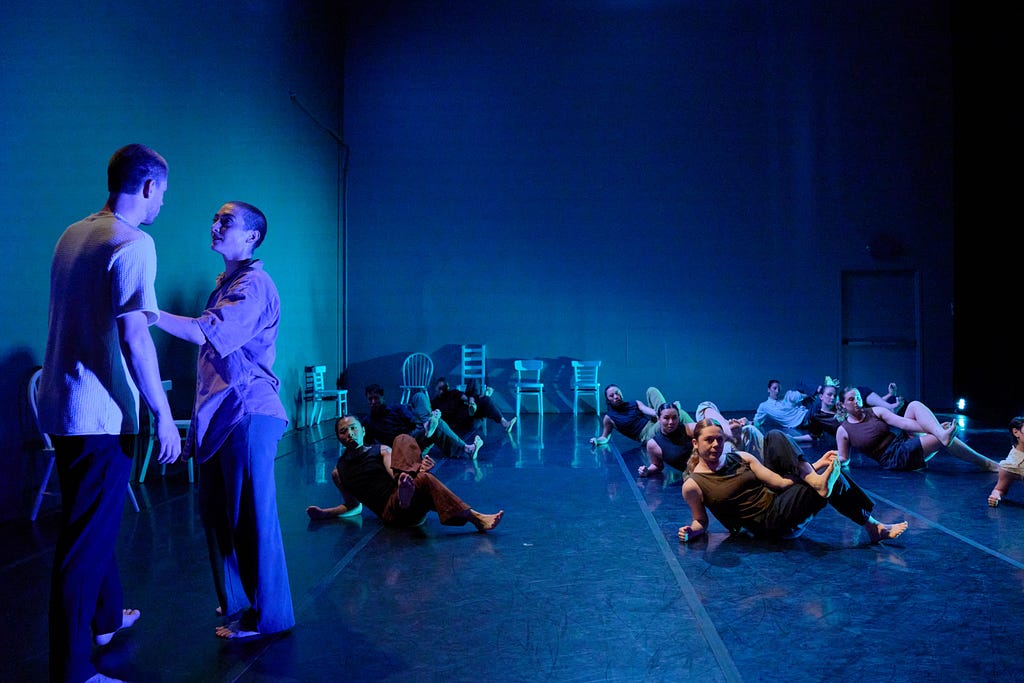
At the outset of Escapement, nine white wooden chairs sat on stage, each occupied by a dancer, facing forward with a keyboard in their laps. Electronic music played, sounding a bit like a video game theme song. The audience found themselves in a world that is automated, highly structured and disjointed. The keyboards clack, the bodies turn at different angles, but as if on a grid — their gestures muted and strictly controlled and their faces impassive.
The ensemble work proceeded to get wilder, but always in this highly mechanized style. Partners lifted each other sideways so they could walk on walls, feet hooked behind necks, bodies cartwheeled over chairs towards each other, only to pause of a brief second face-to-face, before walking away. Each encounter, each relationship, appeared hugely distinct, no matter the brief duration, but no relationships endure or build.
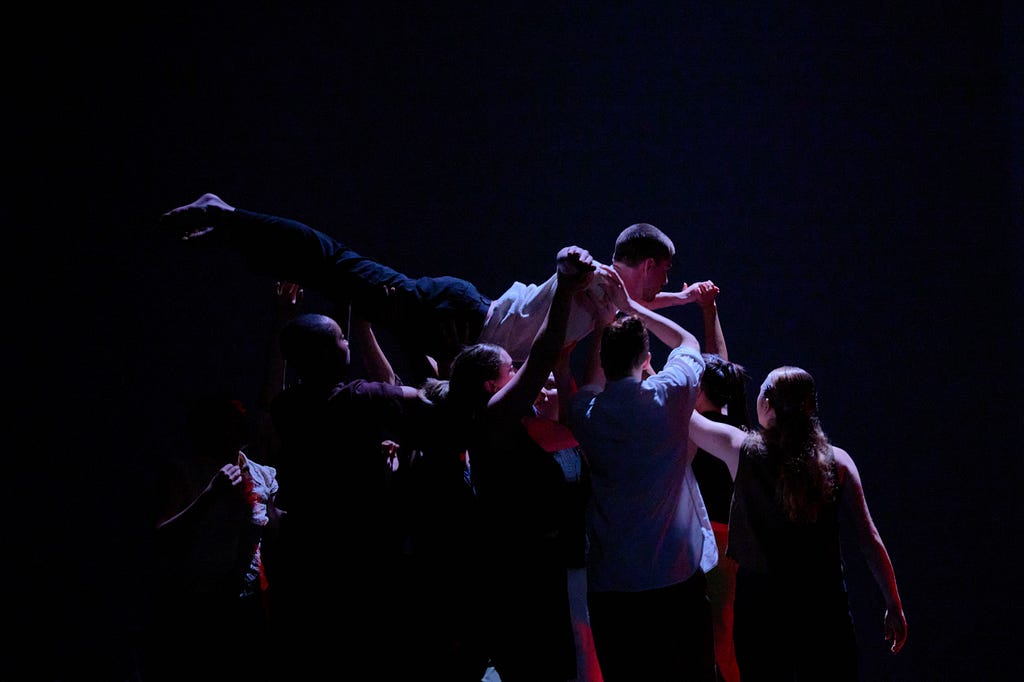
With chairs moved to the wall, different patterns played out: the ensemble grid walked as if locked inside a Pac-Man game, each time a body intersected with another body, they changed direction without interaction. As the piece moved on clusters formed, a circle in all hands inward (a visible homage to the “release of time” theme, which was also huge in the piece). Movement landed on the downbeats. Every piece of music used had a marked beat that seemed to note the passing seconds and minutes. Abstract clock faces appeared through the choreography.
When Ava Shannon appeared on stage their signature gesture featured arms out, perpendicular to the floor with palms flat, looking distinctly like clock hands. Their stunning emotiveness and grace shone through their machine-like gestures. So it was no surprise when they escaped the structure of the ensemble and began to fluidly move about her world. They, above all movers in the piece, seemed there to remind us — the collective human us — that time is happening, that we measure it by machine, but real time should be spent with real people, on real intimacy and real connection, no matter what intense emotion it results in.
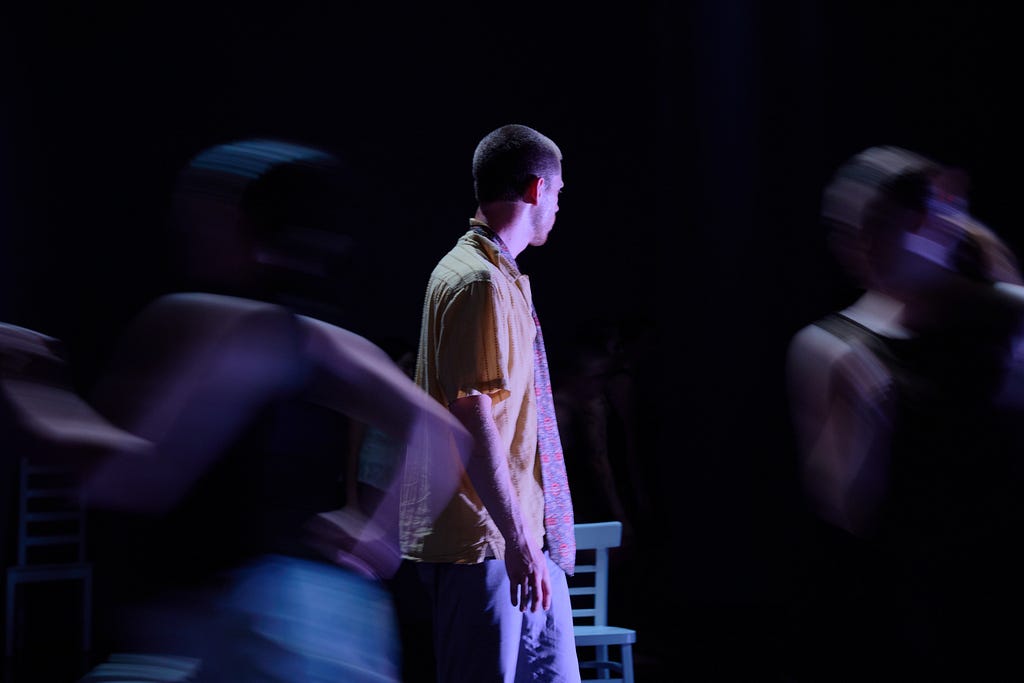
Tai Lum joined her for a stunning duet. His own defining character move resembled the squat clock from Beauty and the Beast, legs in second position plié, arms at downward right angles. He embodied his role perfectly. The pair’s communication and gestures visibly amassed as movement does over the course of long relationships. These moves repeated throughout the piece but with different impacts. First playful, Ava peeks their head from under Lum’s armpit and makes faces at the audience and later jumps on his back playfully. But as the ensemble returns, Shannon tries to prevent Lum from joining their rigid, structured patterns, these same gestures take on a more aggressive tone. When Ava jumps on Tai’s back to prevent his assimilation, they are thrown to the floor — all play gone.
The ensemble work, the establishment of this world of conformity and tech machination, resists a simple narrative: there are relationships and fascinating actions within that world, too. Keyboards fly across the room. Bodies slide to the floor in gorgeous, unified trios. Lum is eventually surrounded by them, as if he were lost in a dense forest, where Shannon cannot get to him.
Eventually the ensemble circles into a giant clock face with a dancer or two standing where each number should be. The bodies rotate from one number position to another and slide to the floor downstage, where the number 6 would be, in duos or trios. Their movements are gorgeous and human, but they cannot move outside the clock.
In the end, they form a grandfather-like clock pyramid against the wall, which Lum climbs to the top of and trust falls backwards — the structured world having won.
Kristen Cosby is a freelance writer, editor, educator, and performer whose work has been supported by the Jan Michalski Foundation, Yaddo, MacDowell, and the Virginia Center for the Creative Arts. Her writing has appeared in literary journals, magazines, and anthologies, earning the Normal Prize in Nonfiction and a Pushcart Prize special mention, while her recent storytelling performances have been featured at The Moth, Redwood Nights, Bawdy Stories, StageWerx, and La Cocina: Voices from the Kitchen.
A Temporal Triumph From Tether Dance Project was originally published in ODC.dance.stories on Medium, where people are continuing the conversation by highlighting and responding to this story.